🎯 Key Points
- Force on a moving charge: F = qv×B = qvB sinθ — zero when v is parallel/antiparallel to B, maximum when perpendicular; force does NO work since it's always perpendicular to v
- Force on a current-carrying conductor: F = IL×B = BIL sinθ
- Biot-Savart law gives B due to a current element; key results: straight wire B=μ₀I/2πr, circular coil centre B=μ₀NI/2R, solenoid B=μ₀nI
- Two parallel wires carrying current in the SAME direction attract; OPPOSITE directions repel — this defines the SI unit ampere
- Cyclotron frequency f=qB/2πm — independent of speed/radius, depends only on charge, mass, and field strength
The magnetic field around a long straight current-carrying wire forms concentric circles, with direction given by the right-hand rule (point thumb along I, fingers curl in the direction of B).
Magnetic Force on a Moving Charge
- The Lorentz force on a charge q moving with velocity v in field B is F = qv × B, with magnitude F = qvB sinθ, where θ is the angle between v and B
- The force is always perpendicular to both v and B, so it changes the direction of motion but never the speed — magnetic force does no work on a moving charge
- If v is perpendicular to a uniform B, the charge moves in a circle of radius r = mv/qB; if v has a component along B too, the path becomes a helix
- If v is parallel or antiparallel to B (θ=0° or 180°), the force is zero and the charge travels in a straight line, completely unaffected by the field
Magnetic Force on a Current-Carrying Conductor
- A straight conductor of length L carrying current I in field B experiences force F = IL × B = BIL sinθ
- This is the working principle behind the electric motor: a current loop placed in a magnetic field experiences a torque that makes it rotate (see below)
Sources of Magnetic Field: The Biot-Savart Law
- Biot-Savart law: dB = (μ₀/4π) × I·dl × r̂/r² — gives the magnetic field contribution from a small current element
- Long straight wire: B = μ₀I/2πr
- Circular coil at centre: B = μ₀NI/2R (N = number of turns, R = radius)
- Solenoid (ideal, long): B = μ₀nI inside, where n = turns per unit length; field outside is nearly zero
Ampere's Circuital Law
- ∮B·dl = μ₀I_enclosed — the line integral of B around any closed loop equals μ₀ times the current enclosed by that loop
- This is the magnetic analogue of Gauss's law in electrostatics, and gives a much faster route to B for highly symmetric situations (straight wire, solenoid, toroid) than directly applying the Biot-Savart law
Force Between Two Parallel Currents — Defining the Ampere
- Two long parallel wires carrying currents I₁ and I₂, separated by distance d, exert a force per unit length on each other: F/L = μ₀I₁I₂/2πd
- Currents in the SAME direction attract; currents in OPPOSITE directions repel
- This force defines the SI unit of current: one ampere is the current that, when flowing through two infinitely long parallel wires 1 m apart, produces a force of exactly 2×10⁻⁷ N per metre of length between them
Torque on a Current Loop and the Moving Coil Galvanometer
- A current loop of area A carrying current I in a uniform field B experiences torque τ = NIAB sinθ, where θ is the angle between the loop's normal and B — this torque tends to align the loop's magnetic moment with B
- A moving coil galvanometer suspends a coil in a radial magnetic field (created by curved pole pieces), so the torque is proportional to current at every deflection angle, giving a linear, easy-to-read scale
- Galvanometer sensitivity increases with larger N, A, or B, or a smaller spring/torsion constant — though this trades off against the instrument's response time
The Cyclotron
- A cyclotron accelerates charged particles using a perpendicular magnetic field (which bends the path into a circle) combined with an alternating electric field (which accelerates the particle each time it crosses the gap between two D-shaped electrodes)
- Cyclotron frequency f = qB/2πm is independent of the particle's speed or orbit radius — this is exactly what allows a fixed-frequency alternating voltage to keep accelerating the particle even as its radius keeps growing
Motion of a Charge in a Magnetic Field
- Circular motion (v ⊥ B): the magnetic force supplies the centripetal force, qvB = mv²/r, giving radius r = mv/qB = p/qB (p = momentum)
- Time period: T = 2πm/qB and frequency f = qB/2πm — both independent of speed and radius; a faster particle simply traces a larger circle in the same time
- Helical motion: if v makes an angle θ with B, split v into v‖ = v cosθ (unaffected, constant along B) and v⊥ = v sinθ (circular); the path is a helix of radius r = mv sinθ/qB
- Pitch (distance advanced per revolution) = v‖ × T = (2πm/qB)·v cosθ
Magnetic Field on the Axis of a Circular Loop
- On the axis of a circular loop of radius R, N turns, carrying current I, at distance x from the centre: B = μ₀NIR² / [2(R² + x²)^(3/2)]
- At the centre (x = 0): B = μ₀NI/2R (the standard result)
- Far on the axis (x ≫ R): B ≈ μ₀NIR²/2x³ = μ₀·(2m)/(4π x³), where m = NIA is the magnetic dipole moment — identical in form to the axial field of an electric dipole
- The field direction along the axis is given by the right-hand rule (curl fingers along I, thumb points along B)
Solenoid and Toroid (Ampere's Law)
- Long solenoid: applying Ampere's law to a rectangular loop gives a uniform interior field B = μ₀nI (n = turns per unit length), directed along the axis; the field outside is essentially zero
- At the open end of a solenoid, the field falls to about half the interior value: B_end ≈ ½μ₀nI
- Toroid (a solenoid bent into a ring): B = μ₀NI/2πr inside the core, where N is the total number of turns and r the mean radius; the field is confined entirely within the core and is zero both inside the central hole and outside the toroid
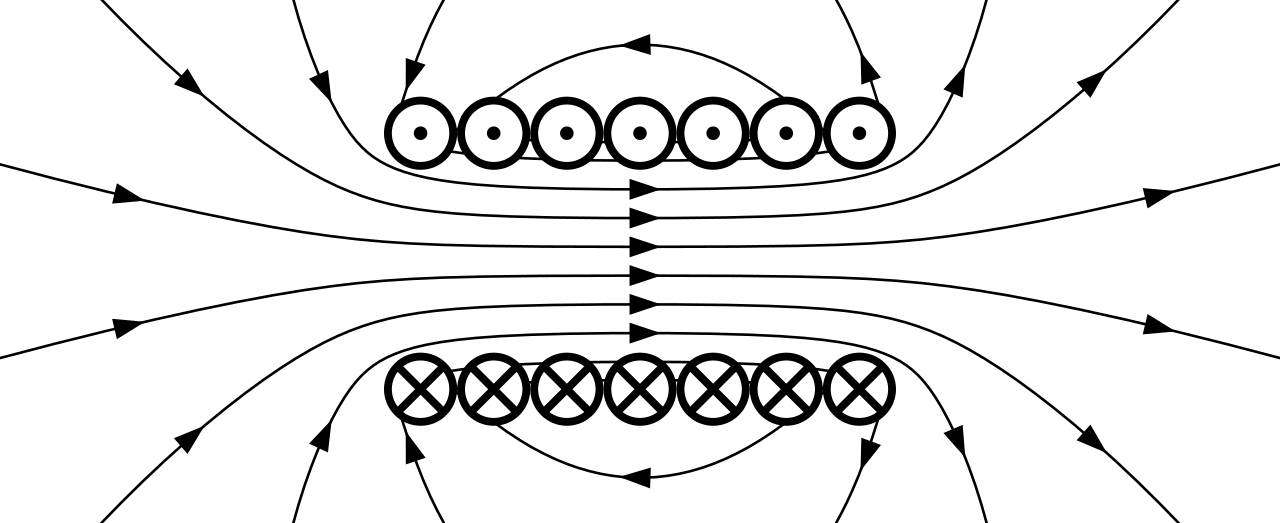
Solenoid field: nearly uniform and axial inside (B = μ₀nI), weak outside — the cross-section shows current out of the page (dots) and into the page (crosses). Image: Geek3, CC BY-SA 3.0, via Wikimedia Commons.
Magnetic Dipole Moment of a Current Loop
- A planar current loop of N turns, area A, carrying current I, behaves as a magnetic dipole with moment m = NIA, directed along the loop's normal (right-hand rule); unit: A·m²
- In a uniform field B it feels a torque τ = m × B = NIAB sinθ and has potential energy U = −m·B = −mB cosθ (minimum when aligned)
- The orbital motion of an electron in an atom constitutes a tiny current loop with magnetic moment; the smallest unit is the Bohr magneton μ_B = eh/4πm ≈ 9.27×10⁻²⁴ A·m²
Converting a Galvanometer: Ammeter and Voltmeter
- A galvanometer (resistance G, full-scale current I_g) is converted to an ammeter by connecting a small shunt resistance S in parallel: S = I_g·G/(I − I_g), where I is the desired full-scale current; an ideal ammeter has very low resistance and is connected in series
- It is converted to a voltmeter by connecting a large resistance R in series: R = V/I_g − G, for full-scale voltage V; an ideal voltmeter has very high resistance and is connected in parallel
- Adding a shunt lowers the effective resistance and increases the current range; adding a series resistor raises resistance and increases the voltage range
🚀 JEE Advanced Edge
Velocity selectors and mass spectrometers: When perpendicular E and B fields act on a charged particle, it travels in a straight line, undeflected, only when qE = qvB, i.e. v = E/B — independent of the charge's sign or magnitude. This is why velocity selectors filter particles of one specific speed regardless of charge, a key step before measuring charge-to-mass ratio in a mass spectrometer.
Why a charge moving along a field line feels nothing: Since magnetic force depends on qv×B, it vanishes both for v=0 (stationary charge) and for v parallel to B — a charged particle can travel right along a field line forever without ever being deflected. This is a frequently tested conceptual trap distinguishing magnetic force from electric force, which acts on any charge whether moving or not.
Worked problem: Two long straight parallel wires 0.05 m apart carry currents of 3 A and 5 A in the same direction. Find the force per unit length between them. Approach: F/L = μ₀I₁I₂/(2πd) = (4π×10⁻⁷ × 3 × 5)/(2π × 0.05) = (4×10⁻⁷×15)/0.1 = 6×10⁻⁵ N/m, and the force is attractive since the currents flow in the same direction.