🎯 Key Points
- Faraday's Law: induced EMF = −dΦ/dt, where Φ=B·A·cosθ is the magnetic flux through a circuit — EMF is induced only while flux is CHANGING, never when it's constant
- Lenz's Law: the induced current always flows in a direction that OPPOSES the change in flux that created it — a direct consequence of conservation of energy
- Motional EMF: a rod of length L moving with velocity v perpendicular to field B generates EMF = BLv
- Self-induction EMF = −L(dI/dt); Mutual induction EMF₂ = −M(dI₁/dt)
- An AC generator converts mechanical energy to electrical energy by rotating a coil in a magnetic field, producing EMF = NBAω sin(ωt)
As a magnet approaches a coil, flux rises steadily and a constant non-zero EMF is induced (Faraday's law). Once the magnet stops moving, flux stays constant and the induced EMF drops to zero — EMF only exists while flux is actively changing.
Faraday's Law of Electromagnetic Induction
- Whenever the magnetic flux Φ=B·A·cosθ linked with a circuit changes, an EMF is induced in it, given by EMF = −N(dΦ/dt) for a coil of N turns
- Flux can change because B changes, A changes, the angle θ between B and the area's normal changes, or any combination of these
- No flux change means no induced EMF, no matter how strong the field is — a magnet held stationary near a coil induces nothing
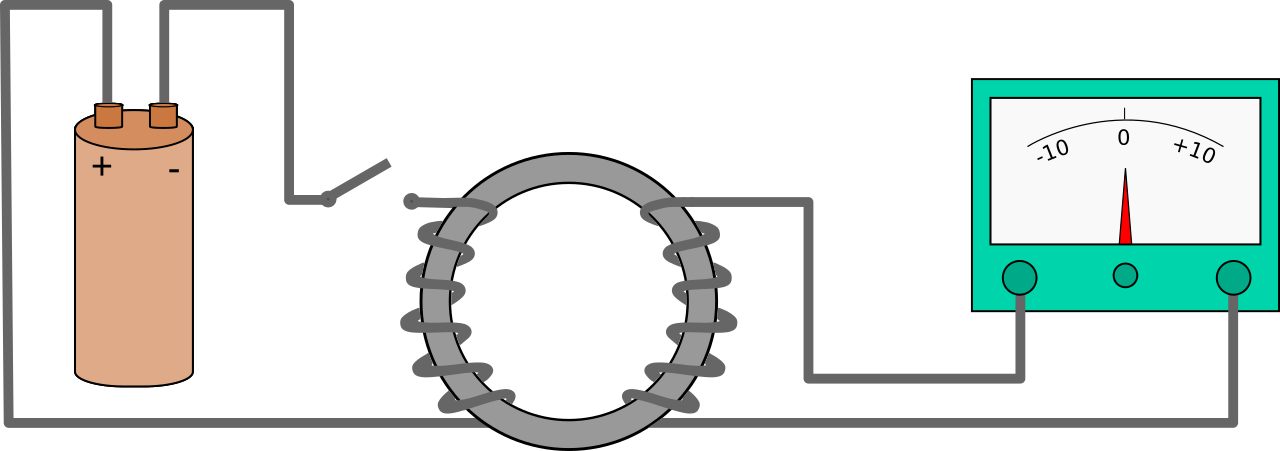
Faraday's law: a changing current in the primary coil changes the magnetic flux through the secondary coil, inducing an emf that deflects the galvanometer. Image: Eviatar Bach, CC0, via Wikimedia Commons.
Lenz's Law and Energy Conservation
- The induced current flows in whichever direction creates a magnetic field that opposes the change in flux — if flux is increasing, the induced current creates a field to oppose the increase; if decreasing, it creates a field to reinforce it
- This opposition means external work must always be done against the induced effects to change the flux — Lenz's law is simply conservation of energy applied to electromagnetism
- The negative sign in Faraday's law, EMF=−dΦ/dt, mathematically encodes Lenz's law
Motional EMF
- A straight conductor of length L moving with velocity v perpendicular to a magnetic field B generates a motional EMF = BLv, caused by the magnetic force on free charges within the moving conductor (an application of the Lorentz force, distinct from flux-based reasoning, though both give the same answer)
- If such a rod slides on conducting rails connected to a resistor, the induced current experiences a retarding force (by Lenz's law) that opposes the motion — leading to a terminal velocity if a constant external force drives the rod, analogous to a viscous drag problem
Self-Induction and Mutual Induction
- Self-induction: a changing current in a coil induces an EMF in the SAME coil, EMF = −L(dI/dt), where L is the self-inductance (henry, H) — this is why circuits with inductors resist sudden changes in current
- Mutual induction: a changing current in one coil induces an EMF in a NEARBY coil, EMF₂ = −M(dI₁/dt), where M is the mutual inductance — the basic principle behind the transformer
- Energy stored in an inductor carrying current I: U = (1/2)LI², stored in the magnetic field itself
Eddy Currents and the AC Generator
- Eddy currents: circulating currents induced in the bulk of a conductor (not confined to a wire) by a changing flux; they oppose the change causing them (used for electromagnetic braking) but cause unwanted heating in transformer/motor cores, minimised by using laminated cores instead of solid metal blocks
- An AC generator converts mechanical energy into electrical energy: a coil of N turns and area A rotates at angular velocity ω in a uniform field B, producing an induced EMF = NBAω sin(ωt) — a sinusoidally alternating voltage
Self-Inductance of a Solenoid
- Self-inductance L depends only on a coil's geometry and its core material, defined through the flux linkage NΦ = LI
- For a long solenoid of N turns, length l, cross-sectional area A, with n = N/l turns per unit length: L = μ₀n²Al = μ₀N²A/l (air core); with a core of permeability μ, replace μ₀ by μ
- L is measured in henry (H): a coil has 1 H if a current changing at 1 A/s induces 1 V across it
- A large inductance opposes rapid current change strongly, so inductors smooth out and resist sudden fluctuations in current
Mutual Inductance of Coupled Coils
- Mutual inductance M relates the flux linked in coil 2 to the current in coil 1: N₂Φ₂ = MI₁, and reciprocally M₁₂ = M₂₁ = M
- For two coaxial solenoids (turns per unit length n₁ and n₂, common length l, area A), M = μ₀n₁n₂Al
- The coupling coefficient k (with 0 ≤ k ≤ 1) gives M = k√(L₁L₂); k = 1 means perfect flux linkage (ideal transformer), while k < 1 indicates flux leakage between the coils
Energy Stored in an Inductor and Magnetic Energy Density
- Building up a current I in an inductor requires work against the back-EMF; this work is stored as magnetic field energy U = (1/2)LI²
- Expressed per unit volume, the magnetic energy density is u = B²/(2μ₀) — the magnetic analogue of the electric energy density (1/2)ε₀E²
- This stored energy is what sustains the spark seen when an inductive circuit is suddenly switched off
🚀 JEE Advanced Edge
Motional EMF and rod-on-rails problems: For a conducting rod of length L sliding with velocity v perpendicular to a magnetic field B, motional EMF = BLv. If the rod moves on frictionless rails connected to a resistor, this EMF drives a current that, by Lenz's law, creates a retarding force on the rod — leading to terminal velocity problems analogous to viscous drag.
Eddy currents: Induced circulating currents in a bulk conductor (not confined to a wire) caused by a changing flux; they oppose motion/change (used for electromagnetic braking) and cause unwanted heating in transformer cores (minimised using laminated cores instead of solid blocks).
Worked problem: A coil of 200 turns and area 0.02 m² rotates at 50 rotations per second in a uniform magnetic field of 0.4 T. Find the peak EMF generated. Approach: ω = 2πf = 2π(50) = 100π rad/s. Peak EMF = NBAω = 200 × 0.4 × 0.02 × 100π = 1.6 × 100π = 160π ≈ 502.7 V.