🎯 Key Points
- Stress = F/A (Pa); Strain = fractional deformation (dimensionless); Hooke's Law: stress = modulus × strain (within elastic limit)
- Young's modulus Y = longitudinal stress/strain (tension/compression); Shear modulus G = shear stress/strain; Bulk modulus B = −ΔP/(ΔV/V)
- Stress-strain curve order: proportional limit → elastic limit → yield point → ultimate tensile strength → fracture
- Poisson's ratio σ = lateral strain/longitudinal strain, typically 0.2–0.4
- Elastic PE per unit volume = ½Y(strain)² — used in bow-and-arrow, spring, and wire-stretching energy problems
A typical stress-strain curve: the initial straight line (Hooke's Law region, slope = Young's modulus) ends at the elastic limit; beyond the yield point, deformation becomes permanent, peaking at the ultimate tensile strength before the wire finally fractures.
Stress and Strain
- Stress is the restoring force per unit area developed inside a deformed body: stress = F/A, SI unit N/m² (pascal, Pa)
- Strain is the fractional change produced in a body due to deforming force; it is dimensionless (a ratio)
- Longitudinal strain = change in length / original length (ΔL/L)
- Shearing strain = relative displacement / perpendicular distance = tan(θ) ≈ θ (for small angles)
- Volumetric strain = change in volume / original volume (ΔV/V)
Types of Stress
- Longitudinal (tensile/compressive) stress: force is perpendicular to the cross-section, causing elongation or compression along the length
- Shearing stress: force is tangential to the surface, causing a change in shape without a change in volume
- Hydraulic/volumetric stress: a uniform force per unit area acting normally over the entire surface, causing a change in volume only
Hookes Law and the Stress-Strain Curve
- Hookes law: within the elastic limit, stress is directly proportional to strain, i.e. stress = (modulus) × strain
- Proportional limit: the point up to which stress-strain graph is a straight line
- Elastic limit: the maximum stress beyond which the body does not return to its original shape on removing the load
- Yield point: beyond this, strain increases rapidly even for small increase in stress (plastic deformation begins)
- Ultimate tensile strength: maximum stress the material can withstand before necking
- Fracture point: the point at which the material breaks
- Ductile materials (like copper) show a large plastic region; brittle materials (like glass) fracture soon after the elastic limit
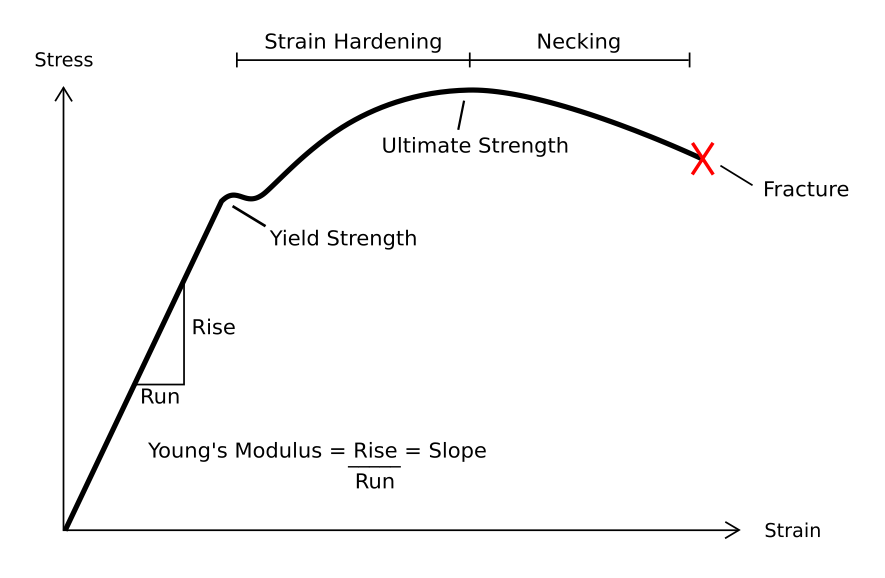
Stress−strain curve of a ductile material. The initial straight-line slope is Young's modulus; beyond the yield strength it deforms plastically up to the ultimate strength, then necks and fractures. Image: Breakdown, CC BY-SA 3.0, via Wikimedia Commons.
The Three Elastic Moduli
- Youngs modulus (Y): Y = longitudinal stress / longitudinal strain = (F/A)/(ΔL/L), applies to solids under tension/compression
- Shear modulus / modulus of rigidity (G or η): G = shearing stress / shearing strain = (F/A)/θ; for a given material G is usually less than Y
- Bulk modulus (B or K): B = -ΔP / (ΔV/V) (negative sign shows volume decreases as pressure increases); compressibility = 1/B
- Gases have very small bulk modulus (highly compressible) compared to solids and liquids
- Steel is more elastic than rubber for the same stress because steel undergoes a smaller strain (higher Y)
Poissons Ratio
- When a rod is stretched, it elongates but also contracts laterally; Poissons ratio σ = lateral strain / longitudinal strain
- σ is dimensionless and theoretically lies between -1 and 0.5 for most materials; typical values are 0.2 to 0.4
Elastic Potential Energy in a Stretched Wire
- Work done in stretching a wire is stored as elastic potential energy: U = ½ × stress × strain × volume = ½ F·ΔL
- Elastic potential energy per unit volume = ½ × Y × (strain)²
Applications
- Bridge girders and cantilever beams are designed using depression formulas; using an I-shaped cross-section gives high strength without too much extra material
- Metallic ropes/cables used in cranes and bridges are chosen for high Youngs modulus so they do not stretch excessively under heavy load
- Thicker columns and pillars in buildings reduce stress (force/area) so the structure stays within its elastic limit
- Rubber is used in shock absorbers and vibration mounts because it can sustain large strains without crossing its elastic limit
Relations Between the Elastic Moduli
- The three moduli and Poisson's ratio (σ) are interrelated for an isotropic material:
- Y = 2G(1 + σ) — links Young's modulus and shear modulus
- Y = 3B(1 − 2σ) — links Young's modulus and bulk modulus
- Y = 9BG/(3B + G) — combined relation
- These show only two of the four quantities (Y, B, G, σ) are independent
Elastic Behaviour: Fatigue and After-effect
- Elastic after-effect: the delay in a body returning fully to its original state after the deforming force is removed (negligible in quartz, large in glass)
- Elastic fatigue: the loss of strength of a material caused by repeated cycles of stress; a wire subjected to repeated stretching can break below its normal breaking stress
- Elastic hysteresis: for materials like rubber, the loading and unloading stress–strain curves do not coincide; the enclosed area represents energy dissipated as heat per cycle
Thermal Stress and Factor of Safety
- Thermal stress: when a rod is heated but not allowed to expand, it develops stress = Y·α·ΔT (α = coefficient of linear expansion, ΔT = temperature change)
- This is why gaps are left in railway tracks and bridges to allow for thermal expansion
- Breaking stress: the maximum stress a material can bear before rupture; it depends on the material, not on the wire's dimensions
- Factor of safety = breaking stress / working (permitted) stress; engineers keep working loads well below the breaking limit for safe design
🚀 JEE Advanced Edge
Elongation under self-weight and variable load: For a wire/rod hanging under its own weight, the tension (and hence stress) varies along its length, so total elongation requires integrating dL = (F(x)/AY)dx over the length, rather than just applying ΔL=FL/AY with a single F.
Series/parallel combination of wires: Two wires of different Y joined end-to-end (series) under the same load stretch by amounts inversely proportional to their individual AY/L "stiffness"; wires side-by-side sharing a load (parallel) split the load in proportion to their stiffness.
Worked problem: A wire of length 2 m and cross-section area 1 mm² stretches by 0.1 mm under a load of 20 N. Find Young's modulus. Approach: Y = (F/A)/(ΔL/L) = (20/10⁻⁶)/(0.1×10⁻³/2) = (2×10⁷)/(5×10⁻⁵) = 4×10¹¹ Pa.