🎯 Key Points
- Scalar vs Vector: Scalars have magnitude only (mass, speed, time). Vectors have magnitude AND direction (displacement, velocity, force).
- Vector addition limits: |A+B|max = A + B (when A and B are in the same direction, θ = 0°); |A+B|min = |A − B| (when they are in opposite directions, θ = 180°).
- Triangle Law: Place vectors head to tail; the resultant is the vector from the tail of the first to the head of the last.
- Parallelogram Law: R = √(A² + B² + 2AB cosθ); direction tan α = (B sinθ)/(A + B cosθ).
- Resolution of vectors: Aₓ = A cosθ, Aᵧ = A sinθ; magnitude |A| = √(Aₓ² + Aᵧ²); angle θ = tan⁻¹(Aᵧ/Aₓ).
- Unit vector: â = A/|A|; has magnitude 1, indicates direction only. î, ĵ, k̂ are unit vectors along x, y, z axes.
- Dot product (scalar): A·B = AB cosθ. Commutative: A·B = B·A. î·î = 1, î·ĵ = 0.
- Cross product (vector): |A×B| = AB sinθ, direction by right-hand rule. Anti-commutative: A×B = −(B×A). î×ĵ = k̂, ĵ×k̂ = î, k̂×î = ĵ.
- Projectile motion (launch speed u, angle θ, g downward): Time of flight T = 2u sinθ/g; Maximum height H = u²sin²θ/(2g); Horizontal range R = u²sin2θ/g. Maximum range Rmax = u²/g at θ = 45°.
- Complementary angles give equal range: Angles θ and (90° − θ) produce the same R.
- Projectile path is parabolic: y = x tanθ − gx²/(2u²cos²θ).
- Uniform circular motion: Speed constant, but velocity direction changes continuously → acceleration exists. Centripetal acceleration aₓ = v²/r = ω²r, directed toward the centre.
- Period and frequency: T = 2πr/v = 2π/ω; frequency f = 1/T; angular velocity ω = 2πf = v/r.
- Relative velocity in 2D: Velocity of A relative to B: vAB = vA − vB (vector subtraction). Magnitude |vAB| = √(vA² + vB² − 2vAvB cosθ) when angle between them is θ.
📖 Full Explanation
1. Scalars and Vectors
A scalar is described completely by its magnitude and appropriate unit — examples include mass (5 kg), temperature (300 K), and time (10 s). A vector requires both magnitude and direction — examples include displacement (50 m, North), force (20 N, upward), and velocity (15 m/s at 30° above horizontal).
Vectors are represented graphically as arrows. The length represents magnitude; the arrowhead indicates direction. In component notation: A = Aₓî + Aᵧĵ + Azk̂.
2. Vector Addition and Subtraction
Triangle Law: To add A and B, place the tail of B at the head of A. The resultant R = A + B is drawn from the tail of A to the head of B.
Parallelogram Law: Place both vectors tail-to-tail. The diagonal of the parallelogram formed is the resultant. Magnitude: R = √(A² + B² + 2AB cosθ), where θ is the angle between the vectors. Direction of R with respect to A: tan α = (B sinθ)/(A + B cosθ).
Important limits: When θ = 0° (same direction), R = A + B (maximum). When θ = 180° (opposite directions), R = |A − B| (minimum). For θ = 90°, R = √(A² + B²).
Subtraction: A − B = A + (−B). The negative of a vector has the same magnitude but reversed direction.
3. Unit Vectors and Resolution of Vectors
The unit vector in the direction of A is â = A/|A|. It has magnitude 1 and only encodes direction. The standard Cartesian unit vectors are î (x-axis), ĵ (y-axis), k̂ (z-axis).
Resolution means expressing a vector along chosen axes: if A makes angle θ with the x-axis, then Aₓ = A cosθ and Aᵧ = A sinθ. Reconstruction: |A| = √(Aₓ² + Aᵧ²), θ = tan⁻¹(Aᵧ/Aₓ). This technique converts any 2D problem into two independent 1D problems.
4. Multiplication of Vectors
Dot (scalar) product: A·B = AB cosθ, where θ is the angle between them. The result is a scalar. Key identities: î·î = ĵ·ĵ = k̂·k̂ = 1; î·ĵ = ĵ·k̂ = k̂·î = 0. In component form: A·B = AₓBₓ + AᵧBᵧ + AzBz. Applications: work W = F·d; power P = F·v.
Cross (vector) product: A×B has magnitude AB sinθ and direction perpendicular to the plane of A and B, given by the right-hand rule (curl fingers from A toward B; thumb points in direction of A×B). Key identities: î×î = 0; î×ĵ = k̂; ĵ×k̂ = î; k̂×î = ĵ (and reversals give negatives). Anti-commutative: A×B = −(B×A). Applications: torque τ = r×F; angular momentum L = r×p.
5. Position, Velocity, and Acceleration Vectors in 2D
In 2D motion, position vector r(t) = x(t)î + y(t)ĵ. Velocity v = dr/dt = (dx/dt)î + (dy/dt)ĵ = vₓî + vᵧĵ. Acceleration a = dv/dt = aₓî + aᵧĵ. The x and y components are independent — a powerful idea that makes projectile motion tractable.
6. Projectile Motion
A projectile is an object given an initial velocity and then left to move under gravity alone (air resistance neglected). Take x horizontal, y vertical (upward positive), origin at launch point.
Initial conditions: uₓ = u cosθ, uᵧ = u sinθ.
Equations of motion:
- Horizontal (no acceleration): x = uₓ t = (u cosθ) t
- Vertical (acceleration = −g): y = uᵧ t − ½gt² = (u sinθ)t − ½gt²; vᵧ = u sinθ − gt
Time of flight: At landing y = 0 again, so t(u sinθ − ½gt) = 0 → T = 2u sinθ/g.
Maximum height: At apex vᵧ = 0 → tapex = u sinθ/g → H = u²sin²θ/(2g).
Horizontal range: R = uₓ × T = (u cosθ)(2u sinθ/g) = u²sin2θ/g.
Maximum range: sin2θ = 1 → 2θ = 90° → θ = 45°; Rmax = u²/g.
Complementary angles: sin2θ = sin2(90°−θ), so angles θ and (90°−θ) give the same range. Example: 30° and 60° both give R = u²sin60°/g.
Equation of trajectory (eliminating t): y = x tanθ − gx²/(2u²cos²θ). This is a parabola (y = ax + bx² form).
Velocity at any instant: v = √(vₓ² + vᵧ²); angle with horizontal = tan⁻¹(vᵧ/vₓ). At apex, velocity is purely horizontal = u cosθ.
7. Uniform Circular Motion
When a particle moves in a circle of radius r with constant speed v, its velocity direction changes at every instant. The rate of change of velocity gives a centripetal (centre-seeking) acceleration.
Centripetal acceleration: aₓ = v²/r = ω²r, directed toward the centre (radially inward). Here ω = v/r is the angular velocity in rad/s.
Angular velocity: ω = dθ/dt. For uniform circular motion, ω is constant. v = rω.
Period: T = 2πr/v = 2π/ω (time for one complete revolution).
Frequency: f = 1/T = ω/(2π); unit is hertz (Hz) or s⁻¹.
There is no tangential acceleration in uniform circular motion (speed is constant). The net acceleration vector always points toward the centre. Note: the centripetal acceleration changes direction continuously, even though its magnitude v²/r is constant.
8. Relative Velocity in 2D
If object A has velocity vA and object B has velocity vB (both measured from the ground frame), then the velocity of A as observed from B is: vAB = vA − vB.
Magnitude when the angle between vA and vB is φ: |vAB| = √(vA² + vB² − 2vAvB cosφ).
Rain-man problem: If rain falls vertically at speed vr and a person walks horizontally at vp, the rain appears to come at an angle θ = tan⁻¹(vp/vr) from the vertical. The person must tilt an umbrella by this angle forward.
River-boat problem: A boat with speed vb (relative to water) crossing a river of width d with current vr: to cross in minimum time, aim directly across → tmin = d/vb, drift = vr·d/vb. To cross with zero drift, aim upstream at angle θ = sin⁻¹(vr/vb).
9. Horizontal Projectile (Launched from a Height)
An object projected horizontally with speed u from a height H (initial vertical velocity zero) is a special projectile. The vertical and horizontal motions stay independent.
- Time of flight: set by the fall only → T = √(2H/g), independent of the launch speed u.
- Horizontal range: R = u·T = u√(2H/g).
- Velocity on landing: horizontal component = u (unchanged); vertical component = gT = √(2gH); resultant speed = √(u² + 2gH), at angle tan⁻¹(√(2gH)/u) below the horizontal.
- Trajectory: y = gx²/(2u²) — a parabola. A dropped object and a horizontally projected object released together hit the ground at the same time.
10. Angular Variables and Kinematic Relations
- Angular displacement θ (radian), angular velocity ω = dθ/dt, angular acceleration α = dω/dt.
- Linear-angular links: arc s = rθ, tangential speed v = rω, tangential acceleration at = rα.
- For constant α, the rotational equations mirror the linear ones: ω = ω₀ + αt; θ = ω₀t + ½αt²; ω² = ω₀² + 2αθ.
- In uniform circular motion α = 0, so there is only centripetal (radial) acceleration ac = v²/r = ω²r and no change in speed.
11. Laws of Vector Addition (Triangle, Polygon, Commutative)
- Triangle law: two vectors are added head-to-tail; the closing side (tail of first to head of second) is the resultant.
- Polygon law: for several vectors, arrange them head-to-tail in sequence; the resultant is drawn from the start of the first to the end of the last. If they close into a polygon, the resultant is zero.
- Vector addition is commutative (A + B = B + A) and associative (A + (B + C) = (A + B) + C).
- The null (zero) vector has zero magnitude and no specific direction; adding it leaves a vector unchanged. Multiplying a vector by a scalar k scales its magnitude by |k| and reverses direction if k is negative.
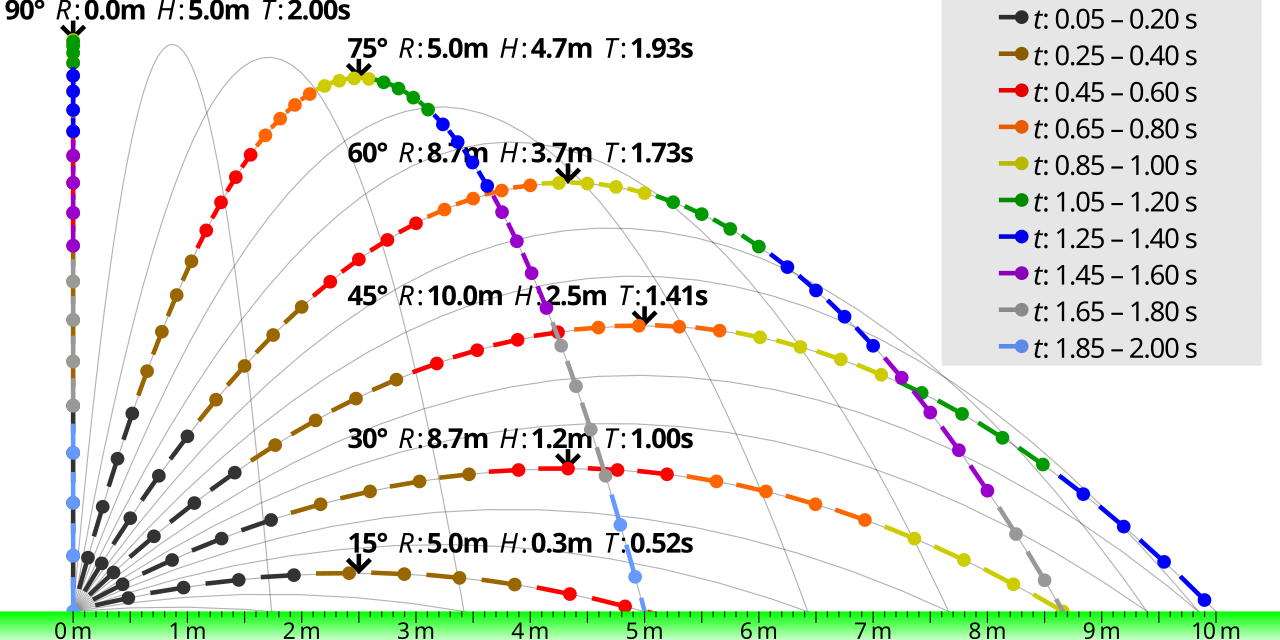
Projectiles at equal speed: range is maximum at 45°, and complementary angles (30° and 60°) share the same range. Image: Cmglee, CC BY-SA 3.0, via Wikimedia Commons.
🚀 JEE Advanced Edge
Vector identities to know cold: |A+B|² + |A−B|² = 2(A² + B²). (A+B)·(A−B) = A² − B². These appear in JEE problems disguised as geometry or work-energy scenarios.
Locus of the tip of the resultant: When two vectors of fixed magnitudes A and B are added and the angle between them varies, the tip of R traces a circle of radius B centred at the tip of A. The resultant magnitude ranges from |A−B| to A+B.
Projectile on an inclined plane: For a projectile launched at angle α to an inclined plane (incline angle β), replace g with components along and perpendicular to the incline. Time of flight T = 2u sinα/(g cosβ); range along incline R = 2u² sinα cos(α+β)/(g cos²β). Maximum range on incline = u²/[g(1+sinβ)] at α = (90°−β)/2 = 45° − β/2.
Angle of projection for a given point: To hit a target at (x, y) from the origin with speed u, the trajectory equation gives a quadratic in tanθ: gx²tan²θ − 2u²x tanθ + (gx² + 2u²y) = 0. Two solutions → two possible angles (one low, one high trajectory); both are real when u⁴ ≥ g²x² + 2gu²y (i.e., the target is inside the parabola of safety).
Velocity at given height: At height h during projectile flight, vᵧ² = u²sin²θ − 2gh; the horizontal velocity remains uₓ = u cosθ throughout. Speed at height h: v = √(u²−2gh). (This is just energy conservation!)
Centripetal acceleration derivation: Express position as r(t) = r cosωt î + r sinωt ĵ. Differentiate twice: a = −ω²r cosωt î − ω²r sinωt ĵ = −ω²r. The negative sign confirms the acceleration is directed toward the origin (centre). Magnitude: ω²r = v²/r.
Non-uniform circular motion: If speed changes, there is a tangential acceleration at = dv/dt along the velocity, in addition to centripetal acceleration ac = v²/r toward the centre. Total acceleration a = √(ac² + at²). This connects to Chapter 5 (laws of motion) when computing net force.
Cross product determinant form: A×B = |î ĵ k̂ / Aₓ Aᵧ Az / Bₓ Bᵧ Bz| (3×3 determinant). Expand along first row: = î(AᵧBz−AzBᵧ) − ĵ(AₓBz−AzBₓ) + k̂(AₓBᵧ−AᵧBₓ). Essential for torque and angular momentum calculations in JEE Advanced problems.
Common NEET trap: The range formula R = u²sin2θ/g applies only when the launch and landing heights are the same. If the projectile lands at a different height, this formula breaks down and you must solve the y-equation directly for time of flight, then compute R = uₓ × T.
Worked Example: Projectile Maximum Height and Range
Problem: A ball is thrown with speed 20 m/s at 30° above the horizontal. Find (a) the time of flight, (b) the maximum height reached, and (c) the horizontal range. (Take g = 10 m/s².)
Solution:
Given: u = 20 m/s, θ = 30°, g = 10 m/s².
Resolve initial velocity: uₓ = 20 cos30° = 20 × (√3/2) = 10√3 m/s ≈ 17.3 m/s. uᵧ = 20 sin30° = 20 × 0.5 = 10 m/s.
(a) Time of flight: T = 2uᵧ/g = 2 × 10/10 = 2 s.
(b) Maximum height: H = uᵧ²/(2g) = (10)²/(2 × 10) = 100/20 = 5 m.
(c) Horizontal range: R = uₓ × T = 10√3 × 2 = 20√3 m ≈ 34.6 m.
Check using formula: R = u²sin2θ/g = (20)²×sin60°/10 = 400×(√3/2)/10 = 20√3 m. ✓
Note: If θ = 60°, R = (20)²sin120°/10 = 20√3 m — same range because 30° and 60° are complementary. But H at 60° = (20 sin60°)²/(2×10) = (10√3)²/20 = 300/20 = 15 m, which is three times larger than at 30°.
Worked Example: Centripetal Acceleration in Circular Motion
Problem: A car moves along a circular road of radius 200 m at a constant speed of 20 m/s. Find (a) the centripetal acceleration and (b) the period of one revolution.
Solution:
(a) aₓ = v²/r = (20)²/200 = 400/200 = 2 m/s², directed toward the centre of the circular path.
(b) T = 2πr/v = 2π × 200/20 = 20π s ≈ 62.8 s.
Angular velocity: ω = v/r = 20/200 = 0.1 rad/s. Verify: aₓ = ω²r = (0.1)² × 200 = 0.01 × 200 = 2 m/s². ✓