🎯 Key Points
- F = GMm/r²; g = GM/R² at Earth's surface; g decreases both with height (g(1−2h/R)) and depth (g(1−d/R))
- Orbital velocity v₀=√(GM/r); escape velocity v_e=√(2GM/R)=√2 × v₀ (always, at the same r)
- Kepler's 3rd law: T² ∝ r³ — a direct consequence of equating gravitational force to centripetal force requirement
- Total energy of a satellite = −GMm/2r (always negative = bound orbit); Binding energy = +GMm/2r
- Astronauts feel "weightless" because they and their spacecraft share the same free-fall acceleration, not because gravity is zero up there
g is maximum at Earth's surface; going up, it falls off as 1/r² (inverse-square); going down, it falls off linearly with depth (since only the mass enclosed within radius r contributes), reaching zero at the centre.
Newton's Law of Gravitation
- F = GMm/r² (attractive force between two masses)
- G = 6.67 × 10⁻¹¹ N·m²/kg²
- g = GM/R² (acceleration due to gravity at Earth surface)
Variation of g
- At height h: g_h = g(1 - 2h/R) for h << R
- At depth d: g_d = g(1 - d/R)
- Due to rotation: g is minimum at equator, maximum at poles
Orbital Mechanics
- Orbital velocity: v₀ = √(GM/r) = √(gR²/r)
- Time period: T = 2π√(r³/GM) (Kepler's 3rd law: T² ∝ r³)
- Escape velocity: v_e = √(2GM/R) = √(2gR) ≈ 11.2 km/s
- Geostationary orbit: T = 24 h, height ≈ 36,000 km
Gravitational Potential Energy
- U = -GMm/r (negative; zero at infinity)
- Total energy of satellite = -GMm/2r (negative, always)
- Binding energy = GMm/2r
Kepler's Laws of Planetary Motion
- Law of Orbits: every planet moves in an elliptical orbit with the Sun at one focus
- Law of Areas: the line joining the planet to the Sun sweeps out equal areas in equal times (areal velocity is constant); this is a direct consequence of conservation of angular momentum
- Law of Periods: the square of the time period is proportional to the cube of the semi-major axis, T² ∝ r³
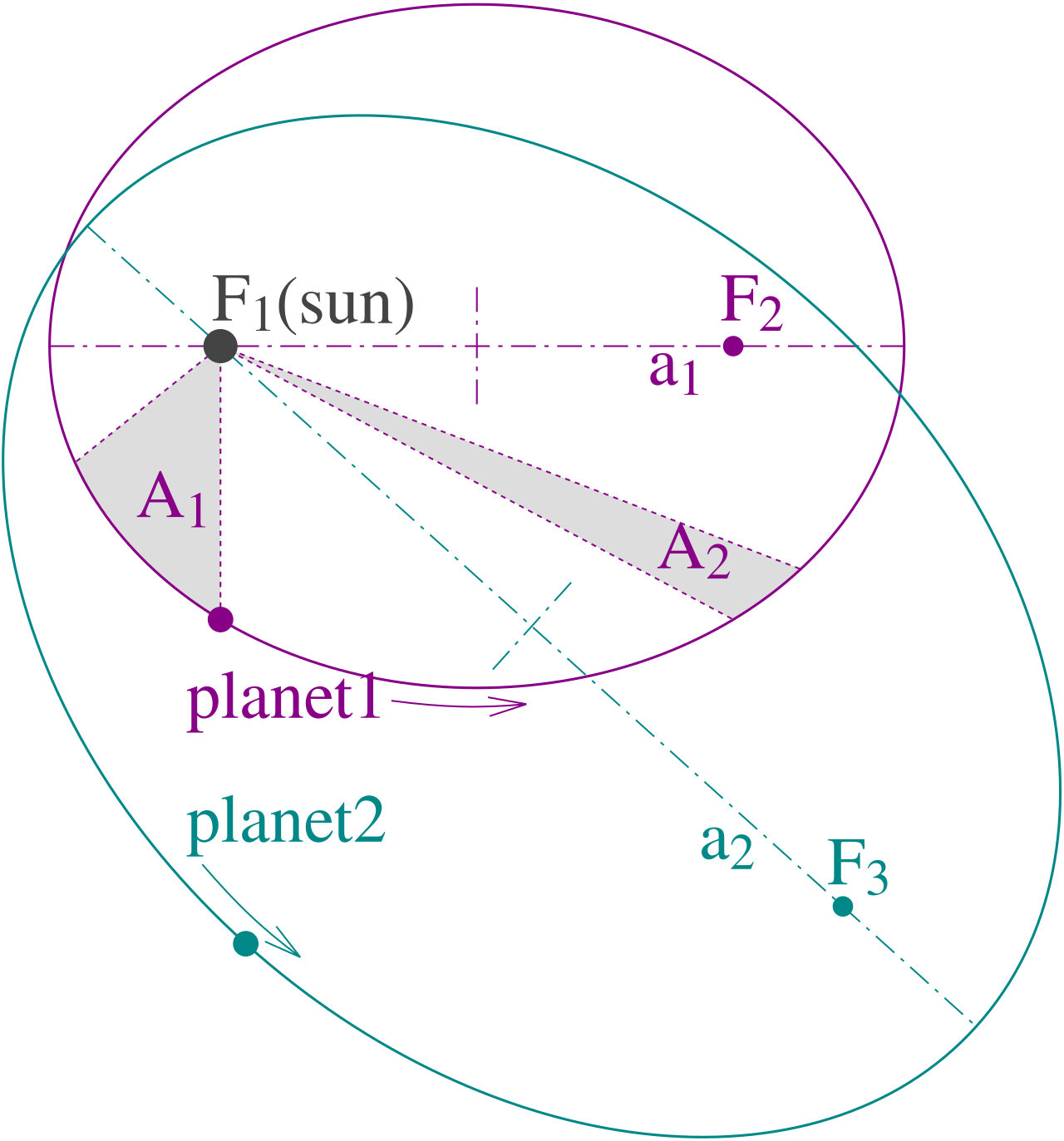
Kepler’s laws: elliptical orbits with the Sun at one focus, equal areas A₁=A₂ swept in equal times, and T² ∝ a³. Image: Hankwang, CC BY 2.5, via Wikimedia Commons.
Gravitational Potential
- Gravitational potential: V = -GM/r (work done per unit mass to bring it from infinity to that point)
- Relation to potential energy: U = mV
- Gravitational potential inside a uniform solid sphere is constant in form but field varies linearly; on the surface V = -GM/R
Weightlessness in Satellites
- An astronaut in orbit experiences apparent weightlessness because both the astronaut and satellite have the same centripetal acceleration (= g at that height) and fall freely around Earth together
- The normal force between astronaut and satellite floor becomes zero, not because gravity vanishes
Relation Between Escape and Orbital Velocity
- v_e = √2 × v₀ (escape velocity is √2 times the orbital velocity at the same radius)
- If orbital speed is increased to √2 times its value, a satellite in circular orbit escapes the gravitational field entirely
Gravitational Field Intensity and Superposition
- Gravitational field intensity: E = F/m = GM/r² (force per unit mass placed at a point; a vector directed towards the source mass)
- Superposition principle: the net gravitational force (or field) due to several masses is the vector sum of the forces (or fields) due to each mass taken individually
- Field inside a uniform solid sphere at distance r from centre: E = GMr/R³ (increases linearly with r); outside: E = GM/r²
- Field due to a uniform spherical shell is zero everywhere inside it
Acceleration due to Gravity: Rotation and Shape of Earth
- Due to Earth's rotation, effective g at latitude λ is g' = g − ω²R·cos²(λ); g is minimum at the equator and maximum at the poles
- If Earth's rotation stopped, g at the equator would increase by ω²R (≈ 0.034 m/s²)
- Because Earth bulges at the equator (R_equator > R_pole), g is also slightly larger at the poles due to the smaller radius there
Types of Satellites: Geostationary and Polar
- Geostationary satellite: orbits in the equatorial plane with period 24 h, same direction as Earth's rotation, at height ≈ 36,000 km; appears fixed in the sky (used for communication)
- Polar satellite: low-altitude (few hundred km) satellite in a north–south orbit passing over the poles; used for weather imaging and remote sensing, scanning the whole globe strip by strip
🚀 JEE Advanced Edge
Variation of g with latitude: Due to Earth's rotation, the effective g at latitude λ is g' = g − ω²R cos²λ, where ω is Earth's angular velocity. This is why g is minimum at the equator (λ=0°, full subtraction) and maximum at the poles (λ=90°, no subtraction since rotation provides no centripetal requirement there).
Energy required to move a satellite between orbits: ΔE = E_final − E_initial = (−GMm/2r_f) − (−GMm/2r_i) — since total energy becomes LESS negative (increases) as r increases, moving a satellite to a HIGHER orbit always requires a net energy INPUT, even though its speed there is actually LOWER (counterintuitive — higher orbit means lower orbital speed but higher total energy, because potential energy increases more than kinetic energy decreases).
Worked problem: Calculate the height of a geostationary satellite above Earth's surface (R=6400 km, g=9.8 m/s², T=24h). Approach: Equate gravitational force to centripetal requirement: GM/r² = ω²r → r³ = GM/ω². Using GM=gR², and ω=2π/T, solve for r (orbital radius from Earth's centre) ≈ 42,300 km, then height = r − R ≈ 35,900 km, matching the well-known ~36,000 km figure.