🎯 Key Points
- v = u + at; s = ut + ½at²; v² = u² + 2as — the three equations of motion for constant acceleration
- Projectile range R = u²sin(2θ)/g is maximum at θ=45°; same range for θ and (90°−θ)
- Time of flight T = 2u sin(θ)/g; max height H = u²sin²(θ)/2g
- On a v-t graph: slope = acceleration, area under curve = displacement
- Relative velocity: V_AB = V_A − V_B (always subtract as vectors, not just magnitudes)
Equations of Motion (Uniform Acceleration)
On a velocity-time graph for uniform acceleration, the slope of the line gives the acceleration and the shaded area under the line gives the displacement.
- v = u + at
- s = ut + ½at²
- v² = u² + 2as
- s(nth second) = u + a(2n-1)/2
Projectile Motion
- Horizontal velocity: constant = u·cos(θ)
- Vertical velocity: v_y = u·sin(θ) - gt
- Time of flight: T = 2u·sin(θ)/g
- Range: R = u²·sin(2θ)/g (maximum at 45°)
- Maximum height: H = u²·sin²(θ)/2g
Relative Velocity
- V_AB = V_A - V_B (velocity of A relative to B)
- Rain-man problems use vector subtraction
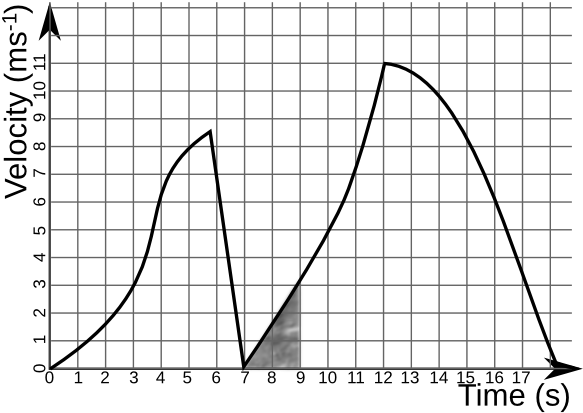
A velocity−time graph: the slope gives acceleration and the shaded area under the curve equals displacement. Image: Sjlegg, Public Domain, via Wikimedia Commons.
Graphs
- Displacement-time graph: slope = velocity
- Velocity-time graph: slope = acceleration, area = displacement
- Acceleration-time graph: area = change in velocity
Distance vs Displacement, Speed vs Velocity
- Distance is the total path length (scalar, never negative); displacement is the shortest straight-line vector from start to finish. Distance ≥ |displacement| always; they are equal only for motion in one direction without reversal.
- Average speed = total distance ÷ total time; average velocity = total displacement ÷ total time. Average speed ≥ |average velocity|.
- For a body covering equal DISTANCES at speeds v₁ and v₂, average speed = 2v₁v₂/(v₁ + v₂) (harmonic mean). For equal TIMES at v₁ and v₂, average speed = (v₁ + v₂)/2 (arithmetic mean).
- Instantaneous velocity = dx/dt; instantaneous acceleration = dv/dt = d²x/dt². Speed is the magnitude of instantaneous velocity.
Relative Velocity in One Dimension
- Velocity of A relative to B: v_AB = v_A − v_B (subtract with sign along the chosen positive direction).
- Same direction: relative speed = |v_A − v_B| (small, e.g. two trains moving the same way).
- Opposite directions: relative speed = v_A + v_B (large, e.g. two trains approaching each other).
- Time to meet / overtake = initial separation ÷ relative speed; useful for train-crossing and catch-up problems.
Motion Under Gravity (Free Fall)
- Near Earth's surface acceleration = g ≈ 9.8 m/s² (often taken as 10 m/s²), directed downward, independent of the body's mass.
- Drop from rest from height h: time to fall t = √(2h/g); speed on landing v = √(2gh).
- Thrown straight up with speed u: time to top = u/g; maximum height = u²/(2g); total time to return to launch level = 2u/g; it returns with the same speed u.
- Symmetry: at any given height, the up-going and down-going speeds are equal in magnitude.
- Distance covered in successive seconds of free fall from rest follows the ratio 1 : 3 : 5 : 7 ... (Galileo's odd-number rule).
Non-Uniform Acceleration (Calculus Approach)
- The three equations of motion apply ONLY for constant acceleration. When acceleration varies, use calculus.
- Given a(t): v = ∫a dt and x = ∫v dt. Given x(t): differentiate to get v = dx/dt and a = dv/dt.
- When acceleration depends on position, use a = v(dv/dx); then v dv = a dx, and integrate to relate speed and position.
- Areas and slopes on motion graphs are the graphical form of these integrals and derivatives (area under a-t = Δv, area under v-t = Δx).
🚀 JEE Advanced Edge
Projectile from a height: When launched horizontally from height H with speed u, time to fall = √(2H/g) (independent of u), and horizontal range = u√(2H/g). The vertical motion is completely independent of the horizontal motion — this decoupling is the single most useful idea for solving 2D projectile problems.
River-boat / rain-man relative velocity problems: To cross a river in minimum time, point the boat straight across (perpendicular to the bank) regardless of current — drift downstream doesn't affect crossing time, since that depends only on the perpendicular velocity component. To cross with minimum drift (shortest path), angle the boat upstream so the resultant velocity points straight across.
Worked problem: A ball is thrown upward with initial velocity 20 m/s from a 25 m tall building. Find total time to reach the ground (g=10 m/s²). Approach: Taking up as positive, displacement = −25 m (net displacement, since it lands below the throw point): −25 = 20t − ½(10)t² → 5t² − 20t − 25 = 0 → t² − 4t − 5 = 0 → (t−5)(t+1)=0 → t=5s (rejecting the negative root).