🎯 Key Points
- Group 15 oxidation states: N shows all states from −3 to +5; P shows −3, +3, +5 (d-orbital availability from 3rd period onwards allows expanded octets)
- F has only −1 oxidation state — it lacks d-orbitals and is the most electronegative element, so it cannot act as a central atom or reach positive states
- NH₃ is a stronger base than PH₃: N's lone pair is in a compact sp³ orbital close to the nucleus and readily donated; P is larger, so its lone pair is more diffuse and less available
- HNO₃ is made industrially by the Ostwald process: NH₃ → NO (over Pt/Rh catalyst, 500°C) → NO₂ → HNO₃
- H₃PO₃ (phosphorous acid) is diprotic, not triprotic — it has one P=O bond and one direct P−H bond; only the two P−OH protons are ionisable
- H₂SO₄ is made by the Contact process: S → SO₂ → SO₃ (V₂O₅ catalyst, 450°C) → H₂SO₄; oleum (fuming H₂SO₄) = H₂SO₄ + dissolved SO₃
- O₂ is paramagnetic: molecular orbital theory gives it two unpaired electrons in degenerate π*2p orbitals (bond order = 2), despite Lewis structure suggesting it is diamagnetic
- Ozone (O₃) is a bent molecule (117.5°); the central O is sp² hybridised; it acts as a powerful oxidising agent (decomposes to give nascent oxygen)
- Interhalogen compounds (XY, XY₃, XY₅, XY₇) form between two different halogens; the more electronegative halogen is the terminal atom; shapes determined by VSEPR (ClF₃ = T-shaped, BrF₅ = square pyramidal)
- Xenon fluorides: XeF₂ (linear, 3 lone pairs on Xe), XeF₄ (square planar, 2 lone pairs on Xe), XeF₆ (distorted octahedral, 1 lone pair on Xe)
- Bleaching powder is Ca(OCl)Cl; chlorine water bleaches by releasing nascent oxygen, not by direct Cl₂ action
- Acidic strength of hydracids: HF < HCl < HBr < HI (bond strength decreases down the group; bond dissociation is the rate-determining step in aqueous acidic behaviour)
📖 Full Explanation
Group 15: Nitrogen Family (N, P, As, Sb, Bi)
Electronic configuration: ns²np³ — three half-filled p-orbitals give Group 15 elements exceptional stability, explaining the high bond dissociation energy of N₂ (945 kJ/mol) and the reluctance of these elements to lose electrons.
Oxidation states: Nitrogen exhibits the full range from −3 (in NH₃, NH₄⁺) through 0 (N₂) to +5 (in HNO₃, N₂O₅). Phosphorus commonly shows −3 (in PH₃), +3 (PCl₃, H₃PO₃), and +5 (PCl₅, H₃PO₄). The heavier elements (As, Sb, Bi) show decreasing stability of the +5 state due to the inert pair effect — Bi(V) is a powerful oxidising agent precisely because it readily drops to the more stable Bi(III).
Allotropes of Phosphorus:
- White phosphorus (P₄): Tetrahedral structure with 60° P−P−P bond angles (strained); highly reactive, luminescent (phosphorescence), ignites spontaneously in air (~34°C), stored under water, extremely toxic
- Red phosphorus: Polymeric chain structure; non-toxic, non-luminescent, much less reactive; used in matchboxes
- Black phosphorus: Most thermodynamically stable form; layered structure similar to graphite; semiconductor
Hydrides of Group 15 (NH₃, PH₃, AsH₃, SbH₃, BiH₃): Thermal stability decreases down the group as bond strength decreases (N−H bond is strongest). Basicity also decreases: NH₃ ≫ PH₃ > AsH₃ ≈ SbH₃ ≈ BiH₃. NH₃ is the only one that acts as a significant Brønsted base in water; PH₃ is only very weakly basic and does not ionise appreciably in water.
Oxoacids of Nitrogen:
- HNO₂ (nitrous acid): Weak acid; acts both as oxidising agent and reducing agent; structure is O=N−OH
- HNO₃ (nitric acid): Strong acid and powerful oxidising agent; dilute HNO₃ gives NO with most metals; concentrated HNO₃ gives NO₂; passivates Fe, Al, Cr (forms protective oxide layer)
Ostwald Process for HNO₃: (1) Catalytic oxidation of NH₃ at ~500°C over Pt/Rh gauze: 4NH₃ + 5O₂ → 4NO + 6H₂O; (2) Oxidation of NO: 2NO + O₂ → 2NO₂; (3) Absorption in water: 4NO₂ + O₂ + 2H₂O → 4HNO₃
Oxoacids of Phosphorus — Basicity Rules: The number of ionisable protons (basicity) equals the number of P−OH groups. P−H bonds are non-ionisable; P=O bonds stabilise the acid. H₃PO₄ (orthophosphoric acid) has three P−OH groups → triprotic. H₃PO₃ (phosphorous acid) has two P−OH groups and one direct P−H bond → diprotic (basicity = 2). H₃PO₂ (hypophosphorous acid) has one P−OH and two P−H bonds → monobasic.
Group 16: Oxygen Family (O, S, Se, Te, Po)
Electronic configuration: ns²np⁴ — two unpaired p-electrons; Group 16 elements show oxidation states of −2 (most common), +2, +4, +6. Oxygen is almost always −2, but in OF₂ it is +2 (since F is more electronegative). Sulfur commonly shows −2, +4, +6.
O₂ and Molecular Orbital Theory: The molecular orbital electronic configuration of O₂ is: (σ1s)²(σ*1s)²(σ2s)²(σ*2s)²(σ2p)²(π2p)⁴(π*2p)² — the last two electrons are distributed one each in the two degenerate π*2p orbitals by Hund's rule, giving O₂ two unpaired electrons and making it paramagnetic. Bond order = (8−4)/2 = 2, confirming the double bond. This is a classic failure of the Lewis structure approach.
Ozone (O₃): Formed in the stratosphere by UV radiation splitting O₂ → 2O•; O• + O₂ → O₃. Ozone absorbs UV-B and UV-C radiation (200–300 nm), protecting life on Earth. Ozone is a strong oxidising agent: O₃ → O₂ + [O] (nascent oxygen); it can oxidise PbS → PbSO₄ (turns black lead sulfide white). Ozone depletion: CFCs release Cl• radicals in the stratosphere (Cl• + O₃ → ClO• + O₂; ClO• + O → Cl• + O₂) — the Cl• is regenerated, creating a catalytic cycle.
Allotropes of Sulfur: Rhombic sulfur (α-S₈, stable below 369 K, crown-shaped S₈ rings); monoclinic sulfur (β-S₈, stable 369–392 K); plastic/amorphous sulfur (cooling molten sulfur rapidly — long chains, elastic).
Contact Process for H₂SO₄:
- Step 1: S + O₂ → SO₂
- Step 2: 2SO₂ + O₂ ⇌ 2SO₃ (V₂O₅ catalyst, 450°C, 1–2 atm — conditions chosen to favour yield while maintaining acceptable reaction rate)
- Step 3: SO₃ + H₂SO₄ → H₂S₂O₇ (oleum/pyrosulfuric acid) — SO₃ cannot be directly absorbed in water because it forms a thick acid mist
- Step 4: H₂S₂O₇ + H₂O → 2H₂SO₄
Properties of H₂SO₄: Strong diprotic acid; dehydrating agent (chars sucrose, removes water of crystallisation); oxidising agent (hot conc. H₂SO₄ oxidises Cu, S, C); non-volatile (displaces volatile acids from their salts, e.g., NaCl + H₂SO₄ → NaHSO₄ + HCl↑).
Oleum (Fuming H₂SO₄): H₂SO₄ with dissolved SO₃; written as H₂S₂O₇ or as H₂SO₄·xSO₃. Used in sulfonation reactions and in production of dyes and explosives.
Group 17: Halogens (F, Cl, Br, I, At)
Electronic configuration: ns²np⁵ — one electron short of a noble gas configuration; all halogens are strong oxidising agents. Reactivity (and oxidising power) decreases down the group: F₂ > Cl₂ > Br₂ > I₂.
Why F₂ is the strongest oxidising agent: Fluorine has the highest electronegativity (4.0), smallest atomic size, weakest F−F bond (low bond dissociation energy due to lone pair−lone pair repulsion in the small F₂ molecule), and highest hydration enthalpy of F⁻. All factors combine to make the F₂/F⁻ reduction potential the highest (+2.87 V).
Anomalous behaviour of Fluorine: (1) Only −1 oxidation state (no d-orbitals, most electronegative); (2) HF is a weak acid (strong H−F bond, only partially dissociates in water) unlike HCl, HBr, HI which are strong acids; (3) HF forms hydrogen bonds (hence higher boiling point than expected); (4) F₂ reacts with water vigorously (2F₂ + 2H₂O → 4HF + O₂); other halogens give HOX + HX in mild disproportionation.
Hydracid acidic strength: HF ≪ HCl < HBr < HI. Down the group, the H−X bond length increases and bond dissociation enthalpy decreases, making ionisation progressively easier. HF's weakness in water is also partly because F⁻ is so small and highly solvated that the equilibrium lies toward HF.
Oxoacids of Halogens (Chlorine): HOCl (hypochlorous) < HOClO (chlorous) < HOClO₂ (chloric) < HOClO₃ (perchloric) — acidic strength increases as the number of terminal oxygen atoms increases (more O atoms draw electron density away from O−H bond, stabilising the conjugate base anion through resonance/induction).
Bleaching powder (Ca(OCl)Cl): Made by passing Cl₂ over slaked lime [Ca(OH)₂] below 40°C. Bleaching is due to nascent oxygen from the reaction of Cl₂ (or OCl⁻) with water in acidic conditions: Ca(OCl)Cl + H₂SO₄ → CaSO₄ + Cl₂ + H₂O → bleaching.
Interhalogen Compounds: Compounds formed between two different halogens (XYₙ where X is the larger/less electronegative halogen). Types and shapes:
- AB type (XY): ClF, BrF, BrCl, ICl, IBr — diatomic, linear
- AB₃ type (XY₃): ClF₃, BrF₃ — T-shaped (5 electron pairs, 2 lone pairs on central atom)
- AB₅ type (XY₅): ClF₅, BrF₅, IF₅ — square pyramidal (6 electron pairs, 1 lone pair)
- AB₇ type (XY₇): IF₇ — pentagonal bipyramidal (7 bond pairs, no lone pairs)
All interhalogen compounds are more reactive than the parent halogens (weaker X−Y bond compared to X−X). They act as strong fluorinating/halogenating agents.
Group 18: Noble Gases (He, Ne, Ar, Kr, Xe, Rn)
Properties: All have completely filled valence shells (ns²np⁶, except He: 1s²). Monoatomic, colourless, odourless, and virtually inert. Their low boiling points reflect weak London dispersion forces only; boiling points increase down the group as atomic size and polarisability increase.
Uses: He — balloons (non-flammable), cryogenics (liquid He cools MRI magnets), deep-sea diving; Ne — signs and indicators (red-orange glow in discharge tubes); Ar — inert atmosphere in welding, filling light bulbs; Kr/Xe — flashbulbs, lasers; Rn — radioactive, used in cancer radiotherapy.
Noble Gas Compounds (Xenon): Neil Bartlett (1962) first showed noble gases could react — he made O₂⁺[PtF₆]⁻ and then Xe[PtF₆]. Compounds of xenon with fluorine and oxygen are the best characterised:
- XeF₂: Xe + F₂ (1:1, 400°C, sealed nickel vessel). Linear shape. Xe has 3 lone pairs + 2 bond pairs = 5 electron pairs → sp³d, trigonal bipyramidal electron geometry with lone pairs in equatorial positions → linear molecular shape. Powerful fluorinating agent.
- XeF₄: Xe + 2F₂ (1:2, 400°C, 6 atm). Square planar shape. Xe has 2 lone pairs + 4 bond pairs = 6 electron pairs → sp³d², octahedral electron geometry with lone pairs opposite each other → square planar molecular shape.
- XeF₆: Xe + 3F₂ (1:3, high pressure, 300°C). Distorted octahedral shape. 1 lone pair + 6 bond pairs = 7 electron pairs → sp³d³, distorted octahedral (pentagonal bipyramidal if lone pair is counted). The lone pair distorts the regular octahedral geometry.
- XeO₃: Formed by hydrolysis of XeF₄ and XeF₆. Pyramidal shape (3 bond pairs + 1 lone pair → sp³).
- XeOF₄: Square pyramidal shape (4 bond pairs + 1 Xe=O + 1 lone pair → sp³d²).
Hydrolysis of xenon fluorides: 6XeF₄ + 12H₂O → 4Xe + 2XeO₃ + 24HF + 3O₂ (disproportionation); XeF₆ + 3H₂O → XeO₃ + 6HF (complete hydrolysis).
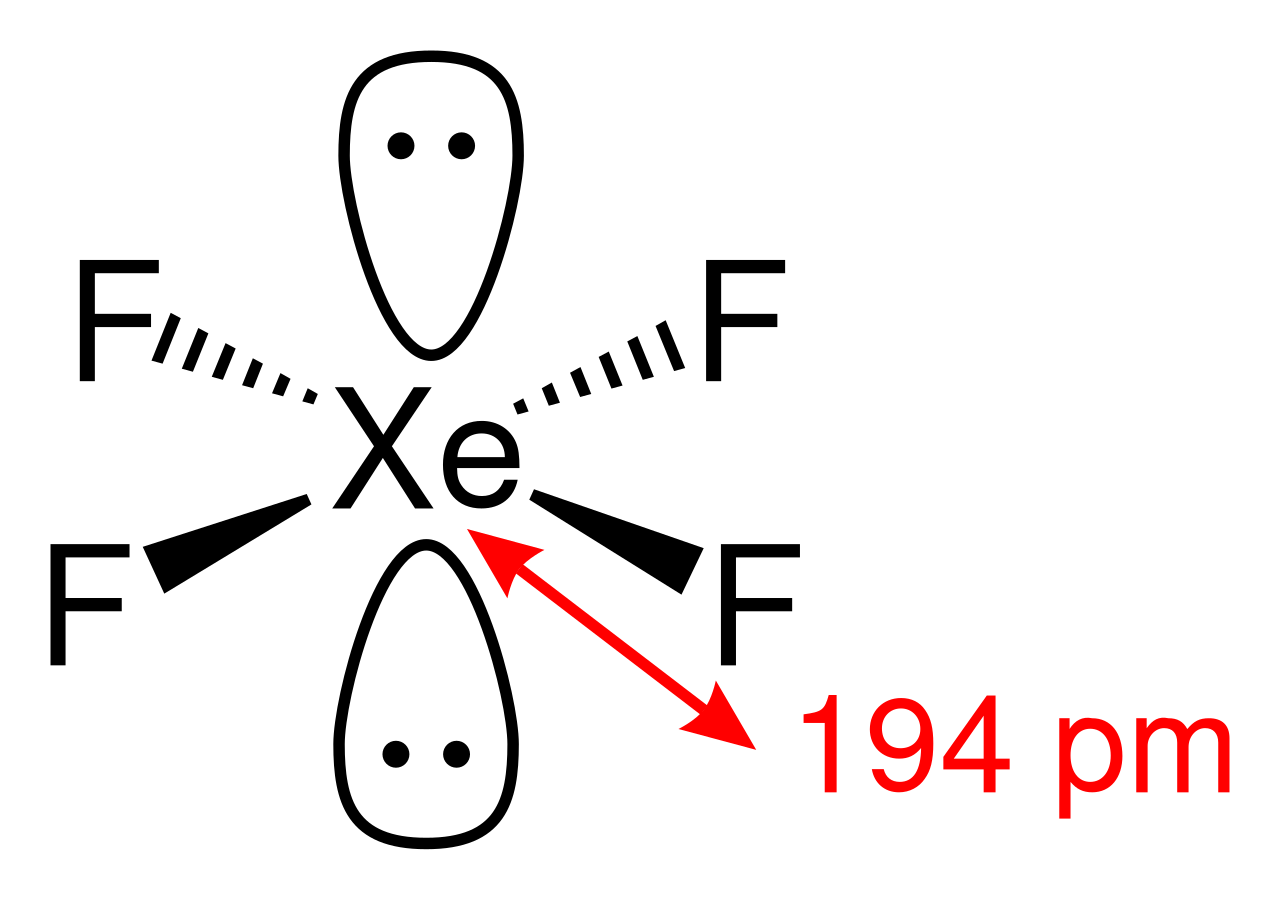
Xenon tetrafluoride (XeF4) has six electron domains around xenon — four Xe–F bonds plus two lone pairs. The lone pairs occupy opposite axial positions, leaving the four fluorine atoms in a square-planar shape (Xe–F ≈ 194 pm). Image: ChemSim, Public Domain, via Wikimedia Commons.
General Trends in Groups 15–18
- Atomic and ionic radii increase down each group as new shells are added (a larger jump from period 2 to 3, then smaller increases).
- Ionization enthalpy decreases down a group; across a period it is higher for the p-block. Group 15 has an unusually high IE due to the extra stability of the half-filled np³ configuration.
- Electronegativity decreases down a group; F, O, N and Cl are among the most electronegative of all elements.
- Metallic character increases down each group: Group 15 runs non-metal (N, P) → metalloid (As, Sb) → metal (Bi); Group 16 non-metal → metalloid (Te) → metal (Po); Groups 17 and 18 are non-metals.
- Catenation (self-linking) is significant for sulphur (S₈ rings, long chains) and limited for nitrogen; it weakens down a group as element–element bond strength falls.
- Anomalous behaviour of the first member (N, O, F) results from small size, high electronegativity, high charge density, and the absence of d-orbitals (no expanded octet).
Dinitrogen and Ammonia
Dinitrogen (N₂): Prepared in the lab by gently heating ammonium nitrite: NH₄NO₂ → N₂ + 2H₂O (obtained in situ from NH₄Cl + NaNO₂). It is very unreactive at ordinary temperature because of the strong N≡N triple bond (945 kJ/mol). Industrially it is obtained by the liquefaction and fractional distillation of air.
Ammonia (NH₃): Manufactured by the Haber process: N₂ + 3H₂ ⇌ 2NH₃ (exothermic); optimum conditions are ~200 atm, ~700 K, an iron-oxide catalyst with a molybdenum promoter. NH₃ is a pyramidal molecule (sp³, one lone pair, bond angle 107°), a weak base in water (NH₃ + H₂O ⇌ NH₄⁺ + OH⁻), and forms complexes with metal ions — e.g. the deep-blue [Cu(NH₃)₄]²⁺ and diamminesilver(I) [Ag(NH₃)₂]⁺.
Oxides of Nitrogen
- N₂O (nitrous oxide, +1): neutral oxide; "laughing gas"; made by heating NH₄NO₃ → N₂O + 2H₂O.
- NO (nitric oxide, +2): neutral oxide; an odd-electron, paramagnetic molecule; formed in the Ostwald process and by lightning in air.
- N₂O₃ (+3): acidic oxide; the anhydride of nitrous acid (HNO₂).
- NO₂ (nitrogen dioxide, +4): acidic, brown, odd-electron gas; dimerises to colourless N₂O₄; 3NO₂ + H₂O → 2HNO₃ + NO.
- N₂O₅ (+5): acidic oxide; the anhydride of nitric acid (HNO₃).
Phosphine and Phosphorus Halides
Phosphine (PH₃): prepared by warming white phosphorus with concentrated NaOH in an inert (CO₂) atmosphere: P₄ + 3NaOH + 3H₂O → PH₃ + 3NaH₂PO₂. It is a much weaker base than NH₃; pure PH₃ is non-inflammable, but traces of P₂H₄ make it ignite spontaneously (the "will-o'-the-wisp" flame).
- PCl₃: P₄ + 6Cl₂ → 4PCl₃; pyramidal (sp³); fumes in moist air and hydrolyses: PCl₃ + 3H₂O → H₃PO₃ + 3HCl. It also converts alcohols and acids to alkyl/acyl chlorides.
- PCl₅: P₄ + 10Cl₂ → 4PCl₅; trigonal bipyramidal (sp³d) in the gas phase but ionic [PCl₄]⁺[PCl₆]⁻ in the solid. Hydrolyses first to POCl₃ and then to H₃PO₄; it is a good chlorinating agent.
Dioxygen, Sulphur Dioxide and Classification of Oxides
Dioxygen (O₂): lab preparation by heating KClO₃ with an MnO₂ catalyst (2KClO₃ → 2KCl + 3O₂), or by decomposing H₂O₂ or HgO. It supports combustion and forms oxides with almost all elements.
Sulphur dioxide (SO₂): made by burning sulphur, roasting sulphide ores (4FeS₂ + 11O₂ → 2Fe₂O₃ + 8SO₂), or Na₂SO₃ + H₂SO₄ → Na₂SO₄ + SO₂ + H₂O. It is an angular molecule, acidic (anhydride of H₂SO₃), and acts as a reducing agent and a (temporary) bleaching agent by reduction.
Classification of oxides:
- Acidic: non-metal oxides — CO₂, SO₂, SO₃, N₂O₅, P₄O₁₀.
- Basic: metal oxides — Na₂O, CaO, MgO.
- Amphoteric: react with both acids and bases — Al₂O₃, ZnO, PbO.
- Neutral: neither acidic nor basic — CO, NO, N₂O, H₂O.
🔬 Advanced / Edge Cases
Why N₂ is so unreactive despite triple bond: N≡N bond energy is 945 kJ/mol — the highest bond dissociation energy of any diatomic homonuclear molecule. Even though the triple bond contains a lot of energy, both N atoms would rather stay bonded to each other than bond with most other atoms. Industrial fixation (Haber process) requires 450°C, 200 atm, and an Fe catalyst just to achieve a modest equilibrium yield.
H₃PO₃ vs H₃PO₄ — the classic misconception: H₃PO₃ looks triprotic from its formula, but structural analysis shows one H is directly bonded to P (a P−H bond, not P−OH). The structure is (HO)₂P(=O)H. Only the two O−H protons are acidic; the P−H proton is non-ionisable. Ka₁ ≈ 5×10⁻² (moderately strong for the first ionisation). Many students lose marks by treating it as triprotic in stoichiometric calculations.
Oxygen's paramagnetism — why Lewis structures fail: The Lewis structure of O₂ shows all electrons paired (a double bond with two lone pairs per O). This predicts diamagnetism. But experimentally, liquid O₂ is attracted to a magnetic field — it is paramagnetic. Molecular orbital theory resolves this: two electrons occupy the degenerate π*2p orbitals one each (Hund's rule in MO theory), giving 2 unpaired electrons. This is a critical distinction for JEE questions asking about theories.
Relative stability of interhalogen vs parent halogen bonds: The X−Y bond in an interhalogen is weaker than the X−X bond in the parent halogen (except F−F, which is anomalously weak). This makes interhalogens more reactive than their parent halogens as a general rule.
Why XeF₂ is a better fluorinating agent than XeF₄ or XeF₆: XeF₂ has two F atoms to donate and the Xe−F bonds in XeF₂ are more reactive (lower bond energy context, strong driving force to form stable Xe and 2 HF or 2 F⁻ as products). XeF₂ is used in organic synthesis to introduce F into molecules selectively.
Inert pair effect in Group 15 and 16: As you go from N to Bi (Group 15), the +5 oxidation state becomes less stable: NF₅ exists but BiF₅ is a very powerful oxidiser; Bi(III) is far more stable. Similarly in Group 16, PoO₃ (Po in +6) is less stable than PoO₂ (+4). The ns² pair is held tightly by poor d/f shielding and increasing nuclear charge.
Common trap: Bleaching powder is not pure Ca(OCl)₂: It is a mixed salt Ca(OCl)Cl (calcium hypochlorite chloride or chlorinated lime). Only one Cl is replaced by OCl⁻. Its effective chlorine content (available Cl₂) determines its bleaching strength.
Worked Example: Ostwald Process Stoichiometry
Problem: What volume of air (21% O₂ by volume) at STP is required to convert 340 g of NH₃ into HNO₃ via the Ostwald process? (Assume 100% conversion at each step.)
Solution: Molar mass of NH₃ = 17 g/mol; moles of NH₃ = 340/17 = 20 mol. The three steps consume O₂ as follows:
- Step 1: 4NH₃ + 5O₂ → 4NO + 6H₂O → 20 mol NH₃ needs (5/4)×20 = 25 mol O₂
- Step 2: 2NO + O₂ → 2NO₂ → 20 mol NO needs (1/2)×20 = 10 mol O₂
- Step 3: 4NO₂ + O₂ + 2H₂O → 4HNO₃ → 20 mol NO₂ needs (1/4)×20 = 5 mol O₂
Total O₂ = 25 + 10 + 5 = 40 mol. Volume of O₂ at STP = 40 × 22.4 = 896 L. Volume of air = 896/0.21 ≈ 4267 L. Answer: ~4267 L of air at STP.
Worked Example: Basicity of Phosphorus Oxoacids
Problem: State the basicity (number of replaceable H atoms) of (a) H₃PO₄, (b) H₃PO₃, (c) H₃PO₂, and explain with structures.
Solution: Basicity = number of P−OH groups (only these protons are ionisable).
- (a) H₃PO₄ (orthophosphoric acid): Structure = (HO)₃P=O → 3 P−OH groups, basicity = 3 (triprotic)
- (b) H₃PO₃ (phosphorous acid): Structure = (HO)₂P(=O)H → 2 P−OH groups + 1 P−H bond, basicity = 2 (diprotic)
- (c) H₃PO₂ (hypophosphorous acid): Structure = (HO)P(=O)H₂ → 1 P−OH group + 2 P−H bonds, basicity = 1 (monobasic)
A quick shortcut: count P−H bonds in the name — every direct P−H reduces basicity by 1 from 3.
Worked Example: VSEPR for Xenon Fluorides
Problem: Predict the shape of XeF₄ using VSEPR theory and state its hybridisation.
Solution: Xe in XeF₄ has 8 valence electrons. 4 are used for bonds to 4 F atoms. Remaining = 8 − 4 = 4 electrons = 2 lone pairs. Total electron pairs = 4 (bond) + 2 (lone) = 6 → sp³d² hybridisation, octahedral electron pair geometry. To minimise lone pair−lone pair repulsion, the 2 lone pairs are placed opposite each other (trans positions). The 4 F atoms occupy the equatorial plane. Molecular shape: square planar. Bond angle F−Xe−F = 90°. This makes XeF₄ a non-polar molecule despite having polar Xe−F bonds (the dipoles cancel due to symmetry).