🎯 Key Points
- Ionic bond = electron transfer (metal + non-metal); Covalent bond = electron sharing (non-metal + non-metal); Metallic bond = delocalised electron sea
- VSEPR predicts shape from total electron pairs (bond pairs + lone pairs) around the central atom; lone pairs repel more than bond pairs
- Hybridisation: sp = linear, sp² = trigonal planar, sp³ = tetrahedral, sp³d = trigonal bipyramidal, sp³d² = octahedral
- Sigma bonds = head-on overlap (strong); Pi bonds = sideways overlap (weaker), always accompany a sigma bond in multiple bonds
- Bond order (MOT) = (bonding e⁻ − antibonding e⁻)/2; higher bond order = shorter, stronger bond
- Hydrogen bonding needs H attached to F, O, or N; explains water's unusually high boiling point
- Fajan's rules: small, highly-charged cation + large anion → more covalent character even in a formally "ionic" compound
Types of Chemical Bonds
- Ionic (electrovalent): Complete transfer of one or more electrons from a metal to a non-metal, forming oppositely charged ions held together by strong electrostatic attraction; e.g., NaCl, MgO. Ionic compounds are typically high-melting, hard, brittle solids that conduct electricity only when molten or dissolved.
- Covalent: Mutual sharing of electron pairs between atoms (usually non-metals); e.g., H₂, CH₄, CO₂. Can be polar (unequal sharing, e.g. HCl) or non-polar (equal sharing, e.g. Cl₂).
- Coordinate (dative): A special covalent bond where both shared electrons come from just one atom (the Lewis base/donor) to another (the Lewis acid/acceptor); e.g., NH₄⁺, H₃O⁺, BF₃·NH₃.
- Metallic: A "sea" of delocalised valence electrons shared collectively among a lattice of metal cations; explains electrical/thermal conductivity, malleability, and ductility.
Lewis Structures, Octet Rule & Formal Charge
Lewis structures show valence electrons as dots/lines around atomic symbols. Most atoms are most stable with 8 valence electrons (octet rule), though there are well-known exceptions: electron-deficient species like BF₃ (only 6 around B), and expanded-octet species like PCl₅ and SF₆ (using d-orbitals, possible from period 3 onward).
Formal charge = (valence electrons of free atom) − (non-bonding/lone pair electrons) − (½ × bonding electrons). It helps decide which of several possible Lewis structures is the most realistic — the best structure usually has formal charges closest to zero, with negative formal charge preferably on the more electronegative atom.
Resonance occurs when a molecule/ion can be represented by two or more valid Lewis structures differing only in electron (not atom) placement — the true structure is a hybrid, more stable than any single contributing structure (e.g., the three equivalent structures of CO₃²⁻, or benzene's two Kekulé structures).
VSEPR Theory
VSEPR theory predicts molecular shape from the number of bonding and lone electron pairs around the central atom.
VSEPR theory predicts molecular shape from the number of bonding and lone electron pairs around the central atom.
Predicts molecular shape based on electron pair repulsion around the central atom.
- 2 bond pairs: Linear (180°), e.g., CO₂, BeCl₂
- 3 bond pairs: Trigonal planar (120°), e.g., BF₃
- 4 bond pairs: Tetrahedral (109.5°), e.g., CH₄
- 3 bp + 1 lone pair: Trigonal pyramidal (107°), e.g., NH₃
- 2 bp + 2 lone pairs: Bent (104.5°), e.g., H₂O
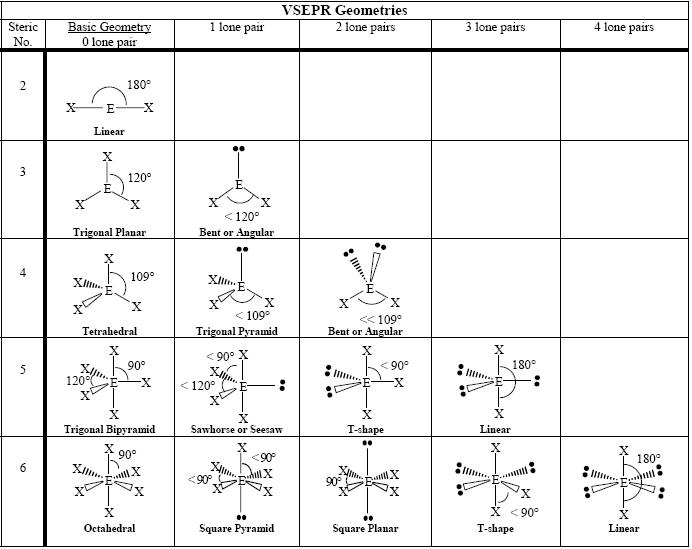
VSEPR shapes by steric number and lone pairs, with bond angles. Public Domain, via Wikimedia Commons.
Hybridization (Valence Bond Theory)
Valence bond theory explains bonding as the overlap of atomic orbitals, often after they mix ("hybridise") into new orbitals of equal energy and shape, to better explain observed molecular geometry.
- sp: Linear, 180°; e.g., BeCl₂, C₂H₂ (each carbon)
- sp²: Trigonal planar, 120°; e.g., BF₃, C₂H₄ (each carbon)
- sp³: Tetrahedral, 109.5°; e.g., CH₄, NH₃ (107°, compressed by lone pair), H₂O (104.5°, compressed by two lone pairs)
- sp³d: Trigonal bipyramidal, 90°/120°; e.g., PCl₅
- sp³d²: Octahedral, 90°; e.g., SF₆
Sigma and Pi Bonds
A single bond is always one sigma (σ) bond — formed by direct, head-on overlap of orbitals along the line joining the two nuclei, giving maximum overlap and bond strength. A double bond = 1σ + 1π; a triple bond = 1σ + 2π. Pi (π) bonds form by sideways (lateral) overlap of parallel unhybridised p-orbitals, above and below the sigma bond axis — this overlap is less effective than head-on overlap, so π bonds are weaker than σ bonds and break more easily (this is why double/triple bonds are reactive sites in organic chemistry).
Molecular Orbital Theory (MOT)
Unlike VB theory (which keeps atomic orbitals localised between two atoms), MOT combines atomic orbitals over the whole molecule to form new molecular orbitals — bonding MOs (lower energy, constructive overlap) and antibonding MOs (higher energy, destructive overlap, marked with *).
Bond order = (electrons in bonding MOs − electrons in antibonding MOs) / 2. Higher bond order means a shorter, stronger bond.
MOT successfully explains why O₂ is paramagnetic (has 2 unpaired electrons in degenerate π* orbitals) — something VB theory cannot explain since it shows all electrons paired in O₂'s simple Lewis structure.
Bond Parameters & Polarity
- Bond length: decreases as bond order increases (triple < double < single)
- Bond angle: determined by hybridisation and lone pair count; lone pairs occupy more space and compress bond angles below the ideal hybridisation value
- Dipole moment (μ = q × d): a measure of bond/molecular polarity. A molecule can have polar bonds yet zero net dipole moment if the bond dipoles cancel by symmetry — e.g. CO₂ (linear) and CCl₄ (tetrahedral) are non-polar overall despite having polar bonds
- Fajan's Rules: predict when an "ionic" compound actually has significant covalent character — covalent character increases when the cation is small and highly charged (high polarising power) and the anion is large and easily distorted (high polarisability). This is why AlCl₃ behaves more like a covalent compound than a typical ionic salt.
Intermolecular Forces
- Hydrogen bonding: A relatively strong dipole-dipole-like attraction between H (bonded to F, O, or N) and a lone pair on a nearby F, O, or N atom; explains water's unusually high boiling point, ice floating on water, and DNA's double helix structure
- Dipole-dipole forces: Attraction between the positive end of one polar molecule and the negative end of another
- London dispersion forces: Present in ALL molecules (polar or non-polar), arising from instantaneous, temporary dipoles; strength increases with molecular size/surface area (more electrons = more polarisable)
Quick Tips
- Lone pairs repel more than bond pairs, reducing bond angle below the ideal hybridisation value
- Higher bond order = shorter bond length and stronger (higher dissociation energy) bond
- CO₂ is linear and non-polar even though individual C=O bonds are polar (the two dipoles point in opposite directions and cancel)
- F-F bond is surprisingly weaker than Cl-Cl, due to strong lone-pair repulsion between the very close-together F atoms
Lattice Enthalpy & the Born-Haber Cycle
Lattice enthalpy is the energy released when one mole of an ionic solid forms from its gaseous ions (or, equivalently, the energy needed to completely separate the solid into gaseous ions). A high (more negative) lattice enthalpy means a more stable, higher-melting ionic solid.
- Lattice enthalpy increases with higher ionic charge and smaller ionic size (stronger electrostatic attraction). This is why MgO (2+/2−) has a much higher lattice enthalpy and melting point than NaCl (1+/1−).
- The Born-Haber cycle is an application of Hess's law used to calculate lattice enthalpy indirectly (it cannot be measured directly). It combines: sublimation enthalpy of the metal + ionization enthalpy + bond dissociation (½ for diatomics) + electron gain enthalpy of the non-metal + lattice enthalpy = enthalpy of formation of the ionic solid.
- Rearranging the cycle lets you solve for whichever single term is unknown (usually the lattice enthalpy).
Bond Parameters in Detail
- Bond length: The equilibrium distance between the nuclei of two bonded atoms. It decreases as bond order increases: C–C (154 pm) > C=C (134 pm) > C≡C (120 pm).
- Bond enthalpy (bond energy): The energy required to break one mole of a bond in the gaseous state. It increases with bond order (a triple bond is stronger than a double, which is stronger than a single).
- Bond angle: The angle between two adjacent bonds at the central atom, fixed by hybridisation and lone-pair count.
- Bond order: The number of bonds between two atoms (1 for single, 2 for double, 3 for triple); higher bond order means shorter and stronger bonds.
- Resonance and bond length: In a resonance hybrid, all equivalent bonds have the same intermediate length (e.g. all three C–O bonds in CO₃²⁻ are identical, between single and double bond length).
Types of Hydrogen Bonding
- Intermolecular hydrogen bonding: Occurs between two separate molecules — e.g. in water, HF, ammonia, and between alcohol molecules. It raises boiling point, melting point, and viscosity because extra energy is needed to break these bonds.
- Intramolecular hydrogen bonding: Occurs within a single molecule, forming a ring — e.g. in o-nitrophenol. Because the H is tied up inside the molecule, it is unavailable for intermolecular bonding, which actually lowers boiling point relative to isomers that hydrogen-bond intermolecularly (e.g. o-nitrophenol boils lower than p-nitrophenol).
- Hydrogen bonds are much weaker than covalent bonds (about 5–40 kJ/mol vs. hundreds of kJ/mol) but stronger than ordinary dipole-dipole and London forces.
Dipole Moment & Percentage Ionic Character
- Dipole moment (μ = q × d) is a vector, measured in Debye (D); it points from the positive to the negative pole and its net value is the vector sum of all individual bond dipoles.
- Symmetrical molecules (CO₂, BF₃, CCl₄, CH₄) have zero net dipole moment because bond dipoles cancel; bent or pyramidal molecules (H₂O, NH₃) have a non-zero net dipole.
- Comparing NH₃ (μ = 1.47 D) and NF₃ (μ = 0.24 D): although N–F bonds are more polar than N–H, in NF₃ the bond dipoles oppose the lone-pair dipole, giving a small net value — a classic exam point.
- Percentage ionic character = (observed dipole moment / dipole moment for 100% ionic bond) × 100. No bond is 100% ionic or 100% covalent; every real bond has partial character of both.
Kössel-Lewis Approach & Limitations of the Octet Rule
The Kössel-Lewis approach explains bonding as atoms attaining the stable noble-gas configuration by losing, gaining, or sharing electrons (the octet rule — eight electrons in the valence shell). It is a useful guide but fails for three important classes of species:
- Incomplete octet (electron-deficient): the central atom has fewer than 8 electrons — e.g. LiCl, BeH₂ (4 e⁻ on Be), BF₃ (6 e⁻ on B). Such molecules act as Lewis acids.
- Expanded octet: from period 3 onward, available d-orbitals let the central atom hold more than 8 electrons — e.g. PF₅ (10), SF₆ (12), H₂SO₄, and [PF₆]⁻.
- Odd-electron molecules: species with an odd total number of valence electrons cannot satisfy the octet — e.g. NO (11 valence e⁻) and NO₂; these are paramagnetic.
- Further, the octet rule says nothing about molecular shape or the relative stability/energy of a molecule, and it cannot account for noble-gas compounds.
Factors Favouring Ionic Bond Formation
- Low ionization enthalpy of the metal: the cation forms easily (favours Group 1 and 2 metals).
- High negative electron gain enthalpy of the non-metal: energy is released when the anion forms (favours Group 16 and 17 non-metals).
- High lattice enthalpy: the single most important factor — the large energy released when gaseous ions pack into the crystal lattice drives the overall process and stabilises the solid. Lattice enthalpy is greatest for small, highly charged ions.
- Ionic bonding is favoured overall only when the energy released (electron gain enthalpy + lattice enthalpy) outweighs the energy absorbed (sublimation + ionization + bond dissociation) — the balance quantified by the Born-Haber cycle.
Valence Bond Theory & Types of Orbital Overlap
Valence bond theory (Heitler, London, Pauling, Slater) pictures a covalent bond as the overlap of two half-filled atomic orbitals with electrons of opposite spin. As two atoms approach, attractive forces (each nucleus for the other's electron) grow faster than the repulsions until, at the equilibrium bond length, the potential energy is a minimum and the molecule is most stable; the energy released is the bond enthalpy.
- Sigma (σ) bond: end-on (axial) overlap — s–s, s–p, or p–p along the internuclear axis; gives maximum overlap, so it is strong.
- Pi (π) bond: sideways (lateral) overlap of parallel p-orbitals above and below the axis; weaker, and always forms in addition to a σ bond.
- The greater the extent of overlap, the stronger the bond; orbitals must overlap with matching symmetry (constructive, same phase) for a bond to form.
🚀 JEE Advanced Edge
MO diagrams for diatomics: For N₂: (σ1s)²(σ*1s)²(σ2s)²(σ*2s)²(π2p)⁴(σ2p)² → bond order = (10−4)/2 = 3 (triple bond, matches Lewis structure). For O₂: (σ1s)²(σ*1s)²(σ2s)²(σ*2s)²(σ2p)²(π2p)⁴(π*2p)² → bond order = (10−6)/2 = 2, with 2 unpaired electrons in π* (paramagnetic) — this mismatch between simple Lewis structures and real magnetic behaviour is a classic JEE Advanced conceptual question.
Back-bonding: In BF₃, each fluorine's filled p-orbital lone pair donates into boron's empty 2p orbital (p-π back bonding), partially satisfying boron's electron deficiency and making BF₃ a weaker Lewis acid than expected from electronegativity alone.
Bent's rule application: In molecules like CH₃F, carbon directs more p-character into the bond toward the more electronegative F atom, and more s-character into the C-H bonds — this subtly affects bond angles away from the idealised 109.5°.
Worked problem: Predict the shape and hybridisation of XeF₄. Xe has 8 valence electrons; 4 are used in Xe-F bonds, leaving 2 lone pairs. Total electron pairs = 6 → sp³d² hybridisation, octahedral electron geometry, but with the 2 lone pairs positioned opposite each other (to minimise repulsion), the molecular shape is square planar.