🎯 Key Points
- d-block: (n−1)d¹⁻¹⁰ ns⁰⁻² — close energy of (n−1)d and ns causes variable oxidation states
- Colour comes from d-d electron transitions; d⁰ and d¹⁰ ions are colourless (no transition possible)
- Lanthanide contraction: steady radius decrease across lanthanides (poor 4f shielding) → makes Zr/Hf, Nb/Ta nearly identical and hard to separate
- Magnetic moment μ = √(n(n+2)) Bohr magnetons, where n = number of unpaired electrons
- Key catalysts: Fe (Haber), V₂O₅ (Contact process), Ni/Pt (hydrogenation)
Aqueous solutions of transition metal ions show characteristic colours caused by electrons absorbing visible light to jump between split d-orbitals; the exact colour depends on the metal, its oxidation state, and surrounding ligands.
Transition Metals (d-Block)
Elements of Groups 3-12 with partially filled d orbitals. Include Fe, Cu, Zn, Cr, Mn, Ni, Co, Ti, V, and others.
General Properties
- Hard, dense metals with high melting and boiling points
- Good conductors of heat and electricity
- Variable oxidation states (due to similar energies of 3d and 4s)
- Form coloured ions and complex compounds
- Many act as catalysts in industrial processes
Variable Oxidation States
- Fe: +2 (FeSO₄, green), +3 (Fe₂O₃, rust)
- Cr: +3 (Cr₂O₃, green), +6 (K₂Cr₂O₇, orange)
- Mn: +2 (pale pink), +4 (MnO₂, black), +7 (KMnO₄, purple)
- Cu: +1 (Cu₂O), +2 (CuSO₄, blue)
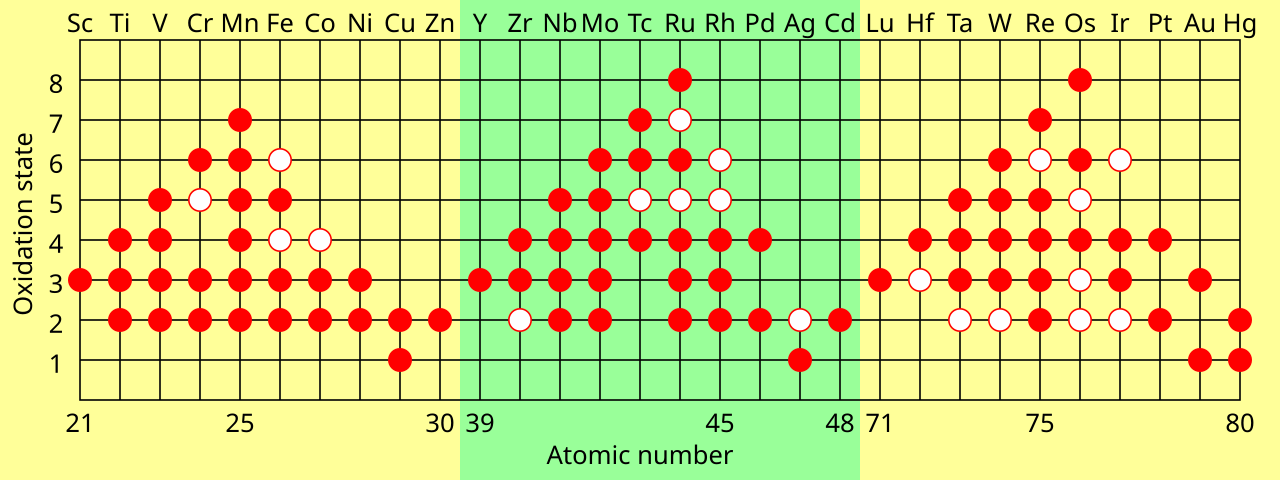
Transition metals show variable oxidation states because their (n−1)d and ns electrons are close in energy and can all take part in bonding. The number of states rises to a maximum near the middle of each series (e.g. Mn reaches +7) and falls towards the ends. Image: Felix Wan / Andel, CC0, via Wikimedia Commons.
Coloured Compounds
Colour arises because d-electrons absorb visible light and jump to higher d-orbitals. The complementary colour is what we observe.
- CuSO₄.5H₂O: Blue; K₂Cr₂O₇: Orange; KMnO₄: Purple
- Zn, Sc, and Ti⁴⁺ are colourless (empty or fully filled d-orbitals)
Important Catalysts
- Fe: Haber process (NH₃ synthesis)
- V₂O₅: Contact process (H₂SO₄ manufacturing)
- Ni or Pt: Hydrogenation of oils
f-Block Elements
- Lanthanides (Ce to Lu): 4f filling; used in permanent magnets and lasers
- Actinides (Th to Lr): 5f filling; mostly radioactive; include U and Pu (nuclear fuel)
- Lanthanide contraction: steady decrease in size across lanthanides; affects properties of 5th and 6th period transition metals
General Electronic Configuration
- d-block: (n-1)d¹⁻¹⁰ ns⁰⁻² ; the (n-1)d and ns orbitals are close in energy, which is the root cause of variable oxidation states
- Cr has configuration 3d⁵4s¹ and Cu has 3d¹⁰4s¹ (not the expected 3d⁴4s² and 3d⁹4s²) because half-filled and fully-filled d-subshells offer extra stability
- f-block: (n-2)f¹⁻¹⁴ (n-1)d⁰⁻¹ ns² ; lanthanides fill 4f, actinides fill 5f
Why Transition Metal Ions are Coloured
- In a free ion the five d-orbitals are degenerate (equal energy), but ligands split them into two sets (d-d splitting, explained by Crystal Field Theory)
- An electron absorbs a specific wavelength of visible light to jump from a lower to a higher d-orbital (d-d transition); the colour seen is complementary to the colour absorbed
- Ions with completely empty (d⁰, e.g., Sc³⁺, Ti⁴⁺) or completely filled (d¹⁰, e.g., Zn²⁺, Cu⁺) d-orbitals are colourless since no d-d transition is possible
Lanthanide Contraction
Steady decrease in atomic and ionic radii of lanthanides from La to Lu, caused by the poor shielding effect of 4f electrons (imperfect shielding allows effective nuclear charge to increase steadily).
- Consequence: radii of second and third-row transition elements in the same group become very close (e.g., Zr and Hf have nearly identical radii), making their chemical separation difficult
- This is why elements like Zr/Hf and Nb/Ta show very similar chemical properties
Magnetic Properties and Interstitial Compounds
- Transition metal ions with unpaired d-electrons are paramagnetic; the magnetic moment increases with the number of unpaired electrons (mu = root of n(n+2) Bohr magnetons)
- Transition metals form interstitial compounds with small atoms like H, C, N trapped in lattice gaps; these are hard, retain metallic conductivity, and have higher melting points than the pure metal
- Alloy formation is common among transition metals because of similar atomic sizes, allowing one metal atom to be readily replaced by another in the lattice
Periodic Trends in the Transition Series
- Atomic radii: Decrease across a series at first, then stay almost constant (added d-electrons shield poorly but electron–electron repulsion offsets the rising nuclear charge)
- Ionisation enthalpy: Rises gradually across a series, but irregularly, owing to the stability of half-filled/filled d-subshells
- Enthalpy of atomisation and melting point: High, and maximum near the middle of the series (Cr, Mo, W) where the number of unpaired d-electrons available for metallic bonding peaks; Zn, Cd, Hg have low values (no unpaired d-electrons)
- Density: Increases across a series as radius falls and atomic mass rises
Potassium Dichromate (K₂Cr₂O₇)
- Preparation: Chromite ore (FeCr₂O₄) fused with Na₂CO₃ in air → Na₂CrO₄; acidified to Na₂Cr₂O₇, then treated with KCl to crystallise K₂Cr₂O₇ (orange crystals)
- Cr₂O₇²⁻ ⇌ 2CrO₄²⁻ equilibrium: Orange dichromate in acid converts to yellow chromate in base and back (pH-dependent)
- Oxidising action (in acidic medium, Cr⁶⁺ → Cr³⁺, gain of 6 e⁻): oxidises Fe²⁺ → Fe³⁺, I⁻ → I₂, H₂S → S, SO₃²⁻ → SO₄²⁻
- Half-reaction: Cr₂O₇²⁻ + 14H⁺ + 6e⁻ → 2Cr³⁺ + 7H₂O (E° = +1.33 V); used in volumetric analysis as a primary standard
Potassium Permanganate (KMnO₄)
- Preparation: Pyrolusite (MnO₂) fused with KOH and an oxidiser (KNO₃/air) → green K₂MnO₄, which is then oxidised (electrolytically or by Cl₂) to purple KMnO₄
- Oxidising action depends on medium:
- Acidic: MnO₄⁻ + 8H⁺ + 5e⁻ → Mn²⁺ + 4H₂O (E° = +1.51 V); strongest, used in titrations (self-indicating)
- Neutral/faintly alkaline: MnO₄⁻ + 2H₂O + 3e⁻ → MnO₂ + 4OH⁻
- Strongly alkaline: MnO₄⁻ + e⁻ → MnO₄²⁻
- In acidic medium it oxidises Fe²⁺ → Fe³⁺, oxalate (C₂O₄²⁻) → CO₂, I⁻ → I₂, and decolourises on reduction — the basis of permanganometry
Lanthanoids vs Actinoids
| Feature | Lanthanoids (4f) | Actinoids (5f) |
|---|---|---|
| Common oxidation state | +3 (dominant) | +3, but many others (+4 to +7) common |
| Radioactivity | Only Pm | All are radioactive |
| Shielding by f-electrons | Better (4f) | Poorer (5f), so actinoid contraction is larger |
| Complex formation | Limited | Greater (higher charge, larger size) |
Standard Electrode Potentials and Reactivity
- Most first-series transition metals have negative E°(M²⁺/M), so they can displace H₂ from dilute acids, but the values are irregular due to differing ionisation and hydration/atomisation enthalpies
- Cu has a POSITIVE E°(Cu²⁺/Cu) = +0.34 V (high atomisation + ionisation enthalpy not offset by hydration), so it does NOT liberate H₂ from dilute acids
- E°(Mn²⁺/Mn) is unusually negative and E°(Zn²⁺/Zn) too, linked to the extra stability of the half-filled d⁵ (Mn²⁺) and filled d¹⁰ (Zn²⁺) configurations of the ions formed
Catalytic Behaviour of Transition Metals
- Transition metals and their compounds are excellent catalysts largely because they show variable oxidation states and can form intermediate complexes with reactants, providing a low-activation-energy pathway
- Their partially filled d-orbitals let them adsorb reactant molecules onto the metal surface (heterogeneous catalysis), weakening bonds and bringing reactants close together
- Key examples: Fe in the Haber process (NH3), V2O5 in the Contact process (H2SO4), finely divided Ni in hydrogenation of oils, and MnO2 in the decomposition of KClO3
- The catalytic action of Fe2+/Fe3+ in the reaction between iodide and persulphate ions illustrates catalysis by oxidation-state cycling in solution
Complex Formation and Alloy Formation
- Complex formation: Transition metal ions readily form coordination complexes because they have small size, high effective nuclear charge (high charge/size ratio) and available vacant d-orbitals to accept lone pairs from ligands, e.g. [Fe(CN)6]4-, [Cu(NH3)4]2+
- Alloy formation: Because transition metals have very similar atomic radii, atoms of one metal can replace atoms of another in the crystal lattice, giving substitutional alloys such as brass (Cu-Zn), bronze (Cu-Sn) and steels
- Alloys are generally harder, have higher melting points and are more resistant to corrosion than the constituent pure metals
Actinoids and Actinoid Contraction
- Actinoids (Th to Lr) involve filling of the 5f orbitals; all are radioactive and elements beyond uranium (transuranics) are man-made
- They show a wider range of oxidation states than lanthanoids (e.g. U shows +3, +4, +5, +6) because the 5f, 6d and 7s orbitals lie close in energy
- Actinoid contraction: a steady decrease in atomic and ionic radii across the series; it is greater than lanthanoid contraction because 5f electrons shield the nuclear charge even more poorly than 4f electrons
- Actinoids have a greater tendency to form complexes than lanthanoids, owing to their higher charges and larger sizes
🚀 JEE Advanced Edge
Why Mn shows the most oxidation states: Mn (3d⁵4s²) is roughly in the middle of the first transition series, giving it the maximum number of accessible oxidation states from +2 to +7 — every electron from 3d and 4s can potentially be involved in bonding, unlike elements at either extreme of the series.
Why Zn, Cd, Hg are NOT considered true transition metals: Despite being in the d-block, they have a completely filled d¹⁰ configuration in both the metal AND their common ions (Zn²⁺, Cd²⁺, Hg²⁺) — no partially-filled d-orbital ever exists, so they show none of the hallmark transition behaviours (no colour, no variable oxidation states, weak catalytic activity).
Calculating magnetic moment from oxidation state: For Fe³⁺ ([Ar]3d⁵), all 5 d-electrons are unpaired (high-spin, since d⁵ is exactly half-filled) → n=5 → μ = √(5×7) = √35 ≈ 5.92 BM, a frequently tested numerical.