🎯 Key Points
- Rate Law: Rate = k[A]^m[B]^n — m, n found experimentally, NOT from balanced equation coefficients
- Order can be zero/fractional/whole; Molecularity is always a whole number (≥1) and only applies to elementary steps
- First-order half-life t½ = 0.693/k is CONSTANT, independent of starting concentration — a key identifying feature
- Arrhenius equation: k = Ae^(−Ea/RT); higher T or lower Ea means faster reaction
- Pseudo-first-order: a higher-order reaction that behaves as first-order because one reactant is in large excess
- For multi-step reactions, the overall rate = rate of the slowest (rate-determining) step
First-order decay curve: concentration halves every t½, and that half-life is constant — a defining test for first-order kinetics.
Rate of Reaction
Rate measures how fast reactants are consumed or products are formed per unit time.
Rate = -Δ[reactant]/Δt = +Δ[product]/Δt
Factors Affecting Rate
- Concentration: More concentration = more collisions = faster rate
- Temperature: Higher temperature gives more energy to molecules
- Catalyst: Provides an alternative lower-energy pathway
- Surface area: More surface = more reaction sites
Rate Law
Rate = k[A]^m[B]^n
- k = rate constant; m and n are determined experimentally (not from stoichiometry)
- Overall order = m + n
Half-Life
- First-order: t½ = 0.693/k (constant; does not depend on concentration)
- Zero-order: t½ = [A]₀/2k
Arrhenius Equation
k = A × e^(-Ea/RT)
- Ea = activation energy (minimum energy needed for reaction)
- log(k₂/k₁) = (Ea/2.303R) × (1/T₁ - 1/T₂)
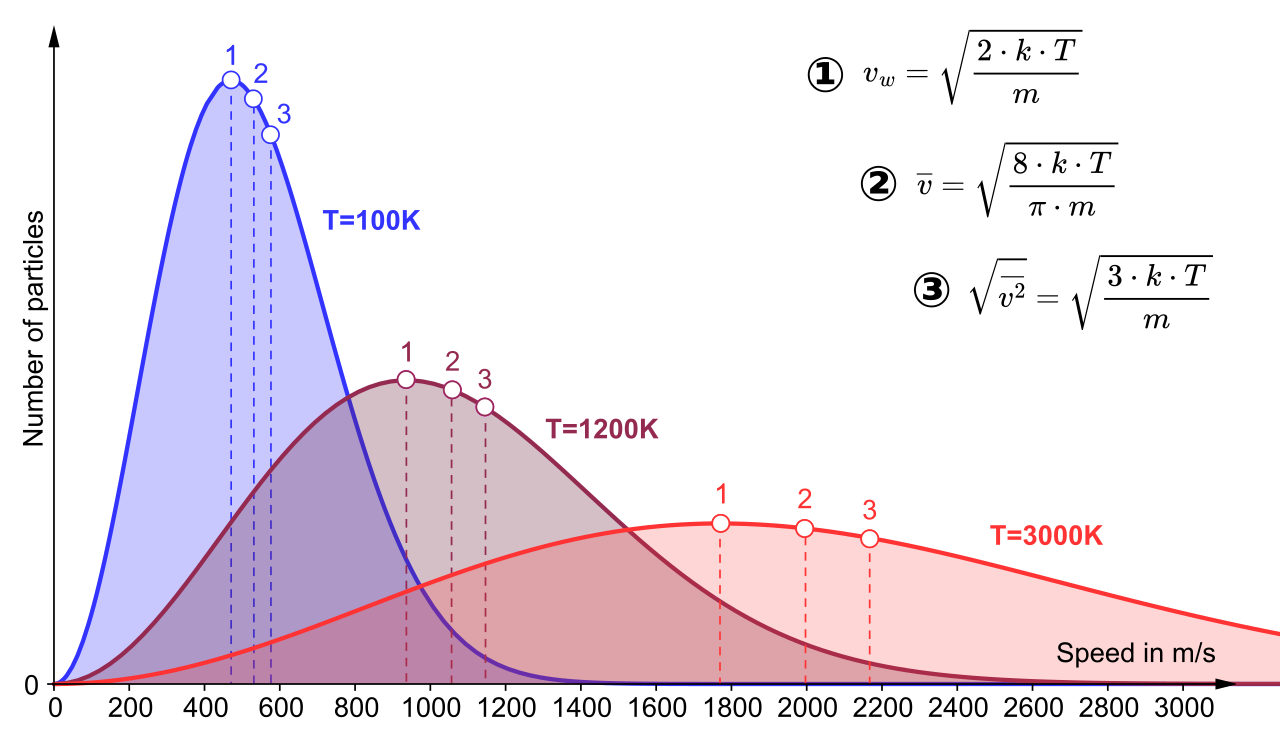
The Maxwell–Boltzmann distribution of molecular speeds at three temperatures. Raising the temperature broadens and flattens the curve and shifts it to higher speeds, so a much larger fraction of molecules has energy exceeding the activation energy — the reason reaction rate rises steeply with temperature. Image: MikeRun, CC BY-SA 4.0, via Wikimedia Commons.
Quick Tips
- A catalyst lowers activation energy without being consumed
- Every 10°C rise roughly doubles the reaction rate
- Half-life of first-order reactions is independent of initial concentration
Order vs Molecularity
- Order of reaction: Sum of powers of concentration terms in the experimental rate law; can be zero, fractional, or a whole number
- Molecularity: Number of reacting species colliding simultaneously in an elementary step; always a whole number, never zero or fractional
- For elementary reactions, order = molecularity; for complex multi-step reactions, order is decided by the slowest (rate-determining) step
Integrated Rate Equations
- Zero order: [A] = [A]₀ - kt; a plot of [A] vs t is a straight line with negative slope k
- First order: k = (2.303/t) log([A]₀/[A]t); a plot of log[A] vs t gives a straight line
- Units of k: zero order = mol L⁻¹ s⁻¹; first order = s⁻¹ (independent of concentration units)
Pseudo-First-Order Reactions
A reaction that is actually higher order but behaves as first order because one reactant is present in large excess, so its concentration stays effectively constant.
- Classic example: acidic hydrolysis of ethyl acetate (water is in large excess): CH₃COOC₂H₅ + H₂O → CH₃COOH + C₂H₅OH
- Inversion of cane sugar in dilute acid is another textbook example
Methods to Determine Order of Reaction
- Initial rate method: Measure rate at different initial concentrations, keeping others constant
- Integrated rate law method: Test which integrated equation gives a constant k for the data
- Half-life method: t½ independent of concentration indicates first order; t½ ∝ 1/[A]₀ⁿ⁻¹ for other orders
- Van't Hoff differential method: Uses log(rate) vs log(concentration) plots; slope gives the order
Collision Theory
- Reaction occurs only when molecules collide with sufficient energy (activation energy) and proper orientation
- Rate = pZAB e^(-Ea/RT), where Z is collision frequency and p is the steric (probability) factor
- Threshold energy = activation energy + average kinetic energy of reactants
Average vs Instantaneous Rate
- Average rate = change in concentration over a measurable time interval (Δ[X]/Δt); it is only an approximation because the rate changes continuously
- Instantaneous rate = rate at a particular instant, found as the slope of the tangent to the concentration–time curve (the limit of the average rate as Δt → 0)
- For a reaction aA + bB → cC + dD, the unique rate = −(1/a)d[A]/dt = −(1/b)d[B]/dt = +(1/c)d[C]/dt = +(1/d)d[D]/dt
Reaction Mechanism and Rate-Determining Step
- Most reactions occur through a sequence of elementary steps (the mechanism); the sum of these steps gives the overall balanced equation
- The rate-determining step is the slowest step; the overall rate law is governed by it and by any steps before it
- This is why the experimental order need not match the stoichiometric coefficients — those come from the overall equation, not the slow step
- Reaction intermediates are produced and consumed within the mechanism and do not appear in the overall equation
Effect of Temperature: Temperature Coefficient
- The temperature coefficient is the ratio of rate constants over a 10°C rise: k(T+10)/k(T), usually between 2 and 3 (rate roughly doubles or triples per 10°C)
- Raising temperature increases the fraction of molecules with energy ≥ Ea (the tail of the Maxwell–Boltzmann distribution), so many more effective collisions occur
- The Arrhenius plot of ln k vs 1/T is a straight line of slope −Ea/R, giving a graphical route to the activation energy
Activation Energy and the Role of a Catalyst
A catalyst provides an alternative pathway with a lower activation energy, so more collisions succeed and the rate rises. It lowers Ea for BOTH forward and backward reactions equally, so it does not shift the position of equilibrium — only speeds up its attainment.
- A catalyst is not consumed and does not change ΔH or the equilibrium constant; it only lowers Ea
- Because Ea drops for forward and reverse reactions alike, both are accelerated equally
Units of the Rate Constant
| Order | Rate law | Units of k |
|---|---|---|
| Zero | Rate = k | mol L⁻¹ s⁻¹ |
| First | Rate = k[A] | s⁻¹ |
| Second | Rate = k[A]² | L mol⁻¹ s⁻¹ |
General rule: units of k = (mol L⁻¹)^(1−order) s⁻¹, so the units themselves reveal the overall order.
🚀 JEE Advanced Edge
Steric factor and orientation: The steric factor p in collision theory accounts for the fact that molecules must collide with the CORRECT orientation, not just sufficient energy — this is why collision theory alone often overestimates rates for complex molecules, and why p < 1 for most real reactions (only a fraction of correctly-energised collisions are also correctly oriented).
Parallel and consecutive reactions: When a reactant can form two different products via two competing pathways (parallel/side reactions), the ratio of products formed equals the ratio of their individual rate constants, NOT the ratio of activation energies directly — useful for selectivity problems in synthesis.
Graphical determination tricks: A straight line on a log[A] vs t plot confirms first order; a straight line on [A] vs t confirms zero order; a straight line on 1/[A] vs t confirms second order. Recognising which linearized plot is given in a JEE graph question is the fastest way to identify the order without doing any calculation.
Worked problem: A first-order reaction is 50% complete in 20 minutes. How long will it take to be 87.5% complete? Approach: 87.5% complete means 12.5% remaining = (1/2)³ of the original, i.e., exactly 3 half-lives have passed. Since each half-life = 20 min, total time = 3 × 20 = 60 minutes.