🎯 Key Points
- First Law: ΔU = q + w (energy is conserved); Second Law: entropy of the universe increases in any spontaneous process
- ΔH = ΔU + Δ(PV); at constant pressure, qp = ΔH
- ΔG = ΔH − TΔS; ΔG < 0 spontaneous, ΔG > 0 non-spontaneous, ΔG = 0 at equilibrium
- Hess's Law: total ΔH is path-independent — add/subtract known reactions to get the target reaction's ΔH
- ΔG° = −RT ln K — links thermodynamics directly to the equilibrium constant
- Isothermal: ΔU=0; Adiabatic: q=0; Isochoric: w=0; Isobaric: q=ΔH
Isothermal expansion follows a gentler curve (heat flows in to keep T constant) while adiabatic expansion drops in pressure more steeply (no heat exchange, so internal energy and temperature fall as the gas does work).
Laws of Thermodynamics
- First Law: Energy cannot be created or destroyed. ΔU = q + w
- Second Law: Entropy of the universe always increases in a spontaneous process
- Third Law: Entropy of a perfect crystal at 0 K is zero
Key Quantities
- Enthalpy (H): Heat content at constant pressure; ΔH = heat absorbed or released
- Entropy (S): Measure of disorder; ΔS is positive when disorder increases
- Gibbs Free Energy: ΔG = ΔH - TΔS
Spontaneity Rules
- ΔG < 0: Spontaneous
- ΔG > 0: Non-spontaneous
- ΔG = 0: At equilibrium
Types of Processes
- Exothermic: ΔH < 0 (releases heat), e.g., combustion, neutralisation
- Endothermic: ΔH > 0 (absorbs heat), e.g., photosynthesis, melting ice
Hess's Law
The total enthalpy change is independent of the path taken. This lets you calculate ΔH for reactions that cannot be measured directly by combining known reactions.
Quick Tips
- Negative ΔG = spontaneous reaction
- At equilibrium, ΔG = 0 and ΔG° = -RT ln K
- High temperature favours reactions with positive ΔS
First Law Applications
- Isothermal process (ΔT = 0): ΔU = 0, so q = -w; work done w = -nRT ln(V₂/V₁)
- Adiabatic process (q = 0): No heat exchange with surroundings, so ΔU = w; temperature changes as the system does work
- Isochoric process (ΔV = 0): No work done (w = 0), so ΔU = q = nCvΔT
- Isobaric process (constant P): q = ΔH = nCpΔT; w = -PΔV
Hess's Law: Worked Example
To find ΔH for C(graphite) + O₂ → CO₂, given: C + ½O₂ → CO (ΔH₁ = -110 kJ) and CO + ½O₂ → CO₂ (ΔH₂ = -283 kJ).
- Since the target equation is the sum of the two steps, ΔH = ΔH₁ + ΔH₂ = -110 + (-283) = -393 kJ/mol
- This matches the directly measured standard enthalpy of formation of CO₂, confirming the path-independence of enthalpy
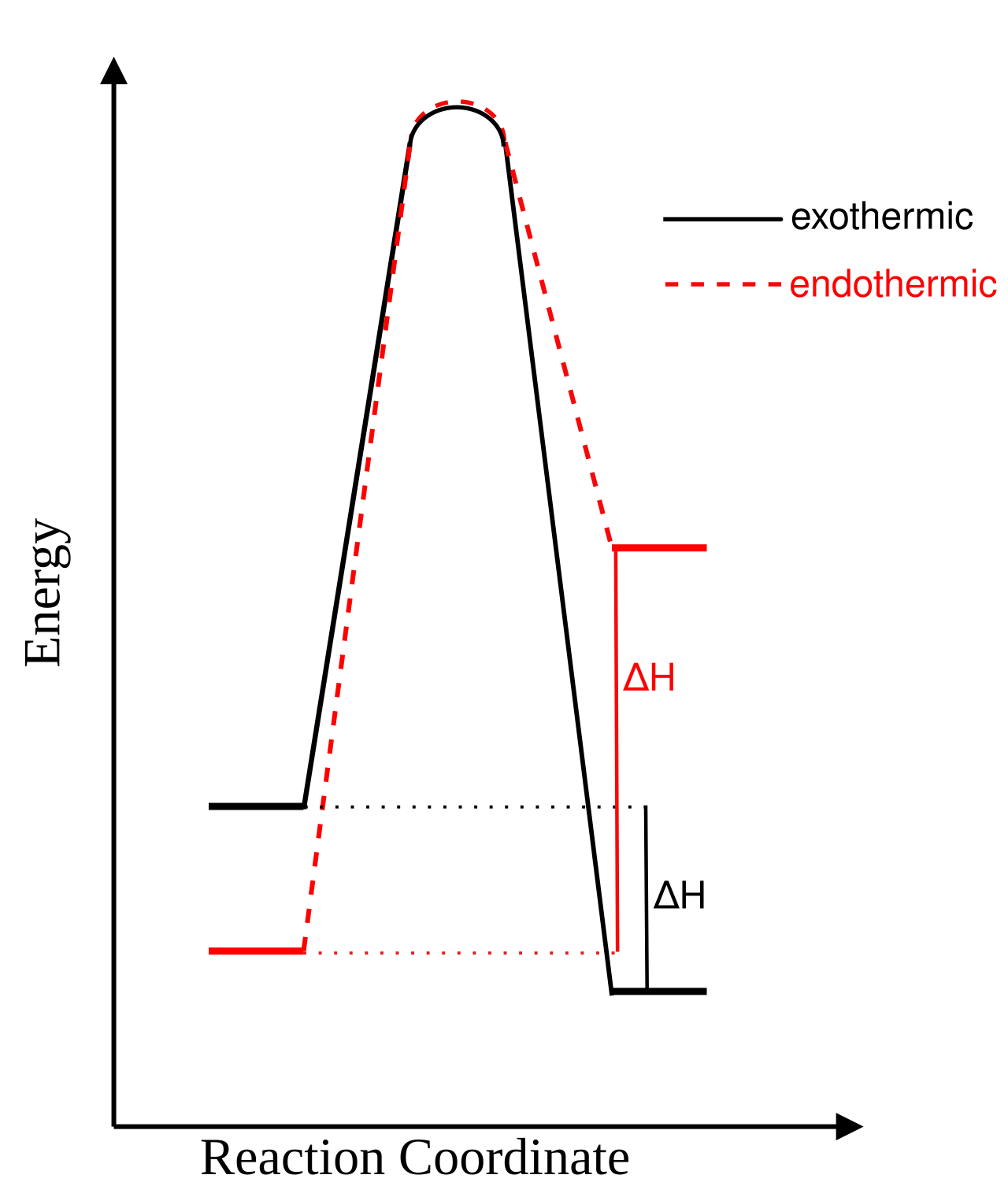
Reaction energy profiles: in an exothermic reaction the products sit below the reactants so ΔH is negative (heat released); in an endothermic reaction the products are higher so ΔH is positive (heat absorbed). Both must first climb the activation-energy barrier. Image: Unknown author, CC BY 4.0, via Wikimedia Commons.
Enthalpy Types
- Enthalpy of formation: heat change when 1 mole of compound forms from elements in their standard states
- Enthalpy of combustion: heat released when 1 mole of substance burns completely in oxygen
- Enthalpy of neutralisation: heat released when 1 mole of H⁺ reacts with 1 mole of OH⁻ (about -57.3 kJ/mol for strong acid-strong base)
- Bond enthalpy: energy needed to break one mole of a particular bond in the gaseous state
Gibbs Free Energy and Spontaneity Cases
- ΔH < 0, ΔS > 0: ΔG always negative, spontaneous at all temperatures
- ΔH > 0, ΔS < 0: ΔG always positive, never spontaneous
- ΔH < 0, ΔS < 0: spontaneous only at low temperature (TΔS term small)
- ΔH > 0, ΔS > 0: spontaneous only at high temperature (entropy term dominates)
System, Surroundings and Types of Systems
The system is the part of the universe under study; the surroundings is everything else. They are separated by a real or imaginary boundary. Systems are classified by what can cross this boundary:
- Open system: exchanges both matter and energy with surroundings (e.g., hot water in an open beaker).
- Closed system: exchanges only energy, not matter (e.g., water in a sealed but conducting flask).
- Isolated system: exchanges neither matter nor energy (e.g., a perfectly insulated thermos).
Intensive properties (temperature, pressure, density, molar volume) do not depend on the amount of substance; extensive properties (mass, volume, internal energy, enthalpy, entropy) scale with the amount of matter.
State Functions vs Path Functions
- State functions depend only on the initial and final states, not the route taken: internal energy (U), enthalpy (H), entropy (S), Gibbs energy (G), temperature, pressure, volume.
- Path functions depend on how the change is carried out: heat (q) and work (w). Individually they are path-dependent, yet their sum (ΔU = q + w) is a state function.
Heat Capacity (Cp and Cv)
- Heat capacity (C): heat needed to raise the temperature of a substance by 1 K; q = CΔT.
- Cv (constant volume): all heat goes to raising internal energy, qv = nCvΔT = ΔU.
- Cp (constant pressure): heat also does expansion work, qp = nCpΔT = ΔH.
- For an ideal gas, Cp − Cv = R (Mayer's relation), so Cp > Cv always. The ratio γ = Cp/Cv is 5/3 for monatomic and 7/5 for diatomic ideal gases.
Entropy and the Second Law
- Entropy (S) measures the degree of disorder/randomness; for a reversible change, ΔS = qrev/T (units J K⁻¹ mol⁻¹).
- Entropy increases: solid → liquid → gas, on dissolution, on mixing, and when the number of gaseous moles rises.
- Second Law: for any spontaneous process, ΔStotal = ΔSsystem + ΔSsurroundings > 0. At equilibrium ΔStotal = 0.
- ΔSsurroundings = −ΔHsystem/T, which links the enthalpy of a reaction to the entropy change it causes in the surroundings.
More Enthalpy Types
- Enthalpy of atomisation (ΔHa): enthalpy change to break 1 mole of a substance completely into gaseous atoms.
- Enthalpy of sublimation: enthalpy change when 1 mole of a solid converts directly to gas; equals ΔHfusion + ΔHvaporisation.
- Lattice enthalpy: enthalpy change when 1 mole of an ionic solid separates into gaseous ions; obtained indirectly via the Born-Haber cycle.
- Enthalpy of hydration/solution: heat change when 1 mole of a substance dissolves (or its ions are hydrated) in a large amount of water.
🚀 JEE Advanced Edge
Entropy of an ideal gas process: ΔS = nCv ln(T₂/T₁) + nR ln(V₂/V₁) for a general process — derived by combining the temperature-dependent and volume-dependent entropy contributions; reduces to simpler forms for isothermal (ΔS = nR ln(V₂/V₁)) or isochoric (ΔS = nCv ln(T₂/T₁)) special cases.
Reversible vs irreversible work: For an isothermal expansion between the same initial and final states, reversible work (w = −nRT ln(V₂/V₁), done in infinite small steps) always extracts MORE work from the system than a single-step irreversible expansion against constant external pressure — this is why reversible processes are the theoretical maximum-efficiency limit.
Bond enthalpy calculations: ΔHreaction = Σ(bond enthalpies broken in reactants) − Σ(bond enthalpies formed in products). Remember bond-breaking is always endothermic (+) and bond-forming is always exothermic (−).
Worked problem: For a reaction with ΔH = −40 kJ/mol and ΔS = −100 J/K/mol, find the temperature above which the reaction becomes non-spontaneous. Approach: At the crossover, ΔG = 0, so T = ΔH/ΔS = (−40000 J)/(−100 J/K) = 400 K. Below 400 K the reaction is spontaneous (ΔH dominates); above 400 K it becomes non-spontaneous (the unfavourable −TΔS term wins).