🎯 Key Points
- 1 mole = 6.022 × 10²³ particles (Avogadro's Number, NA)
- Moles (n) = Given Mass / Molar Mass = Number of particles / NA = Volume at STP / 22.4 L
- STP molar volume = 22.4 L/mol (0°C, 1 atm); at NTP/SATP use 24.79 L/mol if specified
- Molarity (M) = moles of solute / volume of solution in litres
- Empirical formula = simplest whole-number ratio; Molecular formula = (Empirical formula)n, n = Molecular mass / Empirical mass
- Limiting reagent is whichever reactant gives the smaller product yield when divided by its stoichiometric coefficient
- % purity = (mass of pure substance / total mass of sample) × 100
What is a Mole?
A mole is the SI unit for amount of substance, symbol mol. One mole of any substance contains exactly 6.022 × 10²³ elementary entities (atoms, molecules, ions, or electrons) — this fixed number is called Avogadro's Number (NA). It was historically defined as the number of carbon-12 atoms in exactly 12 g of pure ¹²C; since the 2019 SI redefinition, NA = 6.02214076 × 10²³ mol⁻¹ is fixed as an exact constant. The mole lets chemists convert between the microscopic world (individual atoms/molecules, too small to count directly) and the macroscopic world (grams, litres — things we can actually measure on a balance or in a flask).
Key Formulas
Mass connects to moles via molar mass, and moles connect to particle count via Avogadro's number or to gas volume via the 22.4 L/mol rule at STP.
- Number of moles = Mass / Molar Mass
- Number of particles = Moles × 6.022 × 10²³
- Molar volume at STP = 22.4 L for any gas
- Moles of gas = (P × V) / (R × T) — from the ideal gas equation, useful when STP doesn't apply
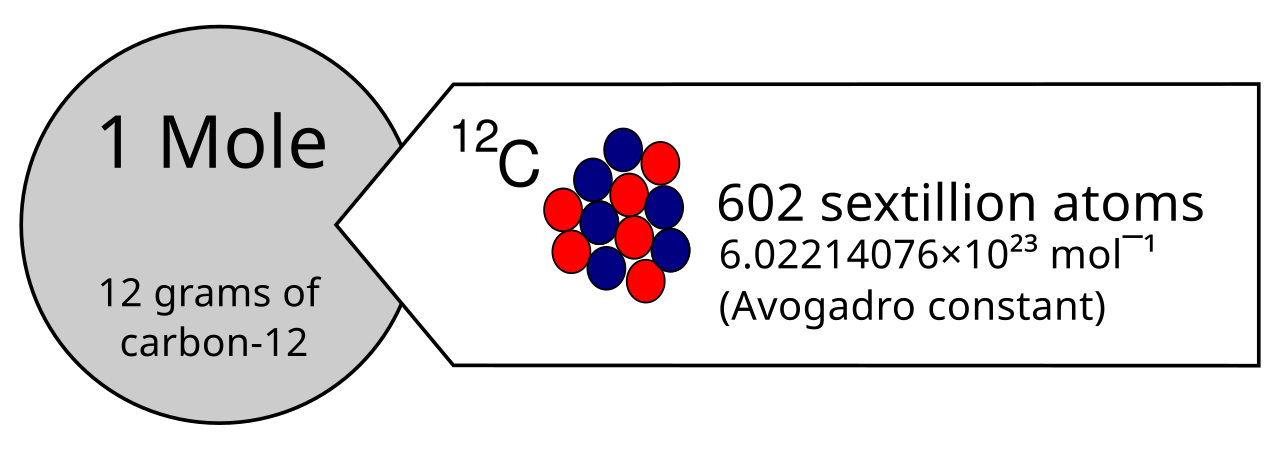
The mole links a countable number to a weighable mass: one mole of any substance contains 6.022 × 10²³ particles (the Avogadro constant), and one mole of carbon-12 weighs exactly 12 g. Image: VectorVoyager, CC BY-SA 4.0, via Wikimedia Commons.
Molar Mass
Molar mass is the mass of one mole of a substance, expressed in g/mol. It is numerically equal to the atomic mass (for elements) or the sum of atomic masses (for compounds), as read off the periodic table.
- H = 1 g/mol, O = 16 g/mol, C = 12 g/mol, N = 14 g/mol, Na = 23 g/mol, Cl = 35.5 g/mol
- H₂O = 2(1) + 16 = 18 g/mol
- NaCl = 23 + 35.5 = 58.5 g/mol
- CO₂ = 12 + 2(16) = 44 g/mol
- CaCO₃ = 40 + 12 + 3(16) = 100 g/mol
- Glucose C₆H₁₂O₆ = 6(12) + 12(1) + 6(16) = 180 g/mol
Percentage Composition
The percentage by mass of an element in a compound tells you how much of the total mass that element contributes.
% of element = (mass of that element in one mole of compound / molar mass of compound) × 100
Example: % of oxygen in CO₂ (molar mass 44): mass of O = 32, so % O = (32/44) × 100 = 72.7%
Empirical and Molecular Formula
The empirical formula shows the simplest whole-number ratio of atoms in a compound. The molecular formula shows the actual number of atoms in one molecule, and is always a whole-number multiple (n) of the empirical formula.
Steps to find empirical formula from % composition: (1) Assume 100 g of compound, so % becomes grams directly. (2) Divide each element's mass by its atomic mass to get moles. (3) Divide all mole values by the smallest one. (4) Round to the nearest whole number (or simplest ratio) — these become the subscripts.
To get the molecular formula: n = Molecular Mass / Empirical Formula Mass, then multiply every subscript in the empirical formula by n.
Example: A compound is 40% C, 6.7% H, 53.3% O by mass, with molar mass 180 g/mol. Moles: C = 40/12 = 3.33, H = 6.7/1 = 6.7, O = 53.3/16 = 3.33. Divide by smallest (3.33): C = 1, H = 2, O = 1 → empirical formula CH₂O (mass 30). n = 180/30 = 6 → molecular formula C₆H₁₂O₆ (glucose).
Stoichiometry & Limiting Reagent
Stoichiometry uses mole ratios from a balanced chemical equation to calculate the amounts of reactants and products. Always balance the equation first, then apply the mole ratio (the coefficients) — never use unbalanced coefficients.
When two or more reactants are given in amounts that don't exactly match the stoichiometric ratio, one of them runs out first — this is the limiting reagent, and it alone determines how much product forms. The other reactant(s), present in more than the required amount, are said to be in excess.
Method: For each reactant, calculate moles of product that could form if that reactant were used completely (moles of reactant ÷ its coefficient × coefficient of product). The reactant giving the smaller amount of product is the limiting reagent — use its value for all further calculations.
Example: N₂ + 3H₂ → 2NH₃. Given 2 mol N₂ and 6 mol H₂. From N₂: 2 mol N₂ → 4 mol NH₃ possible. From H₂: 6 mol H₂ → 4 mol NH₃ possible. Both give the same here (exact ratio), so neither is in excess — but if H₂ were only 3 mol, it would give only 2 mol NH₃ and become the limiting reagent.
Concentration Terms
- Molarity (M) = moles of solute / volume of solution in litres (mol/L). Most common, but temperature-dependent since volume changes slightly with temperature.
- Molality (m) = moles of solute / mass of solvent in kg (mol/kg). Temperature-independent since it uses mass, not volume — preferred for precise work.
- Mole fraction (x) = moles of one component / total moles of all components. Always between 0 and 1; mole fractions of all components in a mixture sum to 1.
- Normality (N) = number of gram-equivalents of solute / volume of solution in litres. N = M × n-factor (valence factor).
- Mass percentage = (mass of solute / mass of solution) × 100
- ppm (parts per million) = (mass of solute / mass of solution) × 10⁶, used for trace concentrations
Equivalent Weight & Equivalent Concept
Equivalent weight = Molar mass / n-factor, where the n-factor depends on the reaction type: for acids it's the number of replaceable H⁺ ions, for bases the number of replaceable OH⁻ ions, for salts the total positive (or negative) charge, and for redox reactions it's the number of electrons gained or lost per mole.
The law of equivalence states that at the point of complete reaction (e.g. complete neutralisation or complete redox), the number of equivalents of all reacting species are equal — this underlies all titration calculations: N₁V₁ = N₂V₂ for a simple acid-base or redox titration between two species.
Solved Examples
Q1. How many molecules are present in 18 g of water?
A: Moles = 18/18 = 1 mol. Molecules = 1 × 6.022 × 10²³ = 6.022 × 10²³
Q2. What volume does 4.4 g of CO₂ occupy at STP?
A: Moles of CO₂ = 4.4/44 = 0.1 mol. Volume = 0.1 × 22.4 L = 2.24 L
Q3. Calculate the molarity of a solution made by dissolving 4 g of NaOH in water to make 500 mL of solution.
A: Moles of NaOH = 4/40 = 0.1 mol. Volume = 0.5 L. Molarity = 0.1/0.5 = 0.2 M
Q4. 5.6 L of a gas at STP weighs 11 g. Find its molar mass.
A: Moles = 5.6/22.4 = 0.25 mol. Molar mass = mass/moles = 11/0.25 = 44 g/mol (likely CO₂ or C₃H₈)
Common Mistakes
- Forgetting to balance the chemical equation before using mole ratios
- Mixing up molarity (per litre of solution) with molality (per kg of solvent)
- Using 22.4 L/mol for gases NOT at STP without first correcting via PV = nRT
- Rounding empirical formula ratios incorrectly — always check if multiplying by a small factor (2, 3) gives cleaner whole numbers before rounding aggressively
- Forgetting that the limiting reagent calculation must be done with moles, not raw grams
Laws of Chemical Combination
These five empirical laws, established before the mole concept, are the foundation of stoichiometry:
- Law of Conservation of Mass (Lavoisier): In a chemical reaction, matter is neither created nor destroyed — the total mass of reactants equals the total mass of products.
- Law of Constant/Definite Proportions (Proust): A given pure compound always contains the same elements in the same fixed proportion by mass, regardless of its source or method of preparation (e.g. water is always 1:8 H:O by mass).
- Law of Multiple Proportions (Dalton): When two elements form more than one compound, the masses of one element that combine with a fixed mass of the other are in a simple whole-number ratio (e.g. in CO and CO₂, the O combining with 12 g C is 16 g and 32 g → ratio 1:2).
- Gay-Lussac's Law of Gaseous Volumes: When gases react, they do so in volumes bearing a simple whole-number ratio to one another and to the products, at the same temperature and pressure (e.g. H₂ + Cl₂ → 2HCl is a 1:1:2 volume ratio).
- Avogadro's Law: Equal volumes of all gases at the same temperature and pressure contain equal numbers of molecules — this reconciled Dalton's atomic theory with Gay-Lussac's law and led to correct molecular formulas.
Atomic, Molecular & Formula Mass
- Atomic mass unit (amu / u / Dalton): 1 u = 1/12 the mass of one ¹²C atom = 1.66 × 10⁻²⁴ g. Atomic masses on the periodic table are relative to this standard.
- Average atomic mass: The weighted average of the masses of all naturally occurring isotopes of an element, weighted by their relative abundance. E.g. chlorine (75% ³⁵Cl + 25% ³⁷Cl) → (0.75 × 35) + (0.25 × 37) = 35.5 u.
- Molecular mass: Sum of the atomic masses of all atoms in a molecule (used for covalent/molecular species).
- Formula mass: The analogous sum for ionic compounds, which exist as extended lattices rather than discrete molecules (e.g. NaCl has a formula mass of 58.5 u, not a "molecular mass").
- Gram atomic/molecular mass: The atomic/molecular mass expressed in grams equals the mass of one mole of that species.
Precision, Accuracy & Significant Figures
- Accuracy is closeness of a measurement to the true value; precision is closeness of repeated measurements to one another. A set of readings can be precise without being accurate.
- Significant figures are all certain digits plus the first uncertain digit. All non-zero digits are significant; zeros between non-zero digits are significant; leading zeros are not; trailing zeros are significant only if a decimal point is present.
- Addition/subtraction: the result keeps as many decimal places as the term with the fewest decimal places. Multiplication/division: the result keeps as many significant figures as the quantity with the fewest significant figures.
- Scientific (exponential) notation: numbers are written as N × 10ⁿ (1 ≤ N < 10) to clearly convey the number of significant figures and simplify very large/small values.
Dimensional Analysis (Factor-Label Method)
Dimensional analysis converts one unit to another by multiplying with conversion factors written as fractions equal to 1, so units cancel like algebraic quantities and only the required unit remains. It is a powerful check on any chemistry calculation.
- Example (unit conversion): Convert 2.5 kg to grams: 2.5 kg × (1000 g / 1 kg) = 2500 g. The "kg" cancels, leaving grams.
- Always set up the conversion factor so that the unit you want to remove appears in the denominator (and the unit you want appears in the numerator).
- SI base units to remember: mass (kg), length (m), amount of substance (mol), temperature (K); K = °C + 273.15.
🚀 JEE Advanced Edge
Mixture stoichiometry: When a mixture of two compounds (e.g. NaHCO₃ and Na₂CO₃) reacts with an acid, set up simultaneous equations using the total mass and total moles of acid/gas evolved to solve for the individual amounts of each component.
Percentage purity & back-titration: If an impure sample is reacted and the "excess" reagent is titrated against another standard solution, the amount actually consumed by the sample = (total reagent taken) − (excess reagent found by back-titration). This is common in impure CaCO₃ / antacid-tablet purity problems.
Eudiometry (gas analysis): For combustion of hydrocarbons analysed by volume (Cundt's/eudiometer-style problems), use Avogadro's law (equal volumes of gases at the same T, P contain equal moles) to directly equate volume ratios to mole ratios — no need to convert to actual moles.
Worked JEE-style problem: A mixture of CaCO₃ and MgCO₃ weighing 2.21 g, on heating, loses 0.94 g as CO₂. Find the % composition. Approach: Let x g be CaCO₃ and (2.21 − x) g be MgCO₃. Moles of CO₂ from each = x/100 and (2.21−x)/84. Total CO₂ mass = 44[x/100 + (2.21−x)/84] = 0.94. Solve the linear equation for x to get the mass of each carbonate, then convert to %.