📚 StudyHub

🔬 Biology  ·  Class 12  ·  NEET

Reproduction in Organisms — Practice Questions with Answers

9 free MCQs on Reproduction in Organisms with worked answers and explanations. Asexual and sexual reproduction, flower anatomy, pollination, fertilization, and seed development.

Take the timed Reproduction in Organisms quiz →

Below are 9 practice questions on Reproduction in Organisms, sorted Easy → Hard. Tap “Show answer & explanation” under any question to check yourself. Want the full theory first? Read the Reproduction in Organisms notes.
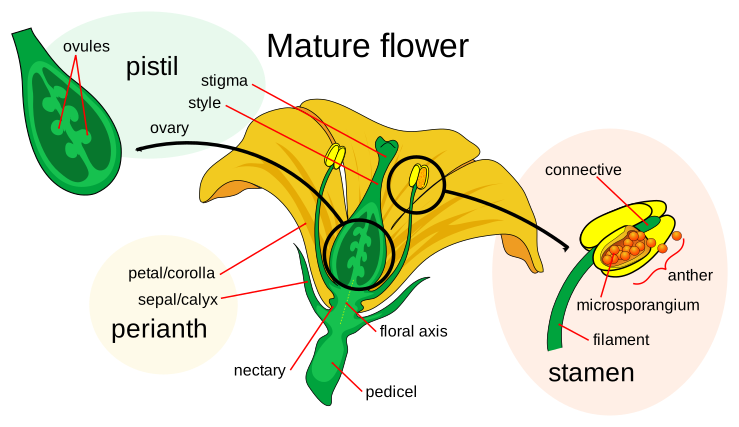
Labeled diagram of a mature flower showing sepals, petals, stamens (anther and filament), and the pistil (stigma, style, ovary with ovules)

Structure of a mature flower. Image: LadyofHats (Mariana Ruiz), Public Domain, via Wikimedia Commons.

Easy — 3 questions

Q1.

Grafting in plants is done to:

  • A Boost the number of seeds a plant yields
  • B Combine desirable traits of two varieties onto one plant
  • C Increase the rate of chlorophyll synthesis in leaves
  • D Generate an entirely new species through hybridization
Show answer & explanation

Answer: B. Combine desirable traits of two varieties onto one plant

Why: Grafting: shoot (scion) of one plant joined to root (rootstock) of another. Combines disease-resistant roots with high-quality fruit varieties.

Q2.

Spores in ferns are produced by:

  • A Seeds formed after fertilization of the ovule
  • B Pollen grains released from the anther
  • C Meiosis in sporangia (on undersides of fronds)
  • D Rhizome fragmentation alone, without spore formation
Show answer & explanation

Answer: C. Meiosis in sporangia (on undersides of fronds)

Why: Fern spores are produced by meiosis in sporangia (groups called sori) on the underside of fronds. Spores germinate into small gametophyte plants.

Q3.

In bryophytes (mosses), the dominant generation is the:

  • A Sporophyte, which bears the capsule on a stalk
  • B Gametophyte (the green plant you see)
  • C Sporophyte and gametophyte in exactly equal proportion
  • D The protonema stage, which dominates over both generations
Show answer & explanation

Answer: B. Gametophyte (the green plant you see)

Why: In mosses (bryophytes), the gametophyte is the dominant, independent generation. The sporophyte (spore-producing) grows on and depends on the gametophyte.

Medium — 4 questions

Q4.

Seed dormancy mechanisms include:

  • A Mainly prolonged dry storage conditions maintained for several full months prior to sowing the seed in most textbook accounts
  • B Hard seed coat (physical), presence of germination inhibitors (chemical), requirement for cold stratification, or light requirement
  • C Exposure to consistently high ambient temperature mainly, with few other environmental cues involved during normal conditions
  • D A substantial lack of available oxygen occurring within the surrounding seed coat tissue over time as generally observed in typical laboratory settings
Show answer & explanation

Answer: B. Hard seed coat (physical), presence of germination inhibitors (chemical), requirement for cold stratification, or light requirement

Why: Seed dormancy: prevents germination in unfavorable conditions. Mechanisms: impermeable seed coat (hard/physical); chemical inhibitors (ABA); cold requirement (vernalization); light requirement; embryo immaturity.

Q5.

The phenomenon of vivipary in plants refers to:

  • A Two separate embryos developing within a single seed coat
  • B Seed or embryo germinating while still attached to the parent plant
  • C Plants producing mature seeds without ever forming flowers
  • D Seeds that require exposure to fire before they can germinate
Show answer & explanation

Answer: B. Seed or embryo germinating while still attached to the parent plant

Why: Vivipary: germination of the seed while still on the parent plant. Common in mangroves (propagules ready to root when they drop). Also occurs in some grasses in humid conditions (precocious germination).

Q6.

A monoecious plant is one that:

  • A Has mainly female flowers, typically requiring a separate male plant nearby in routine practice
  • B Has mainly male flowers, relying on a separate female plant for seed set overall
  • C Has both male and female flowers on the same individual plant (e.g., maize, cucumber)
  • D Has mainly bisexual flowers with fused stamens and pistils throughout in most cases
Show answer & explanation

Answer: C. Has both male and female flowers on the same individual plant (e.g., maize, cucumber)

Why: Monoecious: separate male and female flowers on the same plant (e.g., maize: male = tassel, female = ear; cucumber, corn). Promotes cross-pollination while on same plant.

Q7.

Gymnosperm seed development differs from angiosperm in lacking:

  • A Pollen production, since gymnosperms rely on vegetative propagation
  • B A fruit (seeds are naked, not enclosed in a fruit)
  • C True seeds, producing only spore-like dispersal units instead
  • D Embryo formation, with seeds remaining undifferentiated at release
Show answer & explanation

Answer: B. A fruit (seeds are naked, not enclosed in a fruit)

Why: Gymnosperms (conifers, cycads): seeds not enclosed in a fruit (naked seeds). No ovary wall to develop into fruit. Angiosperms have seeds enclosed within fruit (evolved from ovary wall).

Hard — 2 questions

Q8.

The sporophyte generation is dominant in:

  • A Mainly mosses, where the sporophyte is sometimes thought to overshadow the gametophyte stage
  • B All land plants (embryophytes), sometimes mistakenly thought to be without any exception at all
  • C Ferns, seed plants, and gymnosperms (not mosses/liverworts where gametophyte dominates)
  • D Mainly algae, which are sometimes mistakenly thought to lack a true alternation of generations
Show answer & explanation

Answer: C. Ferns, seed plants, and gymnosperms (not mosses/liverworts where gametophyte dominates)

Why: Sporophyte dominance: in vascular plants (ferns, gymnosperms, angiosperms), the diploid sporophyte is the main plant. In non-vascular plants (mosses), the haploid gametophyte dominates. Trend in land plant evolution.

Q9.

Chemical ecology of seed dispersal involves:

  • A Seeds producing toxic chemical compounds alone as their main documented adaptation specifically related to successful dispersal overall each season in the majority of cases studied
  • B Seeds producing elaioisomes, fleshy fruits with colors targeting specific frugivores, or chemical repellents to keep non-dispersers away while attracting proper seed dispersers
  • C Physical adaptations alone, such as hooked spines or feathery wings, occurring with little accompanying chemistry involved most times as widely reported in standard practice
  • D Color signals alone, occurring largely without any accompanying chemical attractant compounds being produced by the plant itself under most conditions encountered as frequently observed in practice
Show answer & explanation

Answer: B. Seeds producing elaioisomes, fleshy fruits with colors targeting specific frugivores, or chemical repellents to keep non-dispersers away while attracting proper seed dispersers

Why: Seeds coevolve with dispersers: fruit colors match disperser color vision (red for birds, yellow/green for bats); scents attract specific animals; elaiosomes attract ants; capsaicin in chili repels mammals but not birds (birds disperse seeds long-distance).