🎯 Key Points
- Double fertilisation (angiosperms ONLY): sperm+egg→zygote(2n); sperm+2 polar nuclei→endosperm(3n) — the 3n endosperm is unique to angiosperms, gymnosperms lack it
- Autogamy (self, same flower) → Geitonogamy (self, different flower same plant) → Xenogamy (cross, genetically different plant) — ONLY xenogamy creates true genetic variation
- Embryo sac: 7-celled, 8-nucleate (3 antipodal + 2 polar nuclei in central cell + egg apparatus of 1 egg + 2 synergids)
- Parthenocarpy = fruit WITHOUT fertilisation (seedless, e.g. banana); Apomixis = seed WITHOUT fertilisation (e.g. dandelion) — different processes, often confused
- Albuminous seeds retain endosperm (wheat, castor); Non-albuminous seeds consume it, storing food in cotyledons instead (pea, gram)
Asexual Reproduction
- Vegetative propagation: runners (strawberry), bulbs (onion), tubers (potato), rhizomes (ginger), grafting, layering
- Advantages: rapid multiplication, preserves genetic traits, no seeds needed
Flower Structure
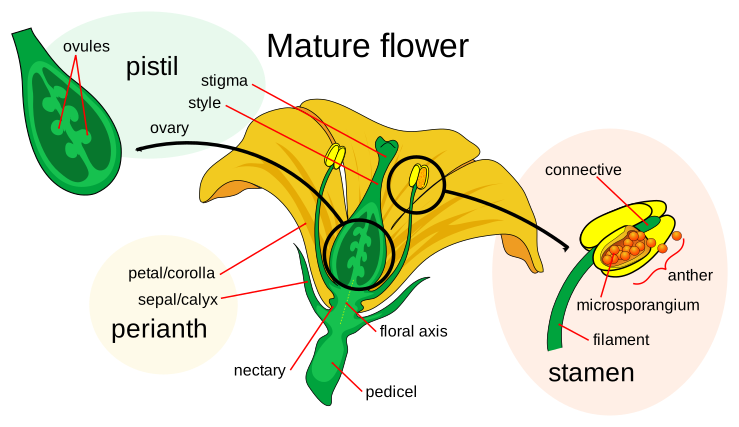
Structure of a mature flower. Image: LadyofHats (Mariana Ruiz), Public Domain, via Wikimedia Commons.
- Sepal: protect bud (calyx)
- Petal: attract pollinators (corolla)
- Stamen: male; anther (makes pollen) + filament
- Pistil: female; stigma + style + ovary (contains ovules)
Double Fertilization (Angiosperms only)
- One sperm + egg → zygote (2n) → embryo
- Second sperm + polar nuclei (2) → triploid endosperm (3n): food for embryo
Seed and Fruit
- Ovule → seed; ovary wall → pericarp (fruit wall)
- Seed: embryo + endosperm + seed coat (testa)
- Parthenocarpy: fruit without fertilization (banana, seedless grapes)
- Apomixis: seed without fertilization (dandelion)
Pollination Types
- Anemophily: wind; Entomophily: insects; Ornithophily: birds; Hydrophily: water
- Self-incompatibility prevents inbreeding in many plants
Pollination: Agents and Types
- Autogamy: self-pollination within the same flower; requires synchrony of anther and stigma maturity (chasmogamy = open flowers; cleistogamy = closed flowers ensure self-pollination, e.g. some Commelina, Viola)
- Geitonogamy: pollen from one flower pollinates another flower of the same plant; genetically still self-pollination
- Xenogamy: pollen from a flower of a genetically different plant; the only type that introduces true genetic variation
- Outbreeding devices that prevent self-pollination: dicliny (unisexual flowers), self-incompatibility, herkogamy (anther and stigma at different positions/heights)
- Pollination agents: abiotic (wind in anemophily, water in hydrophily, e.g. Vallisneria, Zostera) and biotic (insects, birds, bats, even snails in malacophily); insect-pollinated flowers are typically large, colourful, fragrant, and produce nectar
Microsporogenesis and Megasporogenesis
- Anther: bilobed, each lobe with 2 theca; contains 4 microsporangia; microspore mother cells undergo meiosis to form microspore tetrads (pollen grains); pollen wall has hard exine (sporopollenin, resistant to fossilisation) and soft intine
- Ovule: has funicle (stalk), hilum (point of attachment), one or two integuments, micropyle (opening for pollen tube entry), and the nucellus enclosing the embryo sac
- Megasporogenesis: a single megaspore mother cell inside the nucellus undergoes meiosis to give 4 megaspores, of which usually only one (chalazal) survives and develops into the embryo sac
- Female gametophyte (embryo sac) is 7-celled, 8-nucleate: 3 antipodal cells, 2 polar nuclei in the central cell, and the egg apparatus (1 egg cell + 2 synergids with filiform apparatus that guides pollen tube entry)
Embryo and Dispersal
- Dicot embryo: radicle, embryonal axis, and two cotyledons; monocot embryo has one large cotyledon (scutellum) and a coleoptile covering the plumule, with a coleorhiza covering the radicle
- Albuminous seeds retain endosperm at maturity (wheat, maize, castor); non-albuminous seeds consume the endosperm during embryo development so food is stored in cotyledons (pea, gram, groundnut)
- Polyembryony: occurrence of more than one embryo in a seed, seen naturally in Citrus and Opuntia
- Fruit and seed dispersal mechanisms: wind (winged/hairy seeds like Calotropis, drumstick), water (coconut), and animals (sticky or hooked fruits like Xanthium)
Life Span and Phases of Life
- Every organism has a definite life span — the period from birth to natural death — which varies enormously (a mayfly lives a day, a crow ~15 years, a parrot ~140 years, a tortoise up to 150 years, some trees thousands of years); life span is unrelated to organism size
- Juvenile (vegetative) phase: the period of growth before an organism becomes reproductively mature (called the vegetative phase in plants)
- Reproductive phase: the mature phase during which the organism can reproduce; in some plants flowering happens seasonally, in others only once (bamboo flowers once at 50–100 years, then dies)
- Senescent phase: the ageing phase from the end of reproductive capacity to death, marked by slowing metabolism and eventual failure of body functions
Asexual Reproduction: Modes
- Asexual reproduction involves a single parent, no gamete fusion, and offspring that are genetically identical clones; common in lower organisms, algae and fungi
- Binary fission: the parent divides into two (e.g. Amoeba, Paramecium)
- Budding: a small outgrowth (bud) develops and detaches (external buds in yeast and Hydra)
- Fragmentation: the body breaks into fragments, each growing into a new individual (e.g. Spirogyra, Planaria)
- Spore formation: zoospores (motile spores in some algae), conidia (Penicillium), gemmules (internal buds in sponges), and buds; many produced by specialised reproductive structures
- Vegetative propagation in plants: through vegetative propagules such as runners, rhizomes, suckers, tubers, offsets, bulbs, and buds (e.g. the "eyes" of potato, bulbils of Agave, leaf buds of Bryophyllum)
Sexual Reproduction: Events and Phases
- Sexual reproduction involves the fusion of male and female gametes, forming genetically variable offspring; it is elaborate, slower, and involves three sequential phases
- Pre-fertilisation events: gametogenesis (formation of male and female gametes; gametes may be isogametes/homogametes when morphologically similar, or heterogametes when the male gamete/antherozoid and female gamete/egg differ) and gamete transfer to bring the gametes together (pollination in plants; medium usually water in lower organisms)
- Fertilisation (syngamy): fusion of a haploid male and haploid female gamete to form the diploid zygote; may be external (gametes released into water, e.g. bony fishes, frogs) or internal (egg fertilised inside the female body, e.g. birds, mammals, most plants). In parthenogenesis the female gamete develops into a new organism without fertilisation (e.g. honeybees, some lizards)
- Post-fertilisation events: the zygote is the vital link between generations; it undergoes cell division and differentiation (embryogenesis) to form the embryo. Animals may be oviparous (lay fertilised eggs, e.g. birds, reptiles) or viviparous (give birth to young ones, e.g. most mammals)
Sexuality in Organisms and Breeding Cycles
- Bisexual vs unisexual: organisms bearing both sex organs are bisexual (hermaphrodite in animals, e.g. earthworm, leech, sponge; monoecious in plants), while those with only one type are unisexual (dioecious in plants, e.g. papaya)
- Homothallic and monoecious refer to bisexual condition; heterothallic and dioecious refer to the unisexual condition in plants and fungi
- Oestrous cycle: the cyclical changes in reproductive activity seen in non-primate mammals such as cows, sheep, rats, deer and dogs during the breeding season
- Menstrual cycle: the cyclical reproductive changes seen in primates (monkeys, apes and humans), marked by menstrual bleeding
- Based on breeding frequency: seasonal breeders reproduce only in a favourable season, while continuous breeders reproduce throughout the year
🚀 NEET Advanced Edge
Why self-incompatibility is genetically NOT the same as self-sterility from structural causes: Self-incompatibility is a genetic/physiological mechanism (the pollen and stigma recognise "self" and block pollen tube growth) that prevents autogamy even when anther and stigma mature together — distinct from dicliny or herkogamy, which are purely STRUCTURAL barriers (separate sexes or separated anther/stigma position).
Why exine survives fossilisation but intine doesn't: Sporopollenin (the material of the exine) is one of the most resistant organic materials known, surviving strong acids, enzymes, and high temperature — this is why fossil pollen records can be studied (palynology) to reconstruct ancient climates and vegetation, while the soft intine decomposes rapidly.
Apomixis and hybrid seed industry: Since apomixis produces seeds genetically identical to the mother plant (no fertilisation, no genetic recombination), introducing apomixis into hybrid crop varieties would let farmers save and replant hybrid seeds without losing hybrid vigour in the next generation — a major active area of agricultural biotechnology research.