🎯 Key Points
- ΔU = Q − W (W is work done BY the system); Isochoric: W=0; Isobaric: W=PΔV; Isothermal: ΔU=0; Adiabatic: Q=0, PVᵞ=const
- Carnot efficiency η = 1 − T_C/T_H (Kelvin); no real engine can exceed this between the same two temperatures
- C_p − C_v = R (Mayer's relation); γ=C_p/C_v: monoatomic 5/3, diatomic 7/5
- Second Law: heat never flows spontaneously cold→hot; no 100% efficient engine is possible; entropy of an isolated system never decreases
- On a P-V diagram: work = area under curve; in a closed cycle, net work = area enclosed by the loop, and ΔU=0 over the full cycle
The Carnot cycle alternates two isothermal steps (heat absorbed at T_H, released at T_C) with two adiabatic steps (no heat exchange); the enclosed loop area equals the net work output, and η = 1−T_C/T_H is the maximum possible efficiency between those two temperatures.
Zeroth Law
- If A and B are both in thermal equilibrium with C, then A and B are in thermal equilibrium with each other (defines temperature)
First Law of Thermodynamics
- ΔU = Q - W (internal energy change = heat added - work done BY system)
- Isochoric (constant V): W = 0, ΔU = Q
- Isobaric (constant P): W = PΔV
- Isothermal (constant T): ΔU = 0, Q = W = nRT·ln(V₂/V₁)
- Adiabatic (Q = 0): PV^γ = constant; W = -ΔU
Second Law of Thermodynamics
- Heat cannot flow spontaneously from cold to hot
- No engine can be 100% efficient
- Entropy of an isolated system never decreases
Carnot Engine
- Most efficient heat engine operating between T_H and T_C
- Efficiency η = 1 - T_C/T_H (temperatures in Kelvin)
- COP of refrigerator = T_C/(T_H - T_C)
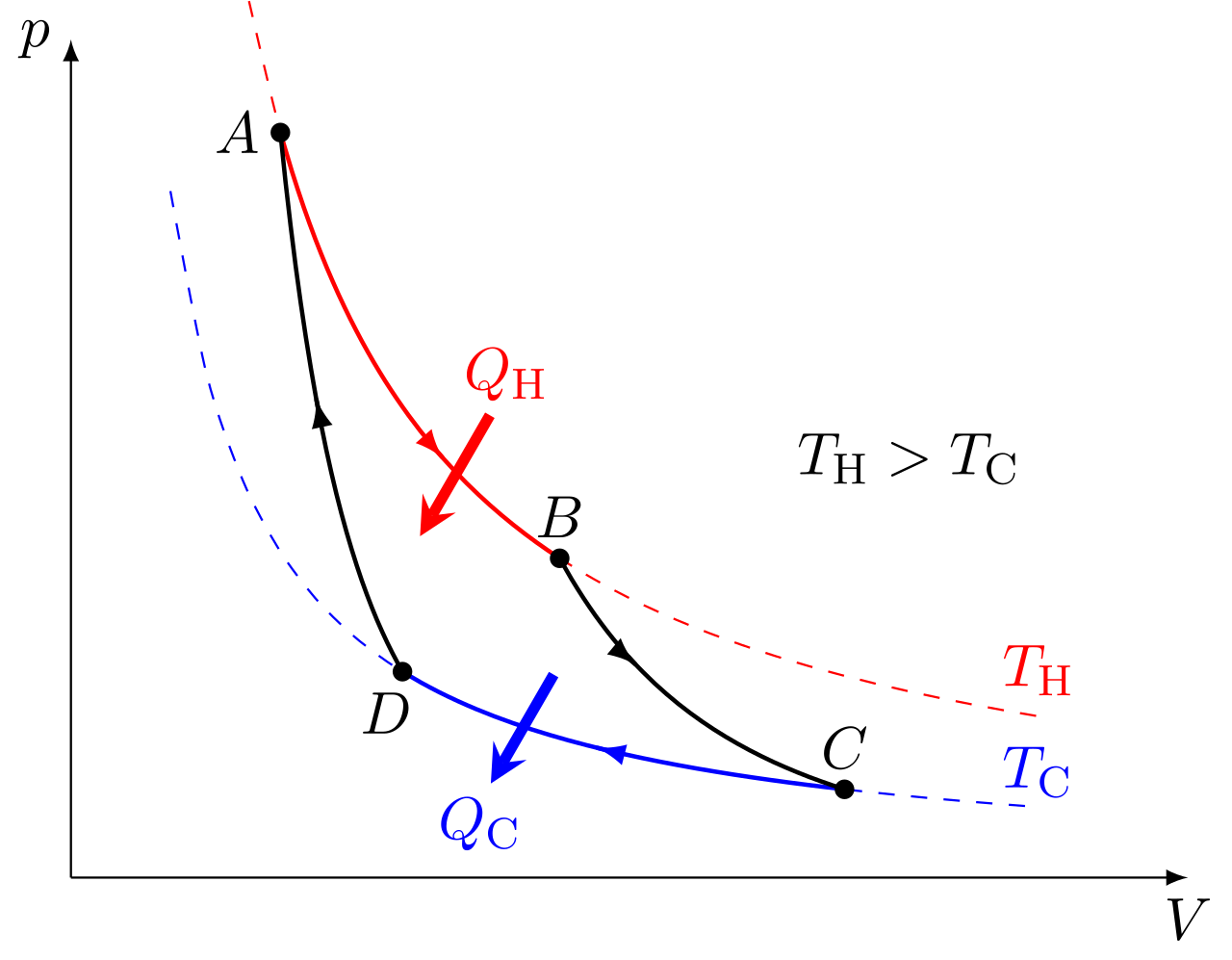
The Carnot cycle: two isothermals (Tₕ, T₃) and two adiabatics; efficiency η = 1 − T₃/Tₕ. Image: Cristian Quinzacara, CC BY-SA 4.0, via Wikimedia Commons.
Kinetic Theory
- Pressure: P = ⅓ρ·v_rms²
- v_rms = √(3RT/M); v_avg = √(8RT/πM); v_mp = √(2RT/M)
- Degrees of freedom: monoatomic=3, diatomic=5, polyatomic=6
- Mean free path: λ = 1/(√2·π·d²·n)
Work Done in Different Processes (PV Diagram)
- On a P-V diagram, work done by the gas equals the area under the curve between initial and final volumes
- Isothermal curve is less steep than adiabatic curve at any common point (adiabatic process changes temperature, so PV^gamma falls off faster than PV = constant)
- In a cyclic process, net work done = area enclosed by the closed loop on the P-V diagram; ΔU = 0 over a full cycle since the system returns to its initial state
Specific Heat Capacities of Gases
- C_p - C_v = R (Mayer's relation, per mole)
- γ = C_p/C_v; monoatomic gas γ = 5/3, diatomic gas γ = 7/5
- Molar specific heat at constant volume: C_v = (f/2)R, where f is degrees of freedom
Heat Engines and Refrigerators
- Heat engine: converts heat into work in a cyclic process; efficiency η = W/Q_H = 1 - Q_C/Q_H
- Refrigerator/heat pump: works in reverse, extracting heat from a cold body and rejecting it to a hot body using external work input
- Coefficient of performance: COP = Q_C/W = Q_C/(Q_H - Q_C)
- Carnot's theorem: no engine working between two given temperatures can be more efficient than a reversible (Carnot) engine
Heat, Internal Energy and Work
- Heat (Q): energy transferred between a system and its surroundings due only to a temperature difference; it is energy in transit, not a property stored in a body
- Internal energy (U): the total energy (kinetic + potential) of all molecules of the system; it is a state variable (depends only on the current state) and for an ideal gas depends on temperature alone
- Work (W): energy transferred when the system pushes its boundary through a displacement (W = PΔV for expansion); like heat, work is a path function, not a state function
- Both Q and W depend on the path taken between two states, but their difference Q − W = ΔU is path-independent, which is the essence of the first law
Thermodynamic State Variables and Equation of State
- State variables (P, V, T, U, entropy) describe the equilibrium state of a system and are independent of how that state was reached
- Extensive variables (V, U, mass, total entropy) depend on system size; intensive variables (P, T, density) do not
- Equation of state: a relation connecting the state variables; for an ideal gas it is PV = nRT, reducing the independent variables to two
- A system is in thermodynamic equilibrium only when mechanical, thermal, and chemical equilibrium all hold simultaneously
Quasi-static, Reversible and Irreversible Processes
- Quasi-static process: an idealised process carried out infinitely slowly so the system stays in equilibrium (uniform P and T) at every instant
- Reversible process: can be exactly retraced so both system and surroundings return to their initial states with no net change; requires it to be quasi-static and free of dissipative effects (friction, viscosity, turbulence)
- Irreversible process: all real, spontaneous processes (sudden expansion, heat flow across a finite temperature difference, friction) that cannot be reversed without leaving a change in the surroundings
- The Carnot engine uses only reversible steps, which is precisely why it sets the maximum possible efficiency between two temperatures
🚀 JEE Advanced Edge
Multi-process cycles: For cycles combining isothermal, isobaric, isochoric, and adiabatic legs (common in JEE), calculate Q, W, ΔU separately for EACH leg using the correct process formula, then sum: total ΔU over the full cycle = 0 (state function returns to start), but total Q and total W are generally non-zero and equal to each other (W=Q for a full cycle, from the first law with ΔU=0).
Polytropic process: A general process PVⁿ=constant covers all the standard cases as special values of n: n=0 is isobaric, n=1 is isothermal, n=γ is adiabatic, n→∞ is isochoric — recognising which special case a "PV^n=const" problem reduces to instantly tells you which formula set to use.
Worked problem: One mole of an ideal monoatomic gas expands adiabatically, and its temperature drops from 400 K to 300 K. Find the work done by the gas (Cv=3R/2). Approach: For adiabatic, W=−ΔU=−nCvΔT=−1×(3R/2)×(300−400)=−(3R/2)×(−100)=150R ≈ 1247 J (gas does positive work while cooling, consistent with adiabatic expansion).