🎯 Key Points
- ΔL=αLΔT (linear), ΔA=βAΔT≈2αAΔT, ΔV=γVΔT≈3αVΔT — area and volume expansion coefficients are roughly 2× and 3× the linear one
- Water's anomalous expansion: contracts 0°C→4°C, expands above 4°C; density max at 4°C
- Calorimetry: heat lost by hot body = heat gained by cold body (isolated system); Q=mL during phase change at constant T
- Conduction needs a medium (Fourier's law H=KA·ΔT/L); Convection needs bulk fluid movement; Radiation needs NO medium and is fastest
- Stefan-Boltzmann: E=σT⁴ (or eσT⁴ with emissivity); Wien's law: λ_m·T=constant — hotter objects radiate peak intensity at shorter wavelengths
- Newton's Law of Cooling: rate of cooling ∝ (T−T₀), valid only for small temperature differences, gives exponential decay
During a phase change (melting or boiling), temperature stays constant while heat is absorbed entirely as latent heat (Q=mL); temperature only rises again once the substance is fully in its new phase.
Temperature Scales
- Celsius, Fahrenheit, and Kelvin (absolute) scales are commonly used
- Conversion: C/100 = (F-32)/180 = (K-273.15)/100
- Absolute zero (0 K = -273.15°C) is the temperature at which ideal gas pressure/volume theoretically becomes zero
- Triple point of water (273.16 K) is used to calibrate the Kelvin scale
Thermal Expansion
- Linear expansion: ΔL = α·L·ΔT, where α is the coefficient of linear expansion (per °C or per K)
- Area (superficial) expansion: ΔA = β·A·ΔT, where β ≈ 2α
- Volume (cubical) expansion: ΔV = γ·V·ΔT, where γ ≈ 3α
- For an ideal gas at constant pressure, γ = 1/T (in kelvin)
- Water shows anomalous expansion: it contracts on heating from 0°C to 4°C and expands above 4°C; density is maximum at 4°C
Specific Heat Capacity and Calorimetry
- Heat capacity: S = ΔQ/ΔT (heat required to raise temperature of a body by 1 degree)
- Specific heat capacity: s = ΔQ/(mΔT), SI unit J/(kg·K); for water, s ≈ 4186 J/(kg·K) = 1 cal/(g·°C)
- Molar specific heat: C = ΔQ/(nΔT), unit J/(mol·K)
- For gases: C_p (constant pressure) is always greater than C_v (constant volume) because at constant pressure some heat is used to do work of expansion
- Mayers relation: C_p - C_v = R (for one mole of an ideal gas)
- Principle of calorimetry: in an isolated system, heat lost by hot body = heat gained by cold body (conservation of heat energy)
Change of State and Latent Heat
- Latent heat: the heat absorbed/released per unit mass at constant temperature during a phase change: Q = mL
- Latent heat of fusion (solid to liquid): for ice, L_f = 3.34 × 10⁵ J/kg (at 0°C)
- Latent heat of vaporization (liquid to gas): for water, L_v = 2.256 × 10⁶ J/kg (at 100°C)
- Temperature remains constant during a phase change even though heat is continuously supplied (this heat changes internal/potential energy, not kinetic energy)
- Sublimation is the direct change from solid to vapour state
Heat Transfer: Conduction
- Conduction is heat transfer through a medium without bulk movement of matter, dominant in solids
- Fouriers law: rate of heat flow H = ΔQ/Δt = K·A·(T1-T2)/L, where K is thermal conductivity, A is area, L is thickness
- Thermal resistance R = L/(K·A); for slabs in series, resistances add: R_total = R1 + R2 + ...
- Metals are good thermal conductors (high K) due to free electrons; wood, air, and glass wool are poor conductors (insulators)
Heat Transfer: Convection and Radiation
- Convection: heat transfer by actual movement of heated fluid particles (natural convection by density difference, or forced convection by a pump/fan)
- Land and sea breezes, the working of a radiator, and atmospheric circulation are convection examples
- Radiation: heat transfer via electromagnetic waves, requires no medium, and is the fastest mode (travels at speed of light)
- Stefan-Boltzmanns law: energy radiated per unit area per unit time by a black body, E = σT⁴, where σ = 5.67 × 10⁻⁸ W/(m²K⁴)
- For a body with emissivity e (e=1 for a perfect black body): E = e·σ·T⁴
- Net rate of loss of heat by radiation: H = e·σ·A·(T⁴ - T₀⁴), where T₀ is surrounding temperature
Wiens Displacement Law and Newtons Law of Cooling
- Wiens displacement law: λ_m·T = b (constant), where λ_m is the wavelength at which spectral emission is maximum; b ≈ 2.898 × 10⁻³ m·K
- As temperature increases, λ_m decreases, i.e. the peak of black body radiation shifts toward shorter wavelengths (used to estimate star surface temperatures)
- Newtons law of cooling: rate of loss of heat of a body is directly proportional to the temperature difference between the body and its surroundings, valid for small temperature differences: -dT/dt = k(T - T₀)
- This leads to an exponential cooling curve: temperature difference decays exponentially with time
Heat, Temperature and Thermal Equilibrium
- Temperature is a measure of the degree of hotness or coldness of a body; heat is energy in transit that flows between two bodies (or a body and its surroundings) because of a temperature difference
- Heat always flows spontaneously from the higher-temperature body to the lower-temperature body until they reach a common temperature
- Thermal equilibrium: two bodies in thermal contact are in equilibrium when there is no net flow of heat between them, i.e. they are at the same temperature
- Zeroth law of thermodynamics: if two systems are each in thermal equilibrium with a third system, then they are in thermal equilibrium with each other — this is what makes temperature a well-defined, measurable quantity
Measurement of Temperature and the Ideal Gas Thermometer
- A thermometer uses a measurable property (a thermometric property) that varies with temperature: e.g. the length of a mercury column, the resistance of a wire, or the pressure/volume of a gas
- Two fixed points (traditionally the ice point 0°C and the steam point 100°C) are used to graduate a scale
- The constant-volume gas thermometer uses the pressure of a fixed volume of gas (P ∝ T); it is the most accurate because all low-density gases give the same reading
- Extrapolating the P–T (or V–T) straight line for any ideal gas to P = 0 meets the temperature axis at −273.15°C, defining absolute zero and the Kelvin (absolute) scale, where T(K) = T(°C) + 273.15
- The Kelvin scale is fixed using the triple point of water (273.16 K) as its single standard reference point
Black Body Radiation and Kirchhoff's Law
- A perfect black body absorbs all radiation incident on it (absorptivity = 1) and is also the best possible emitter at every wavelength
- The spectrum of black-body radiation depends only on temperature and not on the material; as T rises the total emitted energy grows (Stefan-Boltzmann law) and the intensity peak shifts to shorter wavelength (Wien's law)
- Kirchhoff's law of radiation: at a given temperature the ratio of emissive power to absorptive power is the same for all bodies and equals the emissive power of a black body — in short, good absorbers are good emitters
- A cavity with a small hole is a practical realisation of a black body; a black body has emissivity e = 1
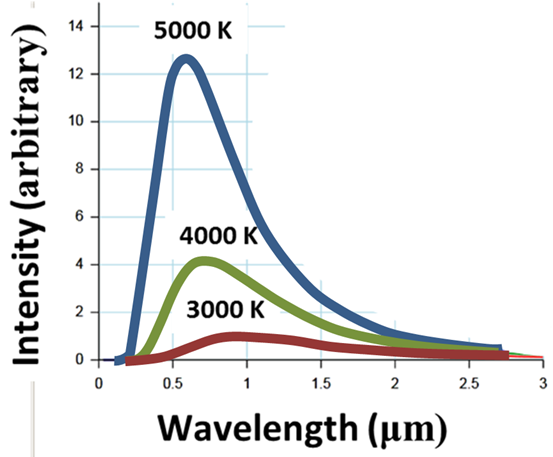
Black-body radiation: as temperature rises (3000 → 5000 K) the emitted intensity grows and the peak shifts to shorter wavelengths (Wien's displacement law). Image: Brews ohare, CC BY-SA 3.0, via Wikimedia Commons.
Greenhouse Effect
- The Earth's surface, warmed by the Sun, re-radiates energy in the long-wavelength infrared region (because it is far cooler than the Sun)
- Atmospheric gases such as carbon dioxide, water vapour, and methane are transparent to incoming visible sunlight but absorb this outgoing infrared radiation, trapping heat near the surface
- This greenhouse effect keeps the Earth warm enough for life; a rising concentration of greenhouse gases enhances it and drives global warming
- It is a direct application of the wavelength dependence of the emission and absorption of thermal radiation
🚀 JEE Advanced Edge
Thermal stress in constrained expansion: If a rod is rigidly clamped at both ends and heated, it cannot physically expand, so the prevented expansion generates internal thermal stress = Y·α·ΔT (Young's modulus × linear expansion coefficient × temperature change) — connecting this topic directly to Mechanical Properties of Solids.
Composite slabs in series/parallel (conduction): For slabs in series (heat flows through one after another), total thermal resistance R_total=R₁+R₂+... (like resistors in series); for slabs in parallel (side by side, same ΔT across both), 1/R_total=1/R₁+1/R₂+... — directly analogous to electrical resistance combination.
Worked problem: Two rods of the same length and area, with conductivities K₁=200 and K₂=400 W/(m·K), are joined end to end (series) between a hot end at 100°C and cold end at 0°C. Find the junction temperature. Approach: In series, heat flow rate is the same through both: K₁A(100−T)/L = K₂A(T−0)/L → 200(100−T)=400T → 20000=600T → T≈33.3°C.