🎯 Key Points
- Cell theory: all living things are made of cells; cell is the basic structural/functional unit; all cells arise from pre-existing cells (Virchow)
- Prokaryotes: no membrane-bound nucleus/organelles (1-10 μm); Eukaryotes: membrane-bound nucleus + organelles (10-100 μm)
- Mitochondria (respiration) and chloroplast (photosynthesis, plants only) are both double-membraned with their own circular DNA — endosymbiont theory
- Ribosomes: 70S in prokaryotes, 80S in eukaryotes (S = sedimentation coefficient, not simply additive)
- Only plant cells: cell wall, chloroplast, large central vacuole; Only animal cells: centrioles
- Fluid mosaic model (Singer & Nicolson, 1972): membrane proteins float/move within a fluid phospholipid bilayer
Cell Theory
- All living things are made of cells
- Cell is the basic unit of structure and function
- All cells arise from pre-existing cells (Virchow)
Prokaryotes vs Eukaryotes
- Prokaryotes: no membrane-bound nucleus (bacteria, archaea); 1-10 micrometers; no membrane-bound organelles
- Eukaryotes: membrane-bound nucleus; 10-100 micrometers; complex organelles; plants, animals, fungi, protists
Key Organelles and Functions
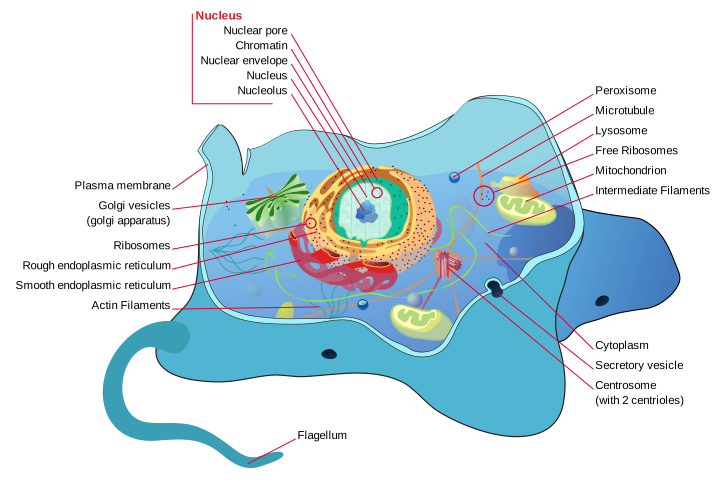
Animal cell structure with major organelles labeled. Image: LadyofHats (Mariana Ruiz), Public Domain, via Wikimedia Commons.
- Nucleus: contains DNA; controls cell activities; nucleolus makes ribosomes
- Mitochondria: powerhouse; site of aerobic respiration; contains own DNA
- Chloroplast: site of photosynthesis (plants only); contains own DNA
- Ribosome: protein synthesis; found in all cells; 70S in prokaryotes, 80S in eukaryotes
- Endoplasmic Reticulum: rough ER (ribosomes, protein processing); smooth ER (lipid synthesis)
- Golgi Apparatus: modifies, sorts, packages proteins; post office of the cell
- Lysosome: digestion; contains hydrolytic enzymes; found in animal cells
- Vacuole: large central vacuole in plants; storage and turgor pressure
- Cell wall: cellulose in plants; peptidoglycan in bacteria
- Plasma membrane: fluid mosaic model (phospholipid bilayer + proteins)
Cell Transport
- Passive transport: diffusion, osmosis (no energy needed)
- Active transport: against concentration gradient (ATP required)
- Endocytosis/Exocytosis: bulk transport of large molecules
Quick Tips
- Mitochondria and chloroplasts have double membrane + own circular DNA (endosymbiont theory)
- Only plant cells have: cell wall, chloroplast, large central vacuole
- Only animal cells have: centrioles (for cell division)
Fluid Mosaic Model of the Plasma Membrane
- Proposed by Singer and Nicolson (1972); describes the membrane as a dynamic structure where the phospholipid bilayer is in a constant fluid state
- Phospholipids are arranged with hydrophilic (polar) heads facing outward toward water and hydrophobic (non-polar) tails facing inward, away from water
- Membrane proteins: integral (embedded in or spanning the bilayer) and peripheral (attached to the surface); proteins can move laterally within the membrane, giving it a "mosaic" quality
- Membrane also contains cholesterol (regulates fluidity) and glycolipids/glycoproteins on the outer surface (cell recognition, signalling)
Cell Wall and Cytoskeleton
- Plant cell wall: made primarily of cellulose, hemicellulose, pectins, and proteins; the middle lamella (calcium pectate) cements adjacent cell walls together; primary wall can grow, secondary wall is laid down after growth stops
- Cytoskeleton: network of protein filaments (microtubules, microfilaments, intermediate filaments) in the cytoplasm; provides mechanical support and shape, helps in cell motility, and aids organelle/chromosome movement during division
- Cilia and flagella: motile, hair-like surface projections with a 9+2 microtubule arrangement (axoneme), covered by the plasma membrane; cilia beat rhythmically (mucus movement in trachea), flagella undulate to move the entire cell (sperm)
- Centrosome: contains two cylindrical centrioles arranged perpendicular to each other, each with a 9+0 microtubule arrangement; forms the basis of cilia/flagella and organises the spindle during cell division (absent in plant cells)
Plant Cell vs Animal Cell: Key Differences
- Plant cells have a rigid cellulose cell wall outside the plasma membrane; animal cells lack a cell wall
- Plant cells usually have one large central vacuole for turgor pressure; animal cells have small, multiple vacuoles if present
- Plant cells contain plastids (chloroplasts, leucoplasts, chromoplasts); plastids are absent in animal cells
- Animal cells have centrioles that organise the spindle apparatus; most plant cells lack centrioles (spindle still forms without them)
- Lysosomes are common in animal cells but rare in plant cells, where the vacuole performs a similar digestive role
Prokaryotic vs Eukaryotic Cell
| Feature | Prokaryotic | Eukaryotic |
|---|---|---|
| Size | Small (1 to 10 micrometres) | Larger (10 to 100 micrometres) |
| Nucleus | No true nucleus; a nucleoid of naked DNA, no nuclear membrane | True nucleus bounded by a nuclear envelope |
| Membrane-bound organelles | Absent | Present (ER, Golgi, mitochondria, etc.) |
| Ribosomes | 70S | 80S (70S inside mitochondria/chloroplasts) |
| Cell wall | Peptidoglycan (murein) | Cellulose (plants), chitin (fungi), or none (animals) |
| Genetic material | Single circular chromosome plus plasmids | Multiple linear chromosomes wound on histones |
| Examples | Bacteria, archaea, cyanobacteria | Plants, animals, fungi, protists |
- Many prokaryotes have infoldings of the plasma membrane called mesosomes (aid respiration, secretion, and DNA replication) and a protective outer glycocalyx (capsule or slime layer)
The Endomembrane System
- A set of organelles whose functions are coordinated: the endoplasmic reticulum, Golgi apparatus, lysosomes, and vacuoles; mitochondria, chloroplasts, and peroxisomes are excluded because their functions are not coordinated with these
- Rough ER (RER): studded with ribosomes; synthesises and transports proteins (abundant in secretory cells). Smooth ER (SER): lacks ribosomes; site of lipid and steroid synthesis and of detoxification (e.g. in liver cells)
- Golgi apparatus: stacked flattened cisternae with a cis (forming, convex) face receiving material from the ER and a trans (maturing, concave) face dispatching it; it modifies, packages, and sorts proteins and lipids, is the main site of glycosylation, and forms lysosomes
- Lysosomes: vesicles rich in acid hydrolases (active at acidic pH) that digest carbohydrates, proteins, lipids, and nucleic acids; the cell's "suicide bags"
- Vacuoles: bounded by a membrane called the tonoplast; in plant cells a large central vacuole can occupy up to 90 percent of the cell volume and maintains turgor; in Amoeba the contractile vacuole handles osmoregulation and food vacuoles hold ingested particles
Mitochondria and Plastids
- Mitochondrion: double-membraned; the inner membrane folds into cristae that enlarge the surface for the electron transport chain, and the inner space is the matrix (site of the Krebs cycle); it has its own circular DNA and 70S ribosomes and is the site of aerobic respiration and ATP production (the "powerhouse of the cell")
- Plastids (in plants and some protists) are of three types: chloroplasts (green, contain chlorophyll, carry out photosynthesis), chromoplasts (yellow, orange, or red carotenoid pigments — petals, fruits), and leucoplasts (colourless storage plastids — amyloplasts store starch, elaioplasts store oils and fats, aleuroplasts store proteins)
- Inside a chloroplast the stroma holds stacks of disc-like thylakoids; a stack is a granum (plural grana), the site of the light reactions; chloroplasts also have their own DNA and 70S ribosomes (semi-autonomous, of endosymbiont origin)
Nucleus and Chromosomes
- Bounded by a double-membraned nuclear envelope perforated by nuclear pores that control the movement of RNA and proteins; its outer membrane is continuous with the ER
- The nucleoplasm contains the nucleolus (not membrane-bound; site of rRNA synthesis and ribosome subunit assembly) and chromatin (DNA wound on histone proteins)
- During division, chromatin condenses into chromosomes; each has a primary constriction, the centromere, bearing disc-shaped kinetochores to which spindle fibres attach
- Classified by centromere position: metacentric (central, V-shaped), sub-metacentric (slightly off-centre, L-shaped), acrocentric (near one end, J-shaped), and telocentric (terminal); a secondary constriction bearing a satellite marks the satellite (SAT) chromosome
🚀 NEET Advanced Edge
Why mitochondria/chloroplasts are semi-autonomous: Both have their own circular DNA, 70S ribosomes (like bacteria, not the cell's own 80S), and can divide independently of the cell cycle — strong evidence for the endosymbiont theory (they were once free-living bacteria engulfed by an ancestral eukaryotic cell).
Distinguishing cell types by a single feature in exam questions: "Has a cell wall but no chloroplast" → fungi (chitin wall) or prokaryote (peptidoglycan), not plant. "Has 70S ribosomes despite being eukaryotic" → must be inside a mitochondrion/chloroplast, not the cytoplasm.
Osmosis numerical reasoning: A cell placed in a hypotonic solution gains water and may undergo lysis (animal cell, no wall) or becomes turgid (plant cell, wall resists bursting); in a hypertonic solution, an animal cell crenates (shrinks) while a plant cell undergoes plasmolysis (membrane pulls away from the wall) — the wall is what makes plant and animal cells respond differently to the same osmotic stress.