🔬 Biology · Class 11 · NEET
Neural Control and Coordination — Practice Questions with Answers
59 free MCQs on Neural Control and Coordination with worked answers and explanations. Brain, spinal cord, neurons, reflex arcs, and sense organs.
Take the timed Neural Control and Coordination quiz →Below are 59 practice questions on Neural Control and Coordination, sorted Easy → Hard. Tap “Show answer & explanation” under any question to check yourself. Want the full theory first? Read the Neural Control and Coordination notes.
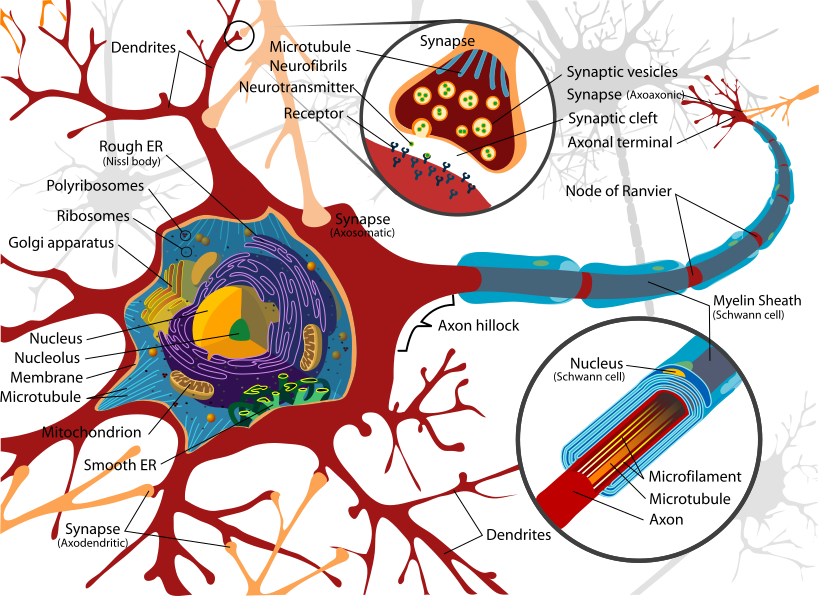
Structure of a neuron. Image: LadyofHats (Mariana Ruiz), Public Domain, via Wikimedia Commons.
Easy — 20 questions
Q1.
The basic structural unit of the nervous system is the:
- A Neuroglia
- B Axon
- C Neuron
- D Synapse
Show answer & explanation
Answer: C. Neuron
Why: The neuron is the basic structural and functional unit of the nervous system. It transmits electrical signals.
Q2.
The axon transmits impulses:
- A Toward the cell body
- B Away from the cell body
- C In both directions
- D Only to other neurons
Show answer & explanation
Answer: B. Away from the cell body
Why: Axons carry nerve impulses away from the cell body to the next neuron or effector organ.
Q3.
Myelin sheath is formed by:
- A Astrocytes, which regulate the blood-brain barrier
- B Schwann cells (in PNS) alone, with no CNS counterpart
- C Neurons themselves, by folding their own membrane
- D Oligodendrocytes (in CNS) or Schwann cells (in PNS)
Show answer & explanation
Answer: D. Oligodendrocytes (in CNS) or Schwann cells (in PNS)
Why: Myelin sheath is formed by Schwann cells in the peripheral nervous system and by oligodendrocytes in the CNS. It speeds nerve impulses.
Q4.
A reflex arc involves:
- A The brain alone, processing input before any response
- B Spinal cord (and sometimes brain) without conscious thought
- C Conscious decision-making in the cerebral cortex
- D Only motor neurons, with no sensory input required
Show answer & explanation
Answer: B. Spinal cord (and sometimes brain) without conscious thought
Why: A reflex arc is a quick automatic response. Simple spinal reflexes bypass the brain: receptor → sensory neuron → spinal cord → motor neuron → effector.
Q5.
The largest part of the human brain is the:
- A Cerebellum
- B Medulla oblongata
- C Cerebrum
- D Pons
Show answer & explanation
Answer: C. Cerebrum
Why: The cerebrum (cerebral cortex) is the largest part. It controls thinking, learning, memory, and voluntary movements.
Q6.
The cerebellum controls:
- A Hunger and thirst
- B Breathing and heart rate
- C Balance and coordination
- D Vision and hearing only
Show answer & explanation
Answer: C. Balance and coordination
Why: The cerebellum coordinates muscle movements, maintains balance and posture.
Q7.
Synapse is the:
- A Cell body of a neuron
- B Junction between two neurons
- C Type of brain cell
- D Part of spinal cord
Show answer & explanation
Answer: B. Junction between two neurons
Why: A synapse is the junction between two neurons (or neuron and effector). Signals cross via neurotransmitters.
Q8.
The resting potential of a neuron is approximately:
- A +70 mV
- B -70 mV
- C 0 mV
- D 120 mV
Show answer & explanation
Answer: B. -70 mV
Why: The resting membrane potential is about -70 mV (inside negative relative to outside) due to K+ leakage and Na+/K+ pump.
Q9.
Acetylcholine and noradrenaline are examples of:
- A Hormones, secreted into the bloodstream by glands
- B Enzymes, which catalyze specific biochemical reactions
- C Neurotransmitters
- D Vitamins, obtained only through dietary intake
Show answer & explanation
Answer: C. Neurotransmitters
Why: Neurotransmitters are chemical messengers released at synapses. Acetylcholine and noradrenaline are the most common.
Q10.
The medulla oblongata controls:
- A Voluntary movement initiated by the motor cortex
- B Learning and memory consolidation in the hippocampus
- C Heartbeat and breathing (vital centers)
- D Balance and posture via the cerebellum
Show answer & explanation
Answer: C. Heartbeat and breathing (vital centers)
Why: The medulla oblongata (brain stem) contains vital centers for heart rate, breathing, blood pressure, and other autonomic functions.
Q11.
Sensory neurons carry signals from:
- A Brain to muscles
- B Muscles to brain
- C Sense organs to CNS
- D CNS to sense organs
Show answer & explanation
Answer: C. Sense organs to CNS
Why: Sensory (afferent) neurons carry signals from receptors (sense organs, skin) to the central nervous system.
Q12.
Motor neurons carry signals from:
- A CNS to muscles/glands (effectors)
- B Muscles directly back to the brain for processing
- C Sensory organs toward the brain for interpretation
- D Signals confined only within the spinal cord itself
Show answer & explanation
Answer: A. CNS to muscles/glands (effectors)
Why: Motor (efferent) neurons carry signals from the CNS to muscles and glands, causing them to respond.
Q13.
The autonomic nervous system controls:
- A Voluntary muscle movement via motor neurons
- B Involuntary body functions (heart, digestion)
- C Conscious thought processed in the cerebrum
- D Only the eyes and ears through cranial nerves
Show answer & explanation
Answer: B. Involuntary body functions (heart, digestion)
Why: The autonomic nervous system (ANS) regulates involuntary functions: heart rate, digestion, respiration, blood pressure.
Q14.
Sympathetic nervous system is activated during:
- A Sleep
- B Digestion after a meal
- C Fight-or-flight response
- D Rest and recovery
Show answer & explanation
Answer: C. Fight-or-flight response
Why: Sympathetic system: fight-or-flight response. Increases heart rate, dilates airways, reduces digestion. Adrenaline released.
Q15.
Parasympathetic nervous system is active during:
- A Fight-or-flight responses during acute danger
- B Sudden emergency responses to perceived threats
- C Rest and digest (calms the body)
- D Extreme physical exercise and exertion
Show answer & explanation
Answer: C. Rest and digest (calms the body)
Why: Parasympathetic system: rest and digest. Slows heart rate, stimulates digestion, constricts pupils.
Q16.
Knee-jerk reflex is an example of:
- A A conditioned reflex learned through repeated practice
- B Unconditioned (inborn) spinal reflex
- C A response primarily mediated through higher brain centers
- D Behavior shaped mainly through repeated learning experience
Show answer & explanation
Answer: B. Unconditioned (inborn) spinal reflex
Why: The knee-jerk (patellar tendon reflex) is a monosynaptic spinal reflex. It does not require brain processing.
Q17.
The hypothalamus controls:
- A Balance and fine motor coordination of all skeletal muscle movement
- B Vital breathing and heart rate functions through the brainstem and medulla
- C Homeostasis, hunger, thirst, body temperature, and pituitary hormones
- D All voluntary movement initiation via the cerebral motor cortex
Show answer & explanation
Answer: C. Homeostasis, hunger, thirst, body temperature, and pituitary hormones
Why: The hypothalamus is the homeostasis center. It regulates body temperature, hunger, thirst, sleep, and controls the pituitary gland.
Q18.
The spinal cord is protected by:
- A Meninges and vertebral column
- B Skull bone alone, with no other covering
- C The brain, positioned directly above it
- D Rib cage surrounding the thoracic cavity
Show answer & explanation
Answer: A. Meninges and vertebral column
Why: The spinal cord is protected by the vertebral column (spine) and three meninges layers (dura, arachnoid, pia mater).
Q19.
Depolarization of a neuron occurs when:
- A K+ rushes into the cell
- B Na+ rushes into the cell
- C Cl- rushes out
- D K+ rushes out
Show answer & explanation
Answer: B. Na+ rushes into the cell
Why: During an action potential, Na+ channels open and Na+ rushes into the cell, making the inside more positive (depolarization).
Q20.
Brain and spinal cord together form the:
- A Peripheral nervous system
- B Central nervous system
- C Autonomic nervous system
- D Somatic nervous system
Show answer & explanation
Answer: B. Central nervous system
Why: The central nervous system (CNS) consists of the brain and spinal cord. Everything outside is the peripheral nervous system (PNS).
Medium — 20 questions
Q21.
Saltatory conduction occurs in:
- A Unmyelinated neurons that conduct impulses continuously
- B Myelinated neurons (impulse jumps between nodes of Ranvier)
- C Mainly sensory neurons carrying afferent signals to the CNS
- D Mainly motor neurons carrying efferent signals to muscles
Show answer & explanation
Answer: B. Myelinated neurons (impulse jumps between nodes of Ranvier)
Why: Saltatory conduction: in myelinated neurons, action potential jumps from one node of Ranvier to the next, greatly speeding conduction.
Q22.
Nodes of Ranvier are gaps in the:
- A Axon itself, where the cytoplasm is interrupted
- B Myelin sheath exposing the axon membrane
- C Cell body, where the nucleus and organelles are located
- D Dendrites, where incoming signals are received
Show answer & explanation
Answer: B. Myelin sheath exposing the axon membrane
Why: Nodes of Ranvier: gaps in the myelin sheath where the axon membrane is exposed. Action potentials regenerate here, enabling saltatory conduction.
Q23.
The all-or-nothing principle of nerve impulses means:
- A All neurons throughout the body fire simultaneously together
- B An impulse is either at full strength or does not occur at all
- C Impulses can vary continuously in strength depending on stimulus size
- D Only motor neurons obey this principle, unlike sensory neurons
Show answer & explanation
Answer: B. An impulse is either at full strength or does not occur at all
Why: All-or-nothing principle: if threshold is reached, a full action potential fires; if not reached, no impulse. Impulse is always full strength.
Q24.
Repolarization of the axon during action potential involves:
- A Na+ flowing in, depolarizing the membrane further
- B K+ flowing out restoring negative inside
- C Ca2+ entering through voltage-gated channels at the terminal
- D Cl- flowing in, hyperpolarizing the resting membrane
Show answer & explanation
Answer: B. K+ flowing out restoring negative inside
Why: Repolarization: K+ channels open and K+ flows out of the cell, restoring the negative resting membrane potential.
Q25.
Inhibitory postsynaptic potentials (IPSPs) involve:
- A Na+ influx causing rapid membrane depolarization
- B Cl- influx or K+ efflux causing hyperpolarization
- C Mainly acetylcholine release at the synaptic cleft
- D Neurotransmitter uptake occurring back from the synapse
Show answer & explanation
Answer: B. Cl- influx or K+ efflux causing hyperpolarization
Why: IPSPs: inhibitory neurotransmitters (GABA, glycine) cause Cl- influx or K+ efflux, hyperpolarizing the membrane, making firing less likely.
Q26.
The blood-brain barrier is formed by:
- A Neurons themselves, by forming an insulating layer around capillaries
- B Tight junctions between brain capillary endothelial cells (and astrocytes)
- C The bony skull enclosing and protecting the brain
- D Cerebrospinal fluid alone, cushioning the brain tissue
Show answer & explanation
Answer: B. Tight junctions between brain capillary endothelial cells (and astrocytes)
Why: BBB: tight junctions between brain capillary endothelial cells (reinforced by astrocyte end-feet) restrict passage of most substances from blood to brain.
Q27.
Long-term potentiation (LTP) is associated with:
- A Forgetting, through gradual weakening of synaptic connections over time under usual circumstances
- B The cellular mechanism of memory formation (strengthening of synaptic connections)
- C Relaxation of skeletal muscle following a period of sustained contraction according to most researchers
- D Release of hormones specifically from the anterior pituitary gland in the majority of cases studied
Show answer & explanation
Answer: B. The cellular mechanism of memory formation (strengthening of synaptic connections)
Why: LTP: long-lasting increase in synaptic strength following repeated stimulation. Believed to be the cellular basis of learning and memory.
Q28.
Cerebrospinal fluid (CSF) is produced in:
- A The cerebral cortex, by neurons lining its outer surface
- B Choroid plexus inside the ventricles
- C The cerebellum, through its dense layer of granule cells
- D The spinal cord, by glial cells lining the central canal
Show answer & explanation
Answer: B. Choroid plexus inside the ventricles
Why: CSF is produced by the choroid plexus in the brain ventricles. It circulates around brain and spinal cord, providing cushioning and nutrients.
Q29.
Dopamine deficiency is associated with which disease?
- A Alzheimer disease
- B Parkinson disease
- C Multiple sclerosis
- D Myasthenia gravis
Show answer & explanation
Answer: B. Parkinson disease
Why: Parkinson disease: degeneration of dopamine-producing neurons in substantia nigra. Causes tremors, rigidity, and impaired movement.
Q30.
The sympathetic nervous system uses which neurotransmitter at target organs?
- A Acetylcholine, released at the neuromuscular junction
- B Noradrenaline (norepinephrine)
- C Dopamine, acting mainly within reward pathways of the brain
- D Serotonin, regulating mood within central synapses
Show answer & explanation
Answer: B. Noradrenaline (norepinephrine)
Why: Sympathetic postganglionic neurons release noradrenaline (norepinephrine) at effector organs. Pre-ganglionic neurons release acetylcholine.
Q31.
GABA is the main _____ neurotransmitter in the CNS:
- A Excitatory
- B Inhibitory
- C Neither excitatory nor inhibitory
- D Only in peripheral nervous system
Show answer & explanation
Answer: B. Inhibitory
Why: GABA (gamma-aminobutyric acid) is the main inhibitory neurotransmitter in the CNS. It reduces neuronal excitability.
Q32.
The corpus callosum connects:
- A Brain to spinal cord via the brainstem pathway
- B Left and right cerebral hemispheres
- C Cerebrum to cerebellum through the pons region
- D Thalamus to hypothalamus within the diencephalon
Show answer & explanation
Answer: B. Left and right cerebral hemispheres
Why: The corpus callosum is a large band of nerve fibers connecting the left and right cerebral hemispheres, allowing them to communicate.
Q33.
Myasthenia gravis is caused by:
- A Dopamine deficiency in the substantia nigra region of the midbrain
- B Autoimmune attack on acetylcholine receptors at neuromuscular junction
- C Progressive loss of the myelin sheath surrounding central nervous system axons
- D Excess GABA accumulation occurring at inhibitory central nervous synapses
Show answer & explanation
Answer: B. Autoimmune attack on acetylcholine receptors at neuromuscular junction
Why: Myasthenia gravis: autoimmune disease. Antibodies block or destroy acetylcholine receptors at NMJ. Causes muscle weakness, especially with repeated use.
Q34.
Broca's area in the left frontal lobe controls:
- A Vision processing, relayed from the occipital lobe
- B Speech production (motor speech)
- C Hearing, processed primarily in the temporal lobe
- D Memory only, consolidated in the hippocampus
Show answer & explanation
Answer: B. Speech production (motor speech)
Why: Broca's area (left inferior frontal gyrus): controls speech production. Damage causes Broca's aphasia -- can understand but cannot produce fluent speech.
Q35.
Spinal cord injury above C4 affects:
- A Mainly leg movement, leaving the arms and trunk unaffected
- B Breathing and all limbs (may require ventilator)
- C Mainly arm movement, sparing the lower limbs largely
- D Mainly bladder control, with limb function largely preserved
Show answer & explanation
Answer: B. Breathing and all limbs (may require ventilator)
Why: The phrenic nerve (C3-C5) controls the diaphragm. Injury above C4 can affect breathing and all four limbs (quadriplegia).
Q36.
Glutamate is the main _____ neurotransmitter in the CNS:
- A Inhibitory, hyperpolarizing postsynaptic neurons via GABA receptors
- B Excitatory (NMDA, AMPA receptor activation)
- C Modulatory mainly, acting through slow second-messenger pathways
- D Peripheral mainly, restricted to neuromuscular junctions
Show answer & explanation
Answer: B. Excitatory (NMDA, AMPA receptor activation)
Why: Glutamate is the main excitatory neurotransmitter in the CNS. It activates NMDA and AMPA receptors and is critical for learning.
Q37.
Pavlov's conditioning is an example of:
- A Innate behavior present from birth, occurring without any prior learning involved
- B Classical conditioning (associating a neutral stimulus with an unconditioned stimulus)
- C Habituation, a decreased response that develops to a repeated harmless stimulus
- D Operant conditioning, where behavior is gradually shaped by reward or punishment
Show answer & explanation
Answer: B. Classical conditioning (associating a neutral stimulus with an unconditioned stimulus)
Why: Pavlov's dog experiment: pairing a bell (neutral stimulus) with food (unconditioned stimulus) caused the dog to salivate to the bell alone: classical conditioning.
Q38.
The thalamus acts as:
- A A long-term memory storage center within the limbic system
- B Relay station for sensory information to cerebral cortex
- C A motor coordination center fine-tuning voluntary movement
- D A hormone production center regulating the endocrine system
Show answer & explanation
Answer: B. Relay station for sensory information to cerebral cortex
Why: The thalamus relays and integrates sensory information (except smell) from the body to the appropriate areas of the cerebral cortex.
Q39.
The term for the minimum voltage that must be reached to trigger an action potential is:
- A Resting potential
- B Threshold potential
- C Graded potential
- D Absolute refractory period
Show answer & explanation
Answer: B. Threshold potential
Why: Threshold potential (around -55 mV): minimum depolarization needed to trigger an action potential. Below threshold, impulse does not occur.
Q40.
Multiple sclerosis results from:
- A Dopamine deficiency in midbrain dopaminergic neurons
- B Autoimmune destruction of myelin sheath in CNS
- C Progressive degeneration and loss of spinal motor neurons
- D Overproduction of acetylcholine at the neuromuscular junction
Show answer & explanation
Answer: B. Autoimmune destruction of myelin sheath in CNS
Why: Multiple sclerosis (MS): autoimmune demyelination of CNS axons. Disrupts nerve signal conduction. Causes varied neurological symptoms, fatigue, vision problems.
Hard — 19 questions
Q41.
NMDA receptors are special among ionotropic receptors because:
- A They respond mainly to GABA, the principal inhibitory neurotransmitter found within the central nervous system as generally observed
- B They require both ligand binding (glutamate) AND membrane depolarization to remove Mg2+ block (coincidence detectors for LTP)
- C They are found mainly within the peripheral nervous system and rarely occur centrally in the brain in typical laboratory settings
- D They signal mainly through a slow G-protein coupled second-messenger cascade rather than a channel directly under usual circumstances
Show answer & explanation
Answer: B. They require both ligand binding (glutamate) AND membrane depolarization to remove Mg2+ block (coincidence detectors for LTP)
Why: NMDA receptors: dual-requirement channels. Both glutamate binding AND membrane depolarization needed. At rest, Mg2+ blocks the channel. Depolarization removes Mg2+. This coincidence detection underlies LTP and memory.
Q42.
Calcium/calmodulin-dependent kinase II (CaMKII) is important in LTP because:
- A It is reported to inhibit presynaptic glutamate release, thereby reducing the overall strength of synaptic transmission at that particular synapse according to most researchers
- B It is persistently activated after brief Ca2+ entry (via NMDA) and phosphorylates AMPA receptors, increasing their conductance, and recruits more AMPA to synapse
- C It is said to enzymatically degrade neurotransmitter molecules that remain within the synaptic cleft after their initial release event in the majority of cases studied
- D It is reported to physically form the entire structural scaffold of the postsynaptic density largely on its own, mostly unaided as widely reported in standard practice
Show answer & explanation
Answer: B. It is persistently activated after brief Ca2+ entry (via NMDA) and phosphorylates AMPA receptors, increasing their conductance, and recruits more AMPA to synapse
Why: CaMKII: activated by Ca2+-calmodulin during LTP induction. Autophosphorylation at Thr286 makes it constitutively active. Phosphorylates GluA1 (AMPA) increasing conductance; promotes AMPA insertion at synapse.
Q43.
The absolute refractory period of a neuron is due to:
- A Potassium channels remaining continuously open, thereby preventing any further membrane depolarization event under most conditions encountered
- B Na+ channels being inactivated (h gate closed) -- no matter how strong the stimulus, no action potential can be generated
- C Continuous chloride efflux that hyperpolarizes the neuronal membrane indefinitely without any recovery period as frequently observed in practice
- D A temporary, complete absence of ATP needed to power the sodium-potassium exchange pump mechanism in many documented cases
Show answer & explanation
Answer: B. Na+ channels being inactivated (h gate closed) -- no matter how strong the stimulus, no action potential can be generated
Why: Absolute refractory period: Na+ channels are in the inactivated state (voltage-dependent inactivation -- h gate closed). A new action potential is impossible regardless of stimulus strength.
Q44.
Quantal neurotransmitter release at the synapse means:
- A Transmitter release scales smoothly and continuously in direct proportion to action potential firing frequency according to conventional understanding
- B Transmitter is released in discrete, all-or-nothing packages (quanta = synaptic vesicles) each containing ~5,000 molecules
- C The total amount of transmitter released varies continuously along an unbroken smooth gradient curve in routine practice
- D Exactly one single transmitter molecule is released from the presynaptic terminal at any given time overall in most cases
Show answer & explanation
Answer: B. Transmitter is released in discrete, all-or-nothing packages (quanta = synaptic vesicles) each containing ~5,000 molecules
Why: Quantal release (Fatt and Katz): neurotransmitter is released in discrete, fixed packets (quanta). Each quantum = one synaptic vesicle (~5,000 molecules). mEPPs (miniature end-plate potentials) represent single quanta.
Q45.
The postsynaptic density (PSD) at excitatory synapses contains:
- A Voltage-gated Na+ channels that are mainly responsible for the rising phase of the action potential itself under typical conditions
- B Scaffold proteins (PSD-95), AMPA and NMDA receptors, signaling enzymes (CaMKII) -- organizing the postsynaptic signaling complex
- C Mainly nicotinic acetylcholine receptors, with very few glutamate receptors present overall according to standard textbooks
- D Mainly inhibitory GABA-A receptors that are clustered tightly at the postsynaptic membrane surface region in general practice
Show answer & explanation
Answer: B. Scaffold proteins (PSD-95), AMPA and NMDA receptors, signaling enzymes (CaMKII) -- organizing the postsynaptic signaling complex
Why: PSD: electron-dense specialization at excitatory synapses. PSD-95 (scaffold protein) anchors NMDA receptors; recruits AMPA receptors, CaMKII, nNOS, and other signaling proteins.
Q46.
Vesicle docking and fusion at the presynaptic terminal requires:
- A Calcium ions alone, requiring little additional dedicated protein fusion machinery at the presynaptic membrane region as frequently described
- B SNARE proteins (synaptobrevin on vesicle, syntaxin and SNAP-25 on plasma membrane) forming a complex when Ca2+ triggers synaptotagmin
- C ATP hydrolysis alone, occurring largely independent of any incoming calcium signal at the synaptic terminal in most textbook accounts
- D Calmodulin protein acting largely alone, without much involvement of a SNARE protein complex at the membrane during normal conditions
Show answer & explanation
Answer: B. SNARE proteins (synaptobrevin on vesicle, syntaxin and SNAP-25 on plasma membrane) forming a complex when Ca2+ triggers synaptotagmin
Why: SNARE complex: v-SNARE (synaptobrevin/VAMP) on vesicle + t-SNAREs (syntaxin, SNAP-25) on plasma membrane zip together. Ca2+ sensor synaptotagmin triggers membrane fusion and neurotransmitter release.
Q47.
Tetrodotoxin (TTX) blocks action potentials by:
- A Blocking voltage-gated K+ channels, thereby preventing normal repolarization of the cell membrane afterward as generally observed in typical laboratory settings
- B Specifically blocking voltage-gated Na+ channels from outside, preventing depolarization (used in research and is the puffer fish toxin)
- C Inhibiting voltage-gated Ca2+ channels located at the presynaptic nerve terminal region specifically under usual circumstances according to most researchers
- D Blocking postsynaptic NMDA receptors, thereby preventing glutamate-induced membrane depolarization events in the majority of cases studied
Show answer & explanation
Answer: B. Specifically blocking voltage-gated Na+ channels from outside, preventing depolarization (used in research and is the puffer fish toxin)
Why: TTX: binds voltage-gated Na+ channels externally, blocking the pore. Prevents Na+ influx and action potential generation. Used to identify Na+-channel-dependent conduction in research.
Q48.
Benzodiazepines (like diazepam) act by:
- A Directly and competitively blocking GABA-A receptors, thereby reducing inhibitory chloride conductance levels as widely reported
- B Acting as positive allosteric modulators of GABA-A receptors, increasing frequency of Cl- channel opening in response to GABA
- C Mimicking the action of glutamate at excitatory NMDA and AMPA receptor binding sites directly in standard practice under most conditions encountered
- D Blocking voltage-gated sodium channels distributed along the entire length of the axon membrane as frequently observed in practice
Show answer & explanation
Answer: B. Acting as positive allosteric modulators of GABA-A receptors, increasing frequency of Cl- channel opening in response to GABA
Why: Benzodiazepines bind allosteric site on GABA-A receptors. In presence of GABA, they increase channel opening frequency. More Cl- influx → greater hyperpolarization → anxiolysis, sedation.
Q49.
Neurogenesis in adult brain primarily occurs in:
- A All regions of the adult brain equally, with little regional specificity
- B Subventricular zone (SVZ) and subgranular zone of hippocampal dentate gyrus
- C Mainly within the granule cell layer of the cerebellum
- D Mainly within nuclei located in the brainstem
Show answer & explanation
Answer: B. Subventricular zone (SVZ) and subgranular zone of hippocampal dentate gyrus
Why: Adult neurogenesis: new neurons continuously produced from neural stem cells in SVZ (migrating to olfactory bulb) and SGZ of hippocampal dentate gyrus. Functional significance in learning and memory.
Q50.
Synaptic scaling (homeostatic plasticity) occurs when:
- A Individual synapses are selectively and permanently strengthened through long-term potentiation alone repeatedly in many documented cases
- B Neurons globally scale all synaptic strengths up or down to maintain stable activity levels (compensating for prolonged changes in activity)
- C Mainly inhibitory GABAergic synapses undergo any measurable change in synaptic strength over time according to conventional understanding
- D Synapses are permanently and irreversibly eliminated, with little compensatory scaling response occurring afterward in routine practice
Show answer & explanation
Answer: B. Neurons globally scale all synaptic strengths up or down to maintain stable activity levels (compensating for prolonged changes in activity)
Why: Synaptic scaling: homeostatic mechanism. Chronic low activity → scale up all AMPA receptors. Chronic high activity → scale down. Maintains neuron firing in a functional range despite Hebbian plasticity.
Q51.
The cerebellum predicts and corrects motor movements using:
- A Direct motor commands transmitted straight from the cerebellum to skeletal muscle fibres, largely bypassing the spinal cord pathway overall
- B Internal forward models: comparing efference copy (predicted movement) with sensory feedback to compute error signals, adjusting motor output
- C Long-term storage of most movement sequence the organism has ever previously learned throughout its entire lifetime span in most cases under typical conditions
- D Visual input alone, largely without much use of any proprioceptive or vestibular motor feedback signal present according to standard textbooks
Show answer & explanation
Answer: B. Internal forward models: comparing efference copy (predicted movement) with sensory feedback to compute error signals, adjusting motor output
Why: Cerebellum contains internal models of body mechanics. Parallel fibers carry sensory state; climbing fibers from inferior olive carry error signals. Plasticity at Purkinje cell synapses fine-tunes movement.
Q52.
The Hodgkin-Huxley model of the action potential uses which equation?
- A Mainly a simple, fixed-threshold equation that includes few voltage-dependent gating variables present in general practice
- B Differential equations with m, h (Na+ channel gating) and n (K+ channel gating) variables derived from voltage-clamp experiments
- C Ohm's law alone, relating membrane current directly to voltage and a fixed resistance term value as frequently described in most textbook accounts
- D The Nernst equation alone, describing mainly the equilibrium potential of a single permeant ion species during normal conditions
Show answer & explanation
Answer: B. Differential equations with m, h (Na+ channel gating) and n (K+ channel gating) variables derived from voltage-clamp experiments
Why: Hodgkin-Huxley model (1952 Nobel Prize): conductance-based equations using m^3h (Na+ activation/inactivation) and n^4 (K+ activation) variables, accurately reproducing action potential shape and propagation.
Q53.
BDNF (brain-derived neurotrophic factor) promotes neuronal survival and LTP by:
- A Blocking glutamate receptors largely, thereby reducing overall excitatory synaptic transmission activity as generally observed in typical laboratory settings
- B Activating TrkB receptors, stimulating MAPK and PI3K signaling, promoting survival gene expression, and modulating synaptic protein synthesis
- C Blocking apoptosis through a single, narrowly defined caspase-dependent signaling pathway mainly under usual circumstances according to most researchers
- D Inactivating synapses that are determined to be no longer needed within current neural circuit pathways in the majority of cases studied
Show answer & explanation
Answer: B. Activating TrkB receptors, stimulating MAPK and PI3K signaling, promoting survival gene expression, and modulating synaptic protein synthesis
Why: BDNF activates TrkB receptor tyrosine kinase. Downstream: MAPK (growth/differentiation), PI3K-Akt (survival, translation), PLCgamma (Ca2+, CREB). Critical for LTP and memory consolidation.
Q54.
The dorsal root ganglion contains:
- A Cell bodies of motor neurons that directly control the contraction of skeletal muscle fibres themselves as widely reported
- B Cell bodies of primary sensory (afferent) neurons that transmit pain, temperature, and touch to the spinal cord
- C Cell bodies of autonomic neurons that regulate involuntary visceral organ function broadly in standard practice
- D Mainly the cell bodies of interneurons confined largely within the grey matter of the spinal cord under most conditions encountered
Show answer & explanation
Answer: B. Cell bodies of primary sensory (afferent) neurons that transmit pain, temperature, and touch to the spinal cord
Why: DRG (dorsal root ganglion): contains cell bodies of primary sensory neurons (pseudounipolar). They receive signals from skin, muscles, organs and transmit to dorsal horn of spinal cord.
Q55.
Pain perception (nociception) involves which key receptor?
- A AMPA receptors, which mainly mediate fast excitatory transmission at central glutamatergic synapses broadly as frequently observed in practice
- B TRPV1 (transient receptor potential vanilloid 1) channels activated by heat (>43C), acid, and capsaicin, initiating pain signals
- C Mainly NMDA receptors, which generally require coincident membrane depolarization in order to open in many documented cases
- D Voltage-gated potassium channels that generally repolarize the neuronal membrane after each firing event according to conventional understanding
Show answer & explanation
Answer: B. TRPV1 (transient receptor potential vanilloid 1) channels activated by heat (>43C), acid, and capsaicin, initiating pain signals
Why: TRPV1: cation channel in nociceptors. Activated by noxious heat, protons (pH<6), and capsaicin. Generates depolarization that propagates as pain signal via C and A-delta fibers.
Q56.
Demyelinating disease slows nerve conduction because:
- A It directly destroys the entire neuron cell body along with its nucleus and cellular organelles in routine practice
- B Loss of myelin sheath converts saltatory conduction to slow continuous conduction; threshold may not be reached at nodes
- C It pharmacologically blocks voltage-gated sodium channels distributed along the entire axon membrane overall in most cases
- D It substantially increases resting membrane permeability specifically to potassium ions present under typical conditions
Show answer & explanation
Answer: B. Loss of myelin sheath converts saltatory conduction to slow continuous conduction; threshold may not be reached at nodes
Why: Myelin loss: action potential must continuously depolarize the axon membrane (continuous conduction) rather than jumping between nodes. Much slower, and in severe demyelination, signal can fail to propagate entirely.
Q57.
The enteric nervous system is called the second brain because:
- A It is sometimes mistakenly thought to control all conscious thought processes largely independent of the cerebral cortex itself
- B It contains ~500 million neurons and can control digestion independently of CNS (two nerve plexuses: myenteric and submucosal)
- C It is reported to store the majority of an organism's long-term declarative memories permanently
- D It is simply located anatomically very close in proximity to the brain structure itself
Show answer & explanation
Answer: B. It contains ~500 million neurons and can control digestion independently of CNS (two nerve plexuses: myenteric and submucosal)
Why: Enteric NS: ~500 million neurons in myenteric plexus (motility) and submucosal plexus (secretion/blood flow). It can regulate digestion autonomously without CNS input.
Q58.
Mirror neurons, first discovered in macaques, fire when:
- A An animal generally detects a sudden change in ambient light intensity within its visual field of view according to standard textbooks
- B An animal performs an action AND when it observes another performing the same action (proposed role in imitation, empathy)
- C Mainly during slow-wave or REM sleep stages, rarely during ordinary waking activity periods in general practice as frequently described
- D Mainly in direct response to acute nociceptive pain stimulation applied to the skin surface in most textbook accounts
Show answer & explanation
Answer: B. An animal performs an action AND when it observes another performing the same action (proposed role in imitation, empathy)
Why: Mirror neurons (di Pellegrino et al., Rizzolatti lab): activate both when animal performs goal-directed action and when it observes the same action. Proposed role in action understanding, imitation, and empathy.
Q59.
In pain wind-up, repeated C-fiber stimulation causes:
- A A steady, progressive decrease in perceived pain intensity over repeated identical stimulation events during normal conditions
- B Progressive increase in dorsal horn neuron response due to NMDA receptor activation and substance P release (central sensitization)
- C Little measurable change in dorsal horn neuron firing rate observed over an extended period of time as generally observed in typical laboratory settings
- D Sensitization restricted mainly to peripheral nociceptor nerve terminals, rarely reaching the spinal cord region under usual circumstances
Show answer & explanation
Answer: B. Progressive increase in dorsal horn neuron response due to NMDA receptor activation and substance P release (central sensitization)
Why: Wind-up: repeated C-fiber stimulation causes progressive increase in dorsal horn WDR neuron firing. Mediated by temporal summation of NMDA activation and substance P. Contributes to chronic pain sensitization.