🎯 Key Points
- Photoelectric effect: KE_max=hf−φ=h(f−f₀); below threshold frequency f₀, NO electrons emitted regardless of intensity (proves particle nature of light)
- Stopping potential eV₀=KE_max — depends only on frequency, NOT intensity (intensity only affects number of photoelectrons/current)
- de Broglie wavelength: λ=h/p=h/mv — applies to ALL matter, not just electrons
- Bohr model: mvr=nh/2π; E_n=−13.6/n² eV; r_n=n²a₀; ionization energy from ground state = 13.6 eV
- Spectral series: Lyman (UV, transitions to n=1), Balmer (visible, to n=2), Paschen (IR, to n=3)
Photoelectric Effect
In the photoelectric setup, light striking the metal plate ejects electrons that cross the evacuated tube to the collector, producing a measurable current on the ammeter.
- Einstein's explanation: E = hf (photon energy)
- Work function: φ = hf₀ (minimum energy to eject electron)
- KE_max = hf - φ = h(f - f₀)
- Stopping potential: eV₀ = KE_max
- Millikan's experiment: confirmed Einstein's photon theory
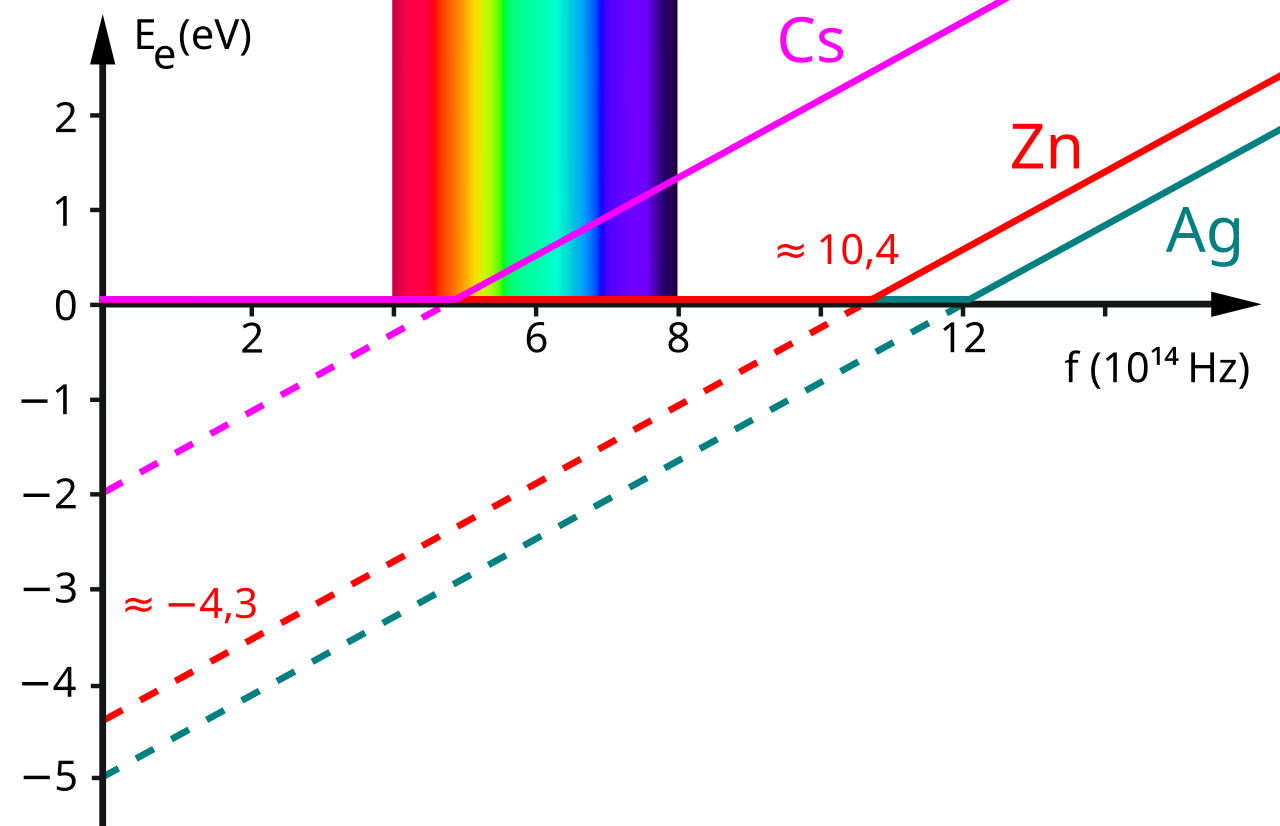
Einstein’s photoelectric equation E = hf − φ: the lines are parallel (common slope h), and each metal has its own threshold frequency and work function. Decimal commas are the European convention (10,4 means 10.4). Image: Klaus-Dieter Keller, MikeRun, CC BY 3.0, via Wikimedia Commons.
de Broglie Waves
- λ = h/p = h/mv (matter waves)
- Davisson-Germer experiment: confirmed wave nature of electrons
Bohr's Model of Hydrogen
In Bohr's model, electrons occupy fixed circular orbits around the nucleus; a transition to a lower orbit releases a photon whose energy equals the difference between energy levels.
- Quantization: mvr = nh/2π (angular momentum)
- Orbit radii: r_n = n²a₀ (a₀ = 0.529 Å = Bohr radius)
- Energy levels: E_n = -13.6/n² eV
- Ground state: E₁ = -13.6 eV; ionization energy = 13.6 eV
- Spectral series: Lyman (UV), Balmer (visible), Paschen (IR)
Electron Emission and Work Function
- Free electrons inside a metal are held in by an attractive surface barrier; the minimum energy needed to just free an electron from the surface is the work function φ (a few eV, e.g. ~2.3 eV for sodium, ~4.5 eV for tungsten)
- Thermionic emission: electrons freed by heating the metal (used in cathode-ray and vacuum tubes)
- Field (cold) emission: electrons pulled out by applying a very strong external electric field
- Photoelectric emission: electrons ejected when light of suitable frequency is incident on the surface
- Secondary emission: electrons knocked out by the impact of fast-moving electrons or other particles
Photoelectric Effect: Early Observations
- Hertz (1887): while producing electromagnetic waves, noticed that ultraviolet light falling on a metal electrode eased the discharge across a spark gap
- Hallwachs and Lenard: showed that a negatively charged zinc plate lost its charge when illuminated with UV light while a positively charged plate did not, proving negative particles (electrons) were being emitted
- Emission occurred only when the incident light frequency exceeded a certain minimum threshold frequency f₀, characteristic of the metal
- The ejected electrons are called photoelectrons and the resulting current the photoelectric current
Experimental Study of the Photoelectric Effect
- Effect of intensity (frequency fixed, above threshold): the photoelectric current, and hence the number of photoelectrons emitted per second, is directly proportional to the intensity of the light
- Effect of potential: the current rises with the accelerating collector potential until it reaches a constant saturation current; a reverse (negative) potential reduces the current, and at the stopping potential V₀ even the fastest electrons are turned back so the current falls to zero
- Effect of frequency: the stopping potential, and hence KE_max of the photoelectrons, increases linearly with frequency but is independent of intensity; below f₀ no emission occurs however intense the light
- Emission is practically instantaneous (within ~10⁻⁹ s) with no time lag even at very low intensity — impossible to explain on the wave theory of light
Particle Nature of Light: The Photon
- Einstein (1905) proposed that light energy is carried in discrete packets called photons, each of energy E = hf and momentum p = hf/c = h/λ
- A photon has zero rest mass, travels at speed c, and is electrically neutral; its energy and momentum are fixed by the frequency of the radiation
- In a photon-electron collision the total energy and momentum are conserved; intensity corresponds to the number of photons crossing unit area per second, not to the energy of an individual photon
- This particle picture explains the threshold frequency, the instantaneous emission, and why KE_max depends on frequency but not intensity — resolving every puzzle of the photoelectric effect
Wave Nature of Matter and the Davisson-Germer Experiment
- de Broglie (1924) proposed that all moving matter has an associated wavelength λ = h/p = h/mv; this wave nature is significant only for very small particles such as electrons because h is extremely small
- For an electron accelerated through a potential V: λ = h/√(2meV) ≈ 1.227/√V nm (with V in volts)
- Davisson-Germer experiment (1927): a beam of electrons accelerated through ~54 V was scattered from a nickel crystal; a pronounced peak in scattered intensity at 50° matched the de Broglie wavelength predicted by diffraction, confirming the wave nature of electrons
- Electron diffraction is direct experimental proof of matter waves and underlies the working of the electron microscope
🚀 JEE Advanced Edge
Photoelectric stopping potential graphs: A graph of stopping potential V₀ vs frequency f is a straight line with slope h/e (giving a way to experimentally determine Planck's constant) and x-intercept at the threshold frequency f₀ — a very common JEE graph-reading question.
de Broglie wavelength of charged particles after acceleration: For a charge q accelerated through potential V, λ=h/√(2mqV) — note this differs from the electron-only version by replacing e with the general charge q, important for proton/alpha-particle de Broglie problems.
Worked problem: Find the de Broglie wavelength of an electron accelerated through a potential difference of 100V. Approach: λ=h/√(2meV) = (6.63×10⁻³⁴)/√(2×9.1×10⁻³¹×1.6×10⁻¹⁹×100) ≈ 1.23×10⁻¹⁰ m = 1.23 Å.