🎯 Key Points
- Light reactions (thylakoid): split water, release O₂, produce ATP+NADPH; Calvin cycle (stroma): fixes CO₂ via RuBisCO using that ATP+NADPH — the dark reaction is NOT actually restricted to darkness, it just doesn't directly need light
- Chlorophyll a is the ONLY pigment that directly participates in the light reaction; chlorophyll b, carotenoids, and xanthophylls are accessory pigments that pass absorbed energy to it
- C3 (rice, wheat) → first product 3-PGA, prone to photorespiration; C4 (maize, sugarcane) → first product OAA, avoids photorespiration via Kranz anatomy; CAM (cactus) → stomata open at NIGHT
- Non-cyclic photophosphorylation (PS II+PS I): makes ATP+NADPH+O₂; Cyclic (PS I only): makes ATP ONLY, no O₂/NADPH — happens when NADP⁺ is scarce
- Blackman's Law of Limiting Factors: photosynthesis rate is governed by whichever factor (light, CO₂, temperature) is in shortest supply, even if the others are abundant
Photosynthetic Pigments
Simplified photosynthesis diagram: light energy, CO2, and H2O enter the leaf and are converted in the chloroplast into glucose and O2.
- Overall equation: 6CO2 + 6H2O + light energy → C6H12O6 + 6O2
- Chlorophyll a: the primary pigment present in all photosynthetic organisms; directly participates in the light reaction by donating electrons
- Chlorophyll b, carotenoids, xanthophylls: accessory pigments; broaden the range of light wavelengths absorbed and pass that energy to chlorophyll a; carotenoids also protect chlorophyll from photo-oxidative damage
- Engelmann's experiment: using the alga Cladophora and aerobic bacteria under a prism-split light spectrum, oxygen evolution (bacterial clustering) was highest in blue and red light, establishing the action spectrum of photosynthesis
Light Reactions (Photochemical Phase)
- Occurs in the thylakoid membrane; involves two photosystems named for their peak absorption wavelength: PS II (P680) and PS I (P700)
- Z-scheme: PS II absorbs light, splits water (photolysis: 2H2O → 4H+ + 4e- + O2, releasing the O2 we breathe), and passes electrons through an electron transport chain (plastoquinone, cytochrome b6f complex, plastocyanin) to PS I; PS I re-energises the electrons and passes them via ferredoxin to NADP+ reductase, forming NADPH
- Non-cyclic photophosphorylation: uses both PS II and PS I; produces ATP, NADPH, AND O2 (the standard pathway)
- Cyclic photophosphorylation: uses ONLY PS I; electrons cycle back to the ETC instead of reducing NADP+; produces ATP only, no O2 or NADPH released — becomes important when NADP+ is in short supply, and is the dominant pathway in bundle sheath chloroplasts of C4 plants
- Chemiosmotic hypothesis: protons accumulated inside the thylakoid lumen (from water-splitting and electron transport) create a gradient that drives ATP synthesis as they flow back out through ATP synthase
Calvin Cycle (Biosynthetic Phase)
- Occurs in the stroma; identical in C3, C4, and CAM plants — it is the universal carbon-fixing engine, only the way CO2 is delivered to it differs
- Carboxylation: RuBisCO fixes CO2 onto RuBP (5-carbon), forming an unstable 6-carbon intermediate that immediately splits into 2 molecules of 3-PGA
- Reduction: 3-PGA is reduced to G3P (glyceraldehyde-3-phosphate) using the ATP and NADPH generated by the light reaction
- Regeneration: most G3P is used to regenerate RuBP (using more ATP) so the cycle can continue; only a fraction is exported to build glucose and other sugars
- To make one glucose molecule, the cycle must turn 6 times (6 CO2 fixed), using 18 ATP and 12 NADPH overall
C3, C4, and CAM Pathways
- C3 pathway: CO2 fixed directly by RuBisCO in mesophyll cells into 3-PGA (a 3-carbon compound); occurs in rice, wheat, and most plants; susceptible to photorespiration
- C4 pathway: CO2 first fixed in mesophyll cells by PEP carboxylase (very high affinity for CO2, NO affinity for O2) into oxaloacetate (OAA, a 4-carbon compound); OAA is converted to malate and shuttled to bundle sheath cells, where it is decarboxylated to release CO2 directly around RuBisCO, suppressing photorespiration; this spatial arrangement is called Kranz anatomy (bundle sheath cells tightly packed around vascular bundles); found in maize, sugarcane, sorghum
- CAM (Crassulacean Acid Metabolism): TEMPORAL (not spatial) separation — stomata open at NIGHT when CO2 is fixed by PEP carboxylase into malate, stored in the vacuole; during the hot day, stomata close (minimising water loss) while stored malate is decarboxylated to feed the Calvin cycle; found in desert succulents like cactus, Agave, pineapple
Photorespiration
- Occurs only in C3 plants, under hot, dry, bright conditions when partially closed stomata cause low internal CO2 and high O2
- RuBisCO, unable to fully discriminate between CO2 and O2, acts as an oxygenase: it adds O2 to RuBP instead of CO2, producing only one PGA plus a 2-carbon phosphoglycolate — no net carbon fixation, no ATP gained, and CO2 is even released, making this purely wasteful for the plant
- C4 plants largely escape photorespiration because CO2 is concentrated around RuBisCO in the bundle sheath, so the oxygenase reaction rarely gets a chance to occur
Factors Affecting the Rate of Photosynthesis
- Blackman's Law of Limiting Factors: when several factors affect a process, the rate is determined by the factor that is in shortest supply (the "limiting factor"), regardless of how abundant the other factors are
- Light intensity: rate increases with intensity up to a saturation point, beyond which CO2 or temperature usually becomes limiting instead
- CO2 concentration: typically the limiting factor in nature (only ~0.04% of air); increasing CO2 raises the rate up to a point
- Temperature: affects enzyme activity (RuBisCO, etc.); has little direct effect on the purely photochemical light reaction but strongly affects the enzymatic Calvin cycle
Early Experiments
- Joseph Priestley (1770s): showed that plants restore the "injured" air spoiled by a burning candle or a breathing mouse — revealing that plants release oxygen essential to animals
- Jan Ingenhousz: demonstrated that sunlight is essential for this air-purifying effect and that only the green parts of a plant release oxygen
- Julius von Sachs: showed that the green parts produce glucose that is usually stored as starch
- Cornelius van Niel: from work on purple and green sulphur bacteria, concluded that the O2 released comes from water, not CO2 (H2O is the hydrogen/electron donor); later confirmed by Ruben and Kamen using the heavy oxygen isotope 18O
- Robert Hill (Hill reaction): isolated chloroplasts release O2 in light even without CO2 (given a suitable electron acceptor), showing the light reaction can proceed independently of carbon fixation
Site of Photosynthesis: Chloroplast Structure
- Photosynthesis occurs mainly in the mesophyll cells of the leaf, inside the chloroplast — a double-membrane-bound organelle
- The stroma is the fluid matrix enclosed by the inner membrane; it houses the enzymes of the Calvin cycle (biosynthetic phase), where CO2 fixation occurs
- The thylakoids are flattened membranous sacs; stacks of thylakoids form grana (singular granum), connected by stroma lamellae; the thylakoid membranes hold the pigments and carry out the light reaction
- This is a clear division of labour: the grana thylakoids run the light-driven reactions while the stroma runs the dark (carbon-fixing) reactions — physically separated but sequentially linked
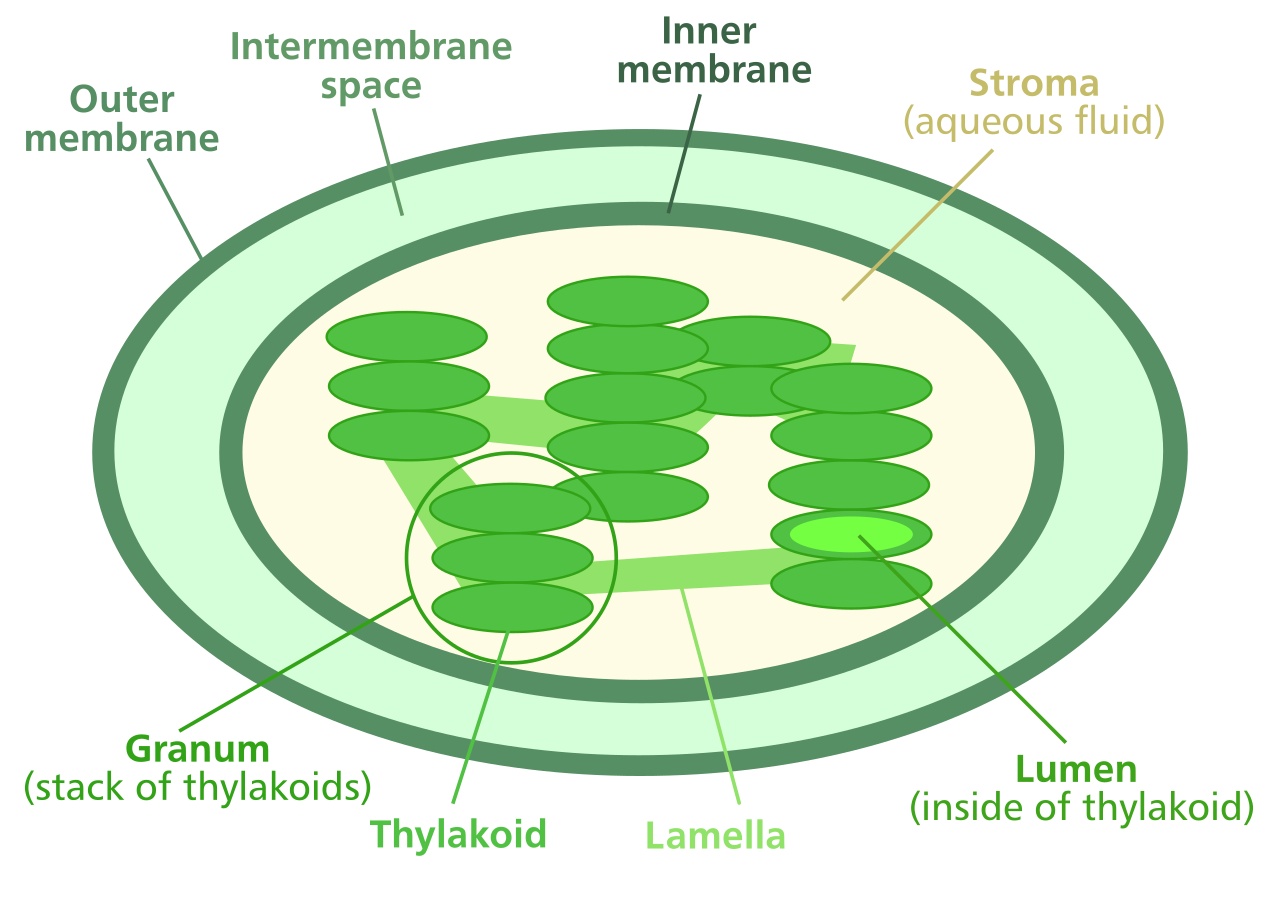
Structure of a chloroplast: the light reactions occur on the thylakoid membranes (stacked into grana) and the Calvin cycle in the surrounding stroma. Image: Ollin and Smartse, Public Domain, via Wikimedia Commons.
Absorption Spectrum and Action Spectrum
- The absorption spectrum is a graph of how much light a pigment absorbs at each wavelength; chlorophyll a and b absorb most strongly in the blue and red regions and least in green (green light is reflected, so leaves look green)
- The action spectrum is a graph of the rate of photosynthesis at each wavelength; it closely overlaps the absorption spectrum of chlorophyll a, with peaks in the blue and red — strong evidence that chlorophyll a is the chief pigment driving photosynthesis
- The maximum rate of photosynthesis therefore occurs in the red and blue regions of the visible spectrum, matching where chlorophyll absorbs most
🚀 NEET Advanced Edge
Why C4 plants outperform C3 in hot, dry climates: C4 plants spatially separate CO₂ fixation (mesophyll cells, forming OAA) from the Calvin cycle (bundle sheath cells), concentrating CO₂ around RuBisCO and avoiding photorespiration — the wasteful process where RuBisCO binds O₂ instead of CO₂ under hot, dry, stomata-closed conditions. This is why maize/sugarcane (C4) are more water/CO₂-efficient than rice/wheat (C3) in such climates.
Why photorespiration persists despite being wasteful: RuBisCO evolved roughly 3.5 billion years ago when Earth's atmosphere had very little O2; its active site was never under evolutionary pressure to exclude O2 perfectly. By the time atmospheric O2 rose (after the photosynthetic explosion), RuBisCO's imperfect specificity was already locked in — photorespiration is essentially a evolutionary leftover rather than a deliberately useful process (though it does provide some photoprotection under excess light).
Worked problem: If one full turn of the Calvin cycle fixes 1 CO2 using 3 ATP and 2 NADPH, find the total ATP and NADPH needed to synthesise one glucose molecule (which requires fixing 6 CO2). Approach: ATP needed = 6 × 3 = 18 ATP. NADPH needed = 6 × 2 = 12 NADPH — matching the standard stoichiometry for photosynthesis.